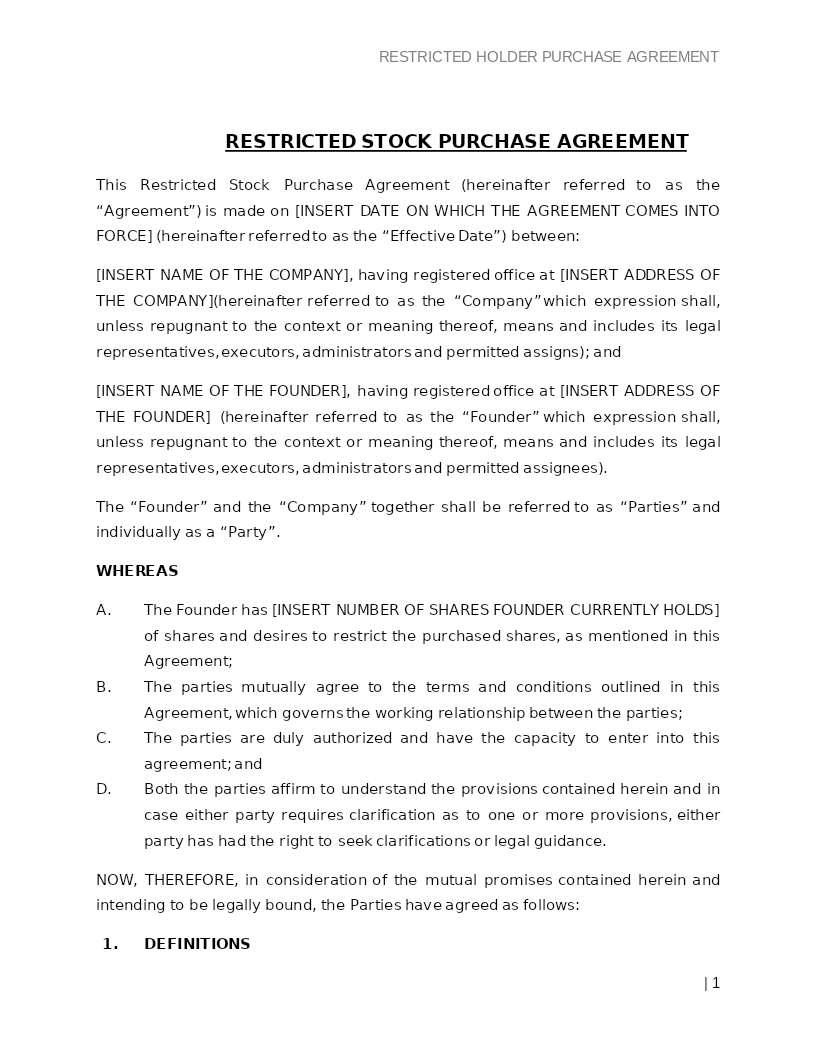
RESTRICTED STOCK PURCHASE AGREEMENT
How does it work?
1. Choose this template
Start by clicking on "Fill out the template"
2. Complete the document
Answer a few questions and your document is created automatically.
3. Save - Print
Your document is ready! You will receive it in Word and PDF formats. You will be able to modify it.
Establishing Clear Ownership & Equity Protections in Startups and Corporations
When companies issue equity to founders, early employees, advisors, or investors, it is crucial to define how those shares are purchased, earned, and protected. A Restricted Stock Purchase Agreement (RSPA) provides this clarity. It outlines key terms such as vesting schedules, transfer restrictions, company repurchase rights, tax implications, and the conditions under which ownership becomes fully vested.
By structuring equity through an RSPA, companies ensure that shares are earned over time, discourage premature departures, and align contributors’ incentives directly with the company’s long-term success.
Where Restricted Stock Purchase Agreements Are Commonly Used
RSPAs are widely used across the U.S. business ecosystem in scenarios such as:
- Founder equity distribution during company incorporation or reorganisation
- Early-employee compensation packages in startups
- Advisor or consultant equity grants
- Early-stage investor purchases of restricted shares
- Implementation of vesting schedules to maintain long-term commitment
- Equity restructuring before funding rounds
Any time the company wants to issue equity with conditions tied to continued service, performance, or time-based vesting, an RSPA is the industry-standard tool.
Different Types of Restricted Stock Agreements You May Encounter
- Time-Based RSPA: Shares vest monthly, quarterly, or annually over a set period (commonly four years), ensuring equity is earned gradually.
- Milestone or Performance-Based RSPA: Shares vest upon achieving specific goals such as product launches, revenue targets, fundraising milestones, or operational achievements.
- Founder Restricted Stock Agreement: Founders receive shares subject to vesting to protect the cap table if any founder leaves early.
- Early-Exercise Restricted Stock Agreement: Employee option holders can exercise their options early, receiving restricted shares that vest over time, often used for tax advantages.
- Investor Restricted Stock Agreement: Investors purchase shares that may include restrictions on sale or transfer during the early stages of company growth.
When Legal Guidance Becomes Helpful
Legal review becomes important when:
- The equity grant includes complex vesting, repurchase, or forfeiture terms
- IP assignment, trade secrets, or confidentiality obligations need to be incorporated
- The company must comply with federal/state securities laws
- Multiple founders or high-value equity issuances are involved
- The RSPA interacts with stock option plans, SAFEs, convertible notes, or investor agreements
- The recipient wants to file an 83(b) election with the IRS
- Multi-jurisdictional contributors or remote teams are involved
- There are concerns about dilution, transferability, or shareholder rights
Legal guidance ensures the agreement is enforceable, compliant, tax-efficient, and aligned with long-term organizational goals.
How to Work with This Template
- Identify the parties and the number of shares being purchased
- Define the vesting schedule and repurchase rights
- Add transfer restrictions and stock certificate legends
- Outline tax implications and 83(b) election instructions
- Choose governing state law (commonly Delaware)
- Review the terms with legal counsel
- Execute using physical or electronic signatures
This template follows U.S. equity distribution standards and works with all major e-signature platforms.
Frequently Asked Questions
Q1. What is a Restricted Stock Purchase Agreement and why is it essential for U.S. startups?
A Restricted Stock Purchase Agreement is a legally binding contract that allows a company to issue shares to founders, employees, or investors with conditions such as vesting or transfer restrictions. In U.S. startups, especially Delaware C-corporations, RSPAs are crucial because they prevent early departures from retaining large equity stakes and protect the cap table as the company grows. By defining ownership rules clearly, they reduce disputes, establish long-term incentives, and help create a stable equity structure before raising capital.
Q2. How does vesting work in a Restricted Stock Purchase Agreement?
Vesting determines when the recipient actually “earns” their shares. The most common structure in the U.S. is four-year vesting with a one-year cliff, meaning no shares vest during the first year and then vest monthly or quarterly thereafter. Vesting ensures contributors earn equity through continued work or performance milestones. If someone leaves early, unvested shares can typically be repurchased by the company at the original price, protecting the remaining founders and investors.
Q3. Why do companies include repurchase rights in Restricted Stock Agreements?
Repurchase rights allow the company to buy back unvested or forfeited shares if a founder, employee, or advisor leaves before their vesting period ends. This prevents inactive or departed individuals from holding significant ownership and ensures equity remains with active contributors. Repurchase rights also demonstrate to investors that the company has a clean and well-structured cap table, which is essential during fundraising.
Q4. What is an 83(b) election and how does it impact restricted stock?
An 83(b) election is an IRS tax filing that lets restricted stock recipients pay taxes on the current value of the shares at the time of purchase instead of as they vest. This can significantly reduce taxes if the company grows and the stock value increases. However, the filing must be submitted within 30 days of receiving the shares no extensions. Many founders and early employees choose to file an 83(b) to minimize future tax burdens, but legal and tax advice is strongly recommended.
Q5. Are Restricted Stock Purchase Agreements only for founders?
No. While RSPAs are commonly used for founders, they are also issued to early employees, advisors, contractors, and sometimes investors. Companies use restricted stock to incentivize long-term commitment without immediately paying high salaries. Because equity is a major part of early-stage compensation, RSPAs provide a structured way to distribute ownership while maintaining company control.
Q6. What restrictions typically apply to restricted stock under an RSPA?
Restricted stock often cannot be transferred, sold, pledged, or assigned until vesting conditions are met. Additional restrictions might include company approval for transfers, lock-in periods, or accelerated vesting rules during mergers or acquisitions. These restrictions protect the company from unwanted shareholders and ensure equity remains aligned with performance and loyalty.
Q7. Are electronic signatures valid for signing Restricted Stock Purchase Agreements in the U.S.?
Yes. Under the ESIGN Act (Electronic Signatures in Global and National Commerce Act), electronic signatures are fully enforceable in all U.S. states. Most startups and corporations use digital tools like DocuSign, Carta, or Pulley to execute RSPAs because it provides secure, time-stamped records of equity grants.
Q8. What happens if a founder or employee leaves before their stock vests?
If someone leaves early, the company generally has the right to repurchase unvested shares at the original purchase price, or the shares are automatically forfeited. This prevents uneven ownership distribution and ensures ongoing contributors maintain control. A clearly drafted RSPA outlines the exact repurchase procedure and timelines to avoid disputes.
Q9. How do Restricted Stock Purchase Agreements impact fundraising and investor due diligence?
Investors closely evaluate vesting schedules, repurchase rights, and equity structure during due diligence. A well-drafted RSPA reassures investors that founders remain committed, equity is properly allocated, and the company’s cap table is professionally managed. Poorly structured equity agreements can delay or derail funding rounds.
Q10. Should I hire a lawyer before signing a Restricted Stock Purchase Agreement?
Yes. RSPAs carry long-term implications for ownership, taxes, vesting, and dilution. A lawyer ensures that vesting schedules, repurchase rights, transfer limitations, and tax obligations reflect your goals and comply with U.S. law. Legal guidance is especially important for founders handling equity for the first time, employees considering an 83(b) election, or companies issuing stock before fundraising.