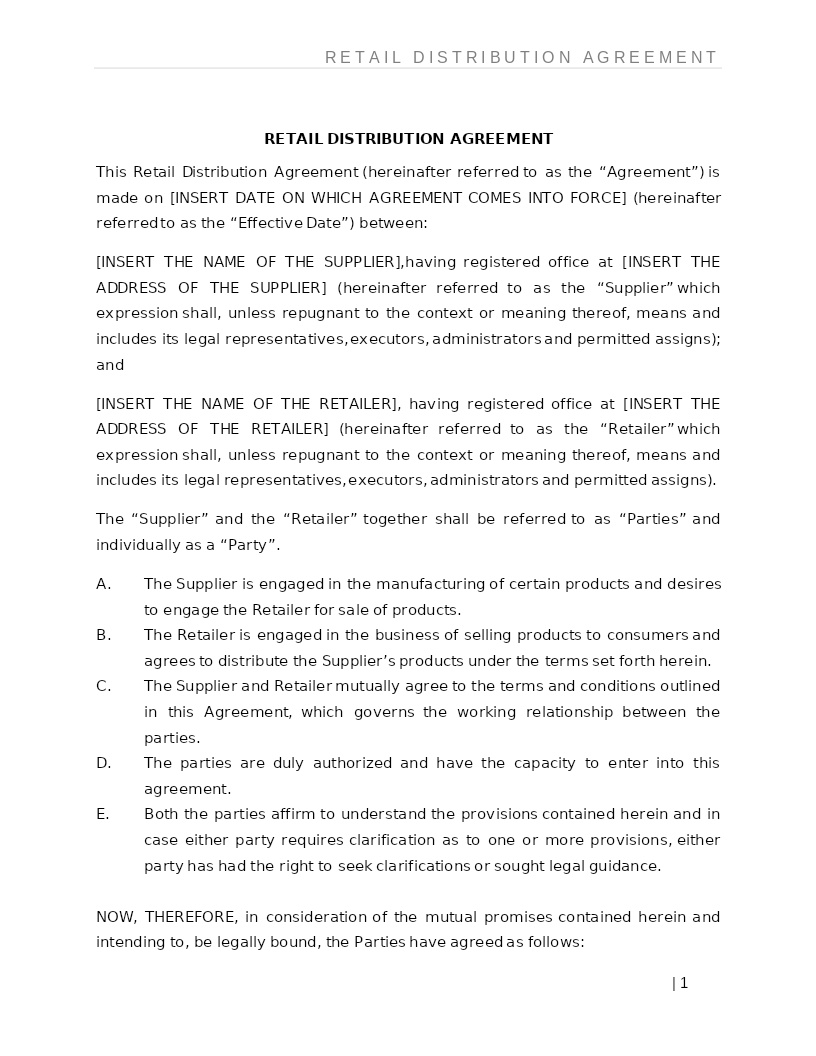
RETAIL DISTRIBUTION AGREEMENT
How does it work?
1. Choose this template
Start by clicking on "Fill out the template"
2. Complete the document
Answer a few questions and your document is created automatically.
3. Save - Print
Your document is ready! You will receive it in Word and PDF formats. You will be able to modify it.
Establishing Product Supply and Sales Channels Through Retail Distribution Arrangements
Manufacturers and suppliers frequently rely on independent retailers to bring their products to the consumer marketplace. To protect both parties’ rights and ensure consistent business operations, it is essential to establish a written agreement governing the distribution relationship. A Retail Distribution Agreement fulfills this purpose. It outlines the terms under which a Supplier authorizes a Retailer to purchase, market, and resell its products, in accordance with U.S. commercial law, Uniform Commercial Code (UCC) principles, consumer product regulations, and applicable state and federal trade requirements.
By executing a Retail Distribution Agreement, the parties create a legally enforceable framework that clarifies pricing, ordering processes, delivery terms, resale rights, branding expectations, confidentiality obligations, and dispute-resolution procedures. This ensures that the product distribution relationship is structured, compliant, and mutually beneficial.
Where Retail Distribution Agreements Are Commonly Used
Retail Distribution Agreements are used across a wide variety of industries and product categories, including:
- Consumer goods, electronics, and home products
- Apparel, accessories, and fashion merchandise
- Health, beauty, and personal-care products
- Food, beverage, and specialty retail goods
- Furniture, appliances, and hardware products
- Sporting goods, outdoor equipment, and hobby items
- Technology products, software-enabled devices, and IoT solutions
- E-commerce, marketplace sellers, and brick-and-mortar stores
Whenever a Supplier intends to sell goods through a Retailer, a Retail Distribution Agreement defines the rights and obligations of both parties.
Different Types of Retail Distribution Agreements You May Encounter
1. Exclusive Distribution Agreements: Grant the Retailer exclusive rights to sell the Supplier’s products within a defined territory or market.
2. Non-Exclusive Distribution Agreements: Allow multiple retailers to sell the same products concurrently.
3. Selective or Tier-Based Distribution Agreements: Limit distribution to retailers who meet specific criteria or branding requirements.
4. Direct-to-Retail Agreements: Apply when the Supplier ships products directly to retail locations or warehouses.
5. Online Retail Distribution Agreements: Governs resale on e-commerce platforms, digital marketplaces, or direct-ship models.
When Legal Guidance Becomes Helpful
Legal counsel may be advisable when:
- The products are subject to regulatory compliance (food, cosmetics, electronics, children’s goods, etc.)
- Pricing strategies may implicate antitrust or resale-price-maintenance rules
- Intellectual property, branding, or packaging will be used by Retailers
- The distribution involves cross-border commerce or multi-state operations
- The Supplier demands exclusivity or specific performance requirements
- Retailers handle returns, warranties, or consumer-facing obligations
- The relationship involves high volume, long-term commitments, or co-branding
Legal review helps ensure that the agreement aligns with U.S. commercial law, consumer protection rules, and industry standards, while minimizing risk.
How to Work with This Template
- Identify the Supplier and Retailer
- Define the scope of distribution rights and territory, if any
- Describe product specifications, packaging, and branding requirements
- Outline ordering procedures, fulfillment terms, and delivery obligations
- Establish pricing, payment schedules, and invoicing processes
- Specify return, warranty, and defective-product protocols
- Address confidentiality, intellectual property, and resale restrictions
- Choose governing law and dispute-resolution procedures
- Review periodically for compliance and accuracy
- Execute the agreement electronically or in writing
This template reflects commonly accepted U.S. retail-distribution practices and is compatible with e-signature platforms.
Frequently Asked Questions
Q1. What is a Retail Distribution Agreement, and why is it important?
A Retail Distribution Agreement is a legally binding contract that outlines the terms under which a Supplier allows a Retailer to purchase and resell its products. It is important because it clarifies pricing, supply terms, intellectual property rights, and obligations under U.S. commercial law, reducing the risk of disputes.
Q2. Does a Retail Distribution Agreement cover pricing and payment terms?
Yes. The agreement usually includes wholesale pricing, payment schedules, credit terms (if any), and billing procedures to ensure transparency and predictable cash flow.
Q3. Can a Retail Distribution Agreement include exclusivity?
Yes. Exclusivity provisions may grant a Retailer the exclusive right to sell products in a defined territory or market segment. Clear drafting is essential to avoid antitrust issues.
Q4. Are there legal requirements for product safety or compliance?
Yes. Many products are subject to federal and state regulations (e.g., FDA, CPSC, FCC). The agreement should specify which party is responsible for compliance.
Q5. Who handles product returns or defective items?
This depends on the agreement. Some suppliers accept returns directly, while others require retailers to manage customer service and provide replacements.
Q6. Can the Retailer modify the packaging or trademarks?
Not without permission. The policy typically prohibits altering trademarks, packaging, or product materials without the Supplier’s written approval.
Q7. Are electronic signatures valid for Retail Distribution Agreements?
Yes. Under the U.S. ESIGN Act, electronic signatures are legally enforceable and routinely used in distribution and supply-chain contracts.
Q8. What happens if the Supplier cannot fulfill an order?
The agreement may outline remedies such as revised delivery schedules, refunds, or credits. Supplier performance obligations should be clearly defined.
Q9. Can the Retailer sell the products online?
Only if permitted by the agreement. Some suppliers impose restrictions on marketplace resale, domain use, or e-commerce channel strategies.
Q10. What happens if the Retailer violates brand-use guidelines or resale terms?
The agreement may allow the Supplier to terminate the relationship, revoke rights, or pursue legal remedies for IP misuse or contract breach.