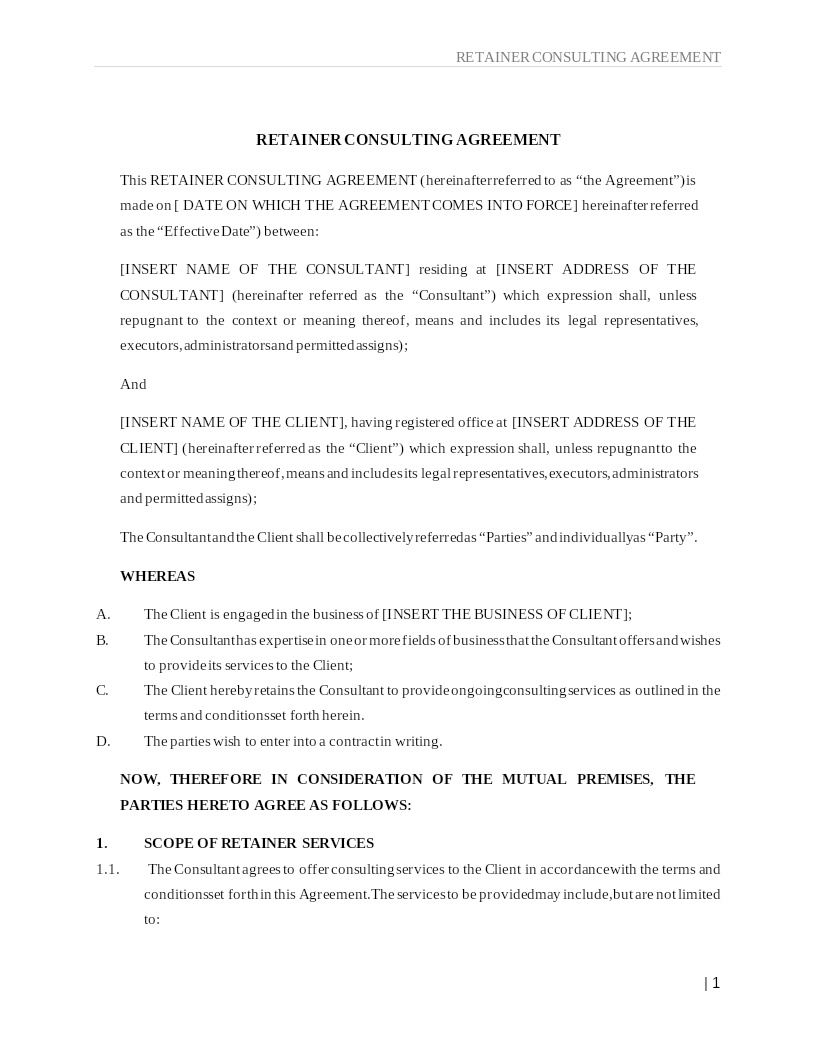
RETAINER CONSULTING AGREEMENT
How does it work?
1. Choose this template
Start by clicking on "Fill out the template"
2. Complete the document
Answer a few questions and your document is created automatically.
3. Save - Print
Your document is ready! You will receive it in Word and PDF formats. You will be able to modify it.
Establishing Reliable, Ongoing Professional Support Through a Retainer
When a client needs continued access to professional services, strategic guidance, or expert consulting over a defined period, a clear framework is essential to govern how that relationship operates. A Retainer Consulting Agreement provides that structure. It explains the consultant’s scope of services, the retainer fee, the availability guaranteed to the client, and the rights and responsibilities of both parties.
Putting a Retainer Consulting Agreement in place promotes continuity, ensures predictable support, and creates clarity regarding how tasks, deliverables, and hours will be managed throughout the engagement period.
Where Retainer Consulting Agreements Are Commonly Used
Retainer engagements are widely used across many sectors where ongoing professional services are necessary, including:
- Legal, financial, and strategic consulting
- Human resources, policy development, and compliance support
- Marketing, branding, and advertising advisory services
- IT, cybersecurity, and software development support
- Operational, business process, and management consulting
- Creative services such as design, content, or PR strategy
- Specialized industry consulting, healthcare, real estate, government, and more
Whenever clients need assured access to consultants without repeatedly renegotiating terms, this agreement provides a stable foundation.
Different Types of Retainer Structures You May Encounter
- Hourly Retainer: The client pays in advance for a defined number of hours the consultant will be available each month.
- Service-Based Retainer: Focuses on recurring deliverables or projects rather than hourly availability.
- Hybrid Retainer: Combines guaranteed availability with additional services billed separately.
- Project-Specific Retainer: Reserved for long-term projects requiring periodic consulting input.
- Advisory Retainer: Provides access to strategic advice, review, and consultation without ongoing deliverables.
When Legal or Professional Guidance Becomes Helpful
Although retainers are common, legal and professional input becomes valuable when:
- The consultant handles sensitive, regulated, or high-value information
- IP ownership, licensing, or usage rights may be disputed
- The agreement spans multiple jurisdictions or involves remote international work
- The retainer includes subcontractors, confidential materials, or proprietary tools
- The fee structure includes rollover hours, non-refundable retainers, or complex billing
- Specific compliance obligations apply to the client’s industry
- Termination, scope change, or performance metrics could create conflict
Professional review strengthens enforceability and protects both parties.
How to Work with This Template
- Identify the consultant and client, clearly defining their roles
- List the services, deliverables, and expectations under the retainer
- Specify the retainer fee, billing cycle, and rollover or refund rules
- Include confidentiality, IP ownership, and data protection terms
- Select governing state law and any performance metrics
- Define availability expectations and communication procedures
- Review the terms jointly, with legal review optional
- Sign electronically or physically to formalize the engagement
This framework follows widely recognized standards used across consulting practices in the United States.
Frequently Asked Questions
Q1. Why is a Retainer Consulting Agreement important for ongoing services?
A retainer agreement ensures the consultant remains available for a defined number of hours or specific services throughout the engagement period. It clarifies expectations, deliverables, and responsibilities so both parties understand what the retainer covers. This prevents misunderstandings and provides consistent support. It also helps clients prioritize tasks and receive timely assistance. Overall, the agreement builds predictability and structure into the consulting relationship.
Q2. What types of services can be included in a retainer?
Retainers may include strategic advisory work, recurring deliverables, operational support, research, policy drafting, or specialized industry consulting. The specific services depend on the consultant’s expertise and the client’s ongoing needs. The agreement outlines these services in detail to avoid ambiguity. Clear definitions ensure both parties understand how the retainer will be allocated. This promotes accountability and alignment.
Q3. How are retainer fees typically structured?
Retainer fees may be fixed monthly payments, prepaid hourly blocks, or hybrid structures combining guaranteed time with additional billable services. The agreement specifies whether fees are refundable or non-refundable and how unused hours are handled. This ensures financial transparency and reduces payment disputes. Clearly defined billing cycles support predictable cash flow for both parties. Fee structures can also be customized to match project needs.
Q4. Does the agreement address confidentiality and proprietary information?
Yes. Retainer agreements typically include strong confidentiality provisions to protect sensitive business information shared during the engagement. These clauses prevent misuse, disclosure, or unauthorized access to client data. They also support compliance with privacy laws and industry regulations. Clear confidentiality expectations enhance trust between the parties. Documentation ensures that proprietary information remains secure long-term.
Q5. How is intellectual property handled under a retainer?
The agreement outlines ownership of deliverables and work product, specifying whether IP belongs to the client, consultant, or both. This prevents future disputes over usage rights and proprietary materials. When necessary, the contract can assign full IP ownership to the client. Alternatively, consultants may retain certain rights to underlying tools or methodologies. Clearly documented IP terms reduce ambiguity and protect both parties.
Q6. What happens if either party wants to terminate the retainer?
Most agreements include termination clauses explaining notice periods, final payments, return of materials, and handling of unused hours. These terms ensure a smooth and fair conclusion to the relationship. The agreement may also outline how pending work will be completed. Clear procedures reduce uncertainty and prevent conflict. Termination terms protect both the consultant’s and the client’s interests.
Q7. Can performance expectations be included in the agreement?
Absolutely. Retainer agreements often incorporate KPIs, milestones, or performance metrics to measure progress. This ensures the consultant’s efforts align with the client’s goals and standards. Defined benchmarks increase accountability and facilitate structured reporting. Performance expectations also help evaluate the value delivered under the retainer. Clarity in metrics strengthens the consultant-client partnership.
Q8. What dispute resolution options are included in a retainer agreement?
Many retainer contracts include mechanisms like mediation, arbitration, or negotiated settlements to resolve disagreements. These processes help avoid lengthy court disputes. By outlining a clear pathway for resolving issues, the agreement promotes fairness and efficiency. Structured dispute resolution builds confidence and reduces the risk of ongoing conflict. It also ensures both parties have a predictable method for addressing concerns.