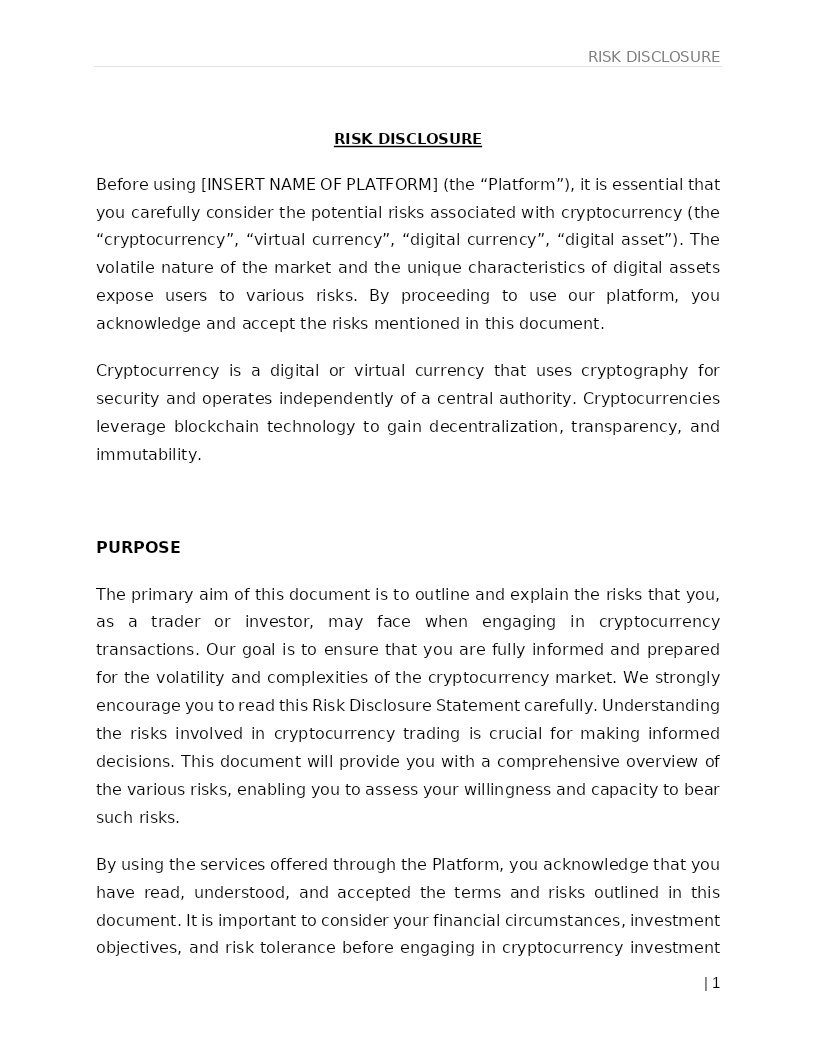
RISK DISCLOSURE
How does it work?
1. Choose this template
Start by clicking on "Fill out the template"
2. Complete the document
Answer a few questions and your document is created automatically.
3. Save - Print
Your document is ready! You will receive it in Word and PDF formats. You will be able to modify it.
Clarifying Potential Hazards and Legal Responsibilities Through a Risk Disclosure
A Risk Disclosure is an essential legal instrument that informs customers, clients, users, investors, or participants of the inherent risks associated with a particular activity, service, product, transaction, or investment. It ensures that individuals receive transparent and accurate information about possible losses, harms, uncertainties, or adverse outcomes. This disclosure is drafted in compliance with U.S. consumer-protection statutes, financial-services regulations, Federal Trade Commission (FTC) guidance, Securities and Exchange Commission (SEC) disclosure rules where applicable, and state contract-law requirements to ensure that parties are fully aware of the risks before engaging in a transaction or activity.
A comprehensive Risk Disclosure mitigates legal liability by explaining foreseeable risks, outlining limitations of warranties, clarifying the voluntary nature of participation, and encouraging individuals to seek independent advice where appropriate. It also establishes that the party providing the product or service has acted in good faith by fully informing the recipient of potential issues, thus strengthening contractual enforceability. Through precise and understandable language, a Risk Disclosure helps protect the organization from claims of nondisclosure, misrepresentation, or deceptive practices.
Where Risk Disclosures Are Commonly Used
Risk Disclosures are widely utilized in a variety of commercial, legal, and consumer-facing contexts, including:
- Financial services, investment offerings, trading platforms, and securities transactions
- Healthcare settings involving medical treatments, procedures, or therapeutic risks
- Fitness centers, recreational facilities, sports programs, and physical-activity waivers
- Technology services and software platforms involving cybersecurity or data-loss risks
- Real-estate transactions, construction activities, or home-inspection processes
- E-commerce platforms involving product-use risks or warranty limitations
- Professional consulting services where outcomes cannot be guaranteed
- Educational courses, training programs, or online learning involving performance risks
Whenever an organization provides goods or services with potential hazards, a written Risk Disclosure helps ensure transparency and legal compliance.
Different Types of Risk Disclosures
1. Financial Risk Disclosures: Explain risks related to investment loss, market volatility, liquidity issues, and economic changes.
2. Product-Use Risk Disclosures: Describe hazards associated with operating equipment, consumer products, or devices.
3. Medical and Health-Related Risk Disclosures: Inform patients of treatment risks, side effects, and alternative options.
4. Activity and Participation Risk Disclosures: Apply to sports programs, events, outdoor recreation, and fitness activities.
5. Data Security and Technology Risk Disclosures: Address risks related to system failures, cyber threats, or data breaches.
When Legal Guidance Becomes Helpful
Legal counsel may be required when:
- The risk disclosure relates to regulated industries such as finance, healthcare, or insurance
- There is a possibility of significant financial loss or physical harm
- The disclosure forms part of a contract with limitations of liability
- Federal or state laws impose mandatory wording or regulatory-specific language
- The risks include cybersecurity, privacy, or data-handling implications
- A company wishes to modify or enhance waiver, indemnity, or mandatory arbitration clauses
- The organization operates across multiple states with varying disclosure rules
- The disclosure must accompany legally sensitive marketing materials or public statements
Legal review ensures compliance with U.S. disclosure laws, protects consumer rights, and strengthens enforceability.
How to Work with This Template
- Clearly identify the activity, service, or product for which the disclosure is provided
- Describe all known and reasonably foreseeable risks in clear, direct language
- Explain limitations on warranties, guarantees, or expected outcomes
- Encourage the recipient to seek professional or independent advice when necessary
- Include statements regarding voluntary participation and assumption of risk
- Clarify the organization’s disclaimers, limitations of liability, and legal rights
- Ensure the disclosure is presented before the individual agrees to participate or purchase
- Require acknowledgment or signature (written or electronic) under U.S. e-signature laws
- Retain records of acceptance for compliance and risk-management purposes
- Update the disclosure periodically to reflect new risks, regulations, or industry changes
This template reflects widely accepted U.S. standards for risk communication and legal disclosure practices.
Frequently Asked Questions
1. What is a Risk Disclosure, and why is it important?
A Risk Disclosure is a formal document informing individuals of the potential risks associated with a product, service, or activity. It is important because it promotes transparency, reduces legal liability, and ensures compliance with U.S. disclosure laws.
2. Does a Risk Disclosure protect a business from lawsuits?
While it does not eliminate all liability, a properly drafted disclosure significantly reduces legal exposure by proving the recipient was informed of potential hazards before participating.
3. Are Risk Disclosures required by law?
In many industries such as finance, healthcare, and securities risk disclosures are mandatory under federal and state regulations. For general consumer products or services, disclosures are strongly recommended but not always required.
4. Should customers sign or acknowledge a Risk Disclosure?
Yes. Written or electronic acknowledgment strengthens enforceability and ensures the customer understood the risks.
5. Can a Risk Disclosure include limitations of liability?
Yes, but such clauses must comply with state laws, which vary regarding enforceability of waivers for negligence, bodily harm, or gross misconduct.
6. Do Risk Disclosures apply to online services or digital platforms?
Absolutely. Technology companies often provide risk disclosures related to cybersecurity, data loss, system downtime, and user-generated content.
7. Can a Risk Disclosure replace a full waiver or contract?
No. While it supports a waiver or agreement, it does not replace a binding liability release or service contract.
8. Are disclaimers required for financial or investment activities?
Yes. The SEC and other regulators mandate standardized risk disclosures for investment products, trading platforms, and securities offerings.
9. How often should a Risk Disclosure be updated?
Regular updates are recommended, particularly when new risks arise, laws change, or organizational practices evolve.
10. Should legal counsel review sensitive risk disclosures?
Yes. When disclosures involve significant risks, regulated industries, or complex legal rights, attorney review ensures compliance and reduces liability