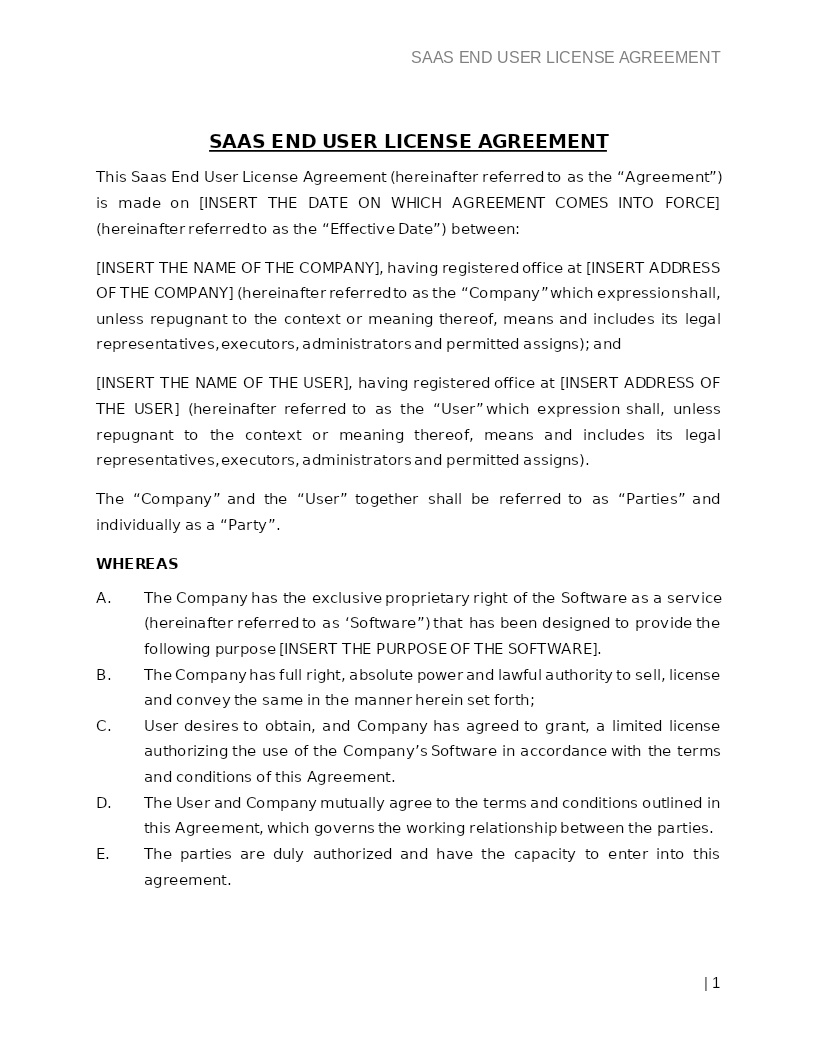
SAAS END USER LICENSE AGREEMENT
How does it work?
1. Choose this template
Start by clicking on "Fill out the template"
2. Complete the document
Answer a few questions and your document is created automatically.
3. Save - Print
Your document is ready! You will receive it in Word and PDF formats. You will be able to modify it.
Understanding a SaaS End User License Agreement (EULA)
When a user accesses cloud-based software, both the provider and the end user need a clear framework that governs how the software may be accessed, used, and protected. A SaaS End User License Agreement (EULA) provides that structure. It establishes the terms of use, licensing rights, restrictions, data-handling requirements, disclaimers, and liabilities associated with the software.
Unlike traditional software licenses that govern installed programs, a SaaS EULA covers subscription-based access, security obligations, uptime expectations, user responsibilities, and intellectual property protections in an online, service-driven environment.
Putting a SaaS EULA in place helps the provider safeguard its technology while ensuring users understand their rights, limits, and responsibilities before accessing the platform.
Where SaaS EULAs Are Commonly Used
SaaS EULAs apply across nearly every software category, especially platforms hosted in the cloud. Common use cases include:
- Business productivity tools (CRM, project management, HR systems)
- AI, analytics, and machine-learning platforms
- Enterprise resource planning (ERP) and workflow automation tools
- Healthcare, legal-tech, finance, or compliance software
- Developer tools, APIs, and cloud infrastructure services
- Education and e-learning software
- Consumer subscription-based apps and digital products
Any time a user interacts with subscription-based software, a SaaS EULA defines what is permitted, what is restricted, and how the software must be used.
Different Types of SaaS EULAs You May Encounter
- Standard End User License Agreement: Covers everyday user access and defines acceptable use, permissions, and restrictions.
- Enterprise SaaS EULA: Includes multi-user terms, seat management, data-security obligations, and SLA references.
- API or Developer EULA: Governs tools, API keys, integration limits, rate limits, and technical usage rights.
- Freemium or Limited-Use EULA: Defines restrictions for free plans, trial access, or demo environments.
- Industry-Specific SaaS EULAs: Used in healthcare, finance, legal tech, or education where additional compliance rules (HIPAA, GLBA, FERPA, etc.) apply.
When Legal Guidance Becomes Helpful
While many SaaS companies start with a general template, legal advice becomes critical when:
- Sensitive data is processed (personal, financial, medical, or regulated information)
- The software uses proprietary algorithms, AI models, or specialized IP
- The business operates across multiple states or countries
- The EULA must align with complex privacy laws—GDPR, CCPA, HIPAA
- The provider needs to define uptime guarantees, SLAs, or service credits
- The platform integrates with third-party services or licensed content
- Liability, indemnity, or IP infringement risks need customization
Legal review reduces exposure and ensures the agreement complies with evolving U.S. regulatory and data-security standards.
How to Work with This Template
- Identify the provider and end user
- Define the license scope: what users can access and how they may use it
- Outline subscription terms, billing, renewal, and termination
- Include IP ownership, restrictions, and prohibited actions
- Specify privacy and security responsibilities
- Add disclaimers, liability limits, and support/uptime details
- Select the governing state law
- Review together (legal review is optional but recommended for SaaS businesses)
- Sign electronically or accept digitally via click-wrap
This template aligns with U.S. SaaS licensing norms and works with major e-signature and acceptance platforms.
Frequently Asked Questions
Q1. What is the main purpose of a SaaS End User License Agreement?
A SaaS EULA establishes the legal and operational rules under which users can access a cloud-based software platform. Its primary purpose is to define usage rights, protect the provider’s intellectual property, outline user obligations, and set expectations for security, data handling, and acceptable behaviour. Because SaaS products operate continuously in an online environment, the EULA ensures both parties understand how the software may be used, what actions are prohibited, and how issues such as misuse, data breaches, or downtime are handled. It acts as the foundational document that governs the entire user provider relationship.
Q2. How is a SaaS EULA different from a general Terms of Service (TOS)?
A SaaS EULA typically focuses on licensing rights and restrictions, whereas Terms of Service cover broader operational and business rules of the platform. While the two often overlap, a EULA is more technical and IP-focused, clarifying how users may access the software, what modifications are prohibited, and how the software’s code, design, and functionality are protected. A TOS may address community guidelines, billing policies, privacy information, and service levels. Most SaaS companies use both documents together to ensure comprehensive legal protection.
Q3. Why is a SaaS EULA legally important for software providers?
A SaaS EULA protects the provider from legal, operational, and security risks inherent in cloud software delivery. It prevents unauthorized access, copying, reverse engineering, or redistribution of the software. It also sets enforceable limits on the provider’s liability for issues like downtime, data loss, or third-party integrations. Without a EULA, providers may be exposed to lawsuits, compliance violations, and uncontrolled misuse of their platform. The EULA ensures that users cannot exceed the boundaries of the license or misuse proprietary IP.
Q4. Does a SaaS EULA address data privacy and security obligations?
Yes. Modern SaaS EULAs include extensive provisions relating to data storage, user privacy, access controls, encryption, data sharing, and compliance with laws like GDPR, CCPA, HIPAA, and state privacy acts. The EULA outlines each party’s responsibilities what the provider must safeguard, what users must protect, and how breaches or unauthorized access will be managed. Clear privacy and security terms build trust and ensure that both sides meet regulatory requirements.
Q5. What happens if a user violates the SaaS EULA?
If the EULA is breached, the provider typically has the right to limit, suspend, or terminate the user’s account and access to the software. Depending on the severity of the violation, the provider may also pursue legal remedies, request damages, or require the user to stop distributing or misusing the software. The EULA outlines the enforcement process clearly so users understand the consequences of unauthorized actions such as hacking attempts, data misuse, or violating security protocols.
Q6. Can a SaaS EULA include subscription, billing, and refund terms?
Yes. Because SaaS products operate on recurring billing models, the EULA often includes details about subscription plans, pricing, renewal rules, cancellation rights, late fees, and refund eligibility. These terms help avoid disputes by clearly explaining how payments work, when billing occurs, and what happens if a user stops paying. Many SaaS companies integrate these terms directly into their EULA for transparency and enforceability.
Q7. Are electronic or click-wrap acceptances legally valid for SaaS EULAs in the U.S.?
Absolutely. Under the ESIGN Act and UETA, click-wrap agreements, digital confirmations, and electronic signatures are fully enforceable. Most SaaS platforms rely on “I Agree” pop-ups or signup acknowledgments. Courts consistently uphold these agreements when the terms are clearly presented, and the user takes an affirmative action to indicate acceptance.
Q8. Can a SaaS EULA be revised or updated over time?
Yes. SaaS platforms frequently update their EULAs to reflect new features, changing regulations, pricing changes, or security updates. Most agreements include a modification clause that describes how changes will be communicated usually via email, dashboard notifications, or updated website postings. Users may be required to re-accept the terms before continuing to use the platform. This built-in flexibility ensures the EULA remains accurate and up-to-date in a fast-evolving digital environment.
Q9. Does a SaaS EULA protect the provider’s intellectual property?
Yes. IP protection is one of the central purposes of a SaaS EULA. It makes clear that the provider retains ownership of all software components: code, algorithms, user interfaces, design elements, databases, and branding. Users are typically prohibited from copying, modifying, reverse-engineering, sublicensing, or reselling the software. These clauses prevent competitors or third parties from exploiting the provider’s proprietary technology.
Q10. Is this SaaS EULA template suitable for small businesses, startups, and enterprises?
Yes. The structure works for all business types, from early-stage SaaS startups to large enterprise platforms. Startups benefit from clear IP and usage terms, while enterprises often require more detailed security, compliance, and SLA provisions which can be easily added. The template is built to align with U.S. legal and SaaS industry standards, making it flexible enough for companies of all sizes.