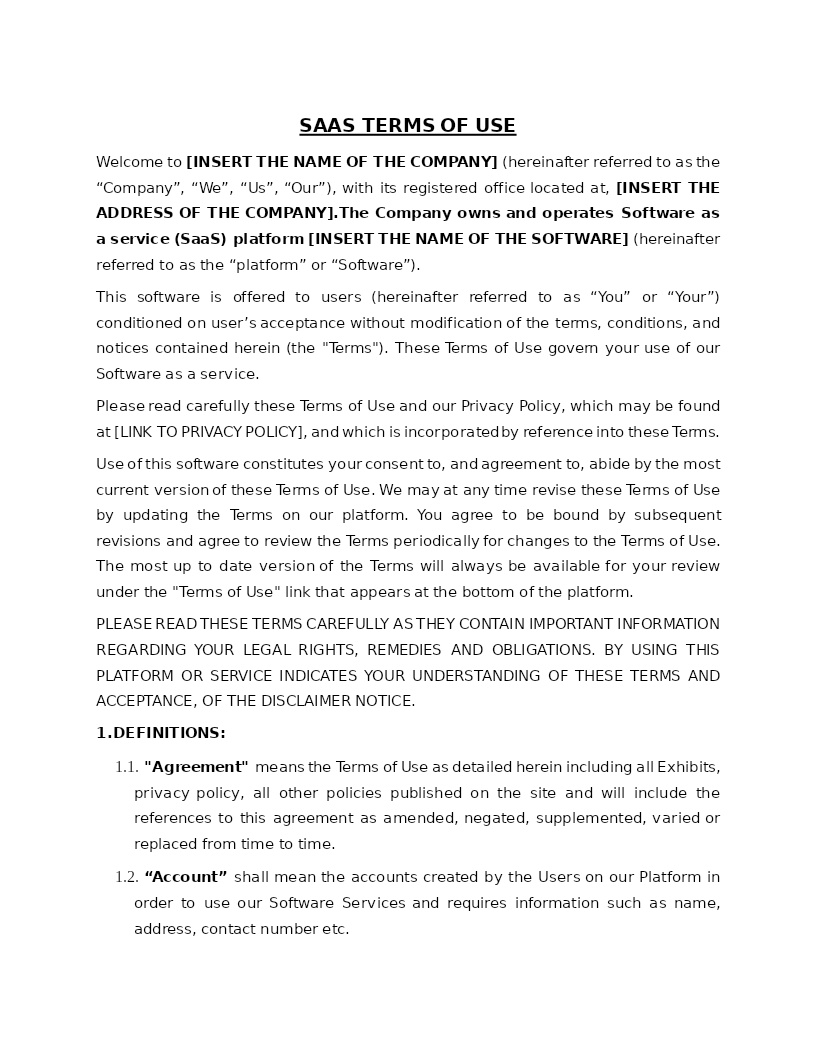
SAAS TERMS OF USE
How does it work?
1. Choose this template
Start by clicking on "Fill out the template"
2. Complete the document
Answer a few questions and your document is created automatically.
3. Save - Print
Your document is ready! You will receive it in Word and PDF formats. You will be able to modify it.
Understanding SaaS Terms of Use
When users access a cloud-based software platform, it’s essential to establish a clear understanding of how the service may be used, what is permitted, and what responsibilities apply to both the provider and the end user.
SaaS (Software-as-a-Service) Terms of Use provide that structure. They outline acceptable use guidelines, account responsibilities, subscription rules, service availability, data usage, intellectual property protections, and limitations of liability.
Putting SaaS Terms of Use in place helps your business operate smoothly by creating transparency about how your platform functions, setting user expectations, and reducing legal and operational risks.
Where SaaS Terms of Use Are Commonly Used
Terms of Use are standard for nearly all cloud-based platforms, including:
• Project management and productivity tools
• CRM and customer engagement platforms
• Online marketplaces and membership portals
• HR, payroll, and employee-management systems
• AI platforms, analytics dashboards, and automation tools
• E-commerce software and subscription-based applications
• Collaboration tools, messaging systems, and communication services
Any time users create accounts, upload data, or rely on online software, Terms of Use serve as the rulebook for how the platform may be accessed.
Different Types of SaaS Terms You May Encounter
- Standard Terms of Use: Broad rules that apply to all users of a SaaS platform.
- Paid Subscription and Billing Terms: Used when users pay monthly or yearly for access, including renewal and cancellation rules.
- Enterprise or Custom License Terms: Tailored for organizations with multiple users or advanced service features.
- Acceptable Use Policies (AUPs): Define prohibited actions such as misuse, abuse, or unlawful activity.
- Data Processing Addendums (DPAs): Added when handling personal data under laws like GDPR or U.S. privacy regulations.
When Legal Guidance Becomes Helpful
Legal review becomes valuable when:
• You collect or process sensitive user data, including payment or personal information
• Your platform integrates third-party services or APIs
• You offer enterprise services, custom permissions, or API access
• U.S. privacy laws (CCPA/CPRA, state privacy acts) apply
• Your Terms include liability limitations, warranties, or auto-renewal billing
• You provide globally accessible services involving cross-border data transfers
A lawyer can help ensure your Terms are enforceable, compliant, and aligned with industry standards.
How to Work with This Template
• Identify the platform owner and outline user eligibility
• Define the scope of access trial, subscription, or enterprise
• Clearly specify user obligations, restrictions, and prohibited actions
• Address billing, renewals, upgrades, downgrades, and refunds
• Include intellectual property ownership and license limitations
• Add privacy, data usage, and security commitments
• Choose the governing U.S. state law
• Review and publish online; acceptance occurs upon account creation or use
Frequently Asked Questions
Q1. What are SaaS Terms of Use, and why are they necessary?
SaaS Terms of Use establish the legal rules for accessing and using cloud-based software. They protect both the business and its users by clarifying rights, responsibilities, acceptable use, and limitations reducing the risk of disputes or misuse.
Q2. Are SaaS Terms of Use legally enforceable in the U.S.?
Yes. U.S. courts generally enforce properly drafted online agreements, especially when the user has clearly accepted them through a click-wrap or sign-in process. The clearer the presentation, the stronger the enforceability.
Q3. Do SaaS Terms of Use need to include a privacy policy?
While the Privacy Policy is often separate, the Terms of Use should reference it. U.S. privacy laws require transparency about how personal data is collected, stored, and processed, especially for subscription-based services.
Q4. What types of restrictions are typically included?
Common restrictions include prohibiting unauthorized access, reverse engineering, harmful activities, content misuse, or violating security protocols. These restrictions safeguard the platform and its users.
Q5. Can SaaS Terms of Use address payment and subscription billing?
Yes. Billing details such as subscription cycles, renewals, cancellations, refunds, and upgrade/downgrade policies are essential elements and ensure transparency in financial transactions.
Q6. Who owns the data uploaded to a SaaS platform?
Users typically retain ownership of their data, while the provider owns the platform and software. Terms of Use explain how data can be stored, processed, or removed and outline procedures for exporting data if the user ends the service.
Q7. Do SaaS Terms of Use protect intellectual property?
Absolutely. They clarify that the provider owns all software, designs, features, and content. The user receives a limited license to use the platform but does not acquire ownership of its technology.
Q8. What happens if a user violates the Terms of Use?
Violations may lead to account suspension, termination, service limitations, or legal action. Clear enforcement rules help protect the platform and other users from harmful or unauthorized activities.
Q9. Are electronic signatures or click-wrap consent valid for SaaS Terms?
Yes. Under the U.S. ESIGN Act, electronic acceptance including click-wrap and sign-in-wrap agreements is legally valid as long as the user is given reasonable notice and the opportunity to review the terms.
Q10. How often should SaaS Terms of Use be updated?
Updates are recommended whenever new features are launched, billing structures change, privacy laws evolve, or the company expands internationally. Users should be notified of significant updates to maintain compliance.