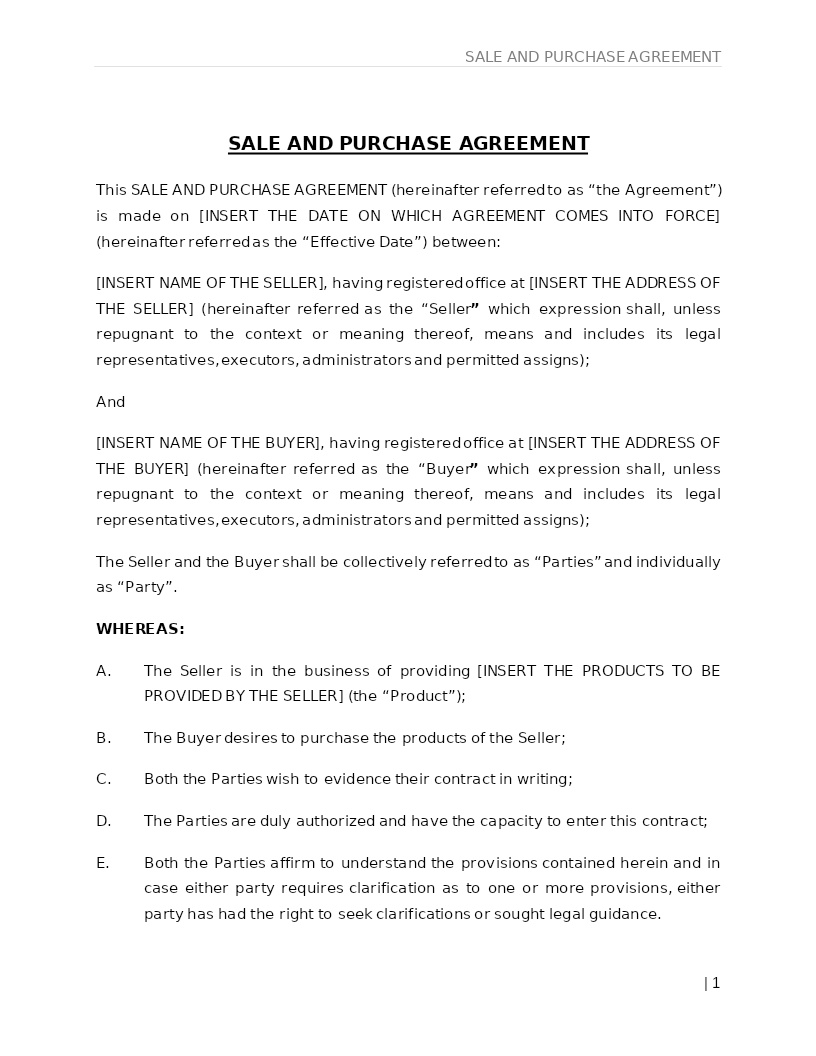
SALE AND PURCHASE AGREEMENT
How does it work?
1. Choose this template
Start by clicking on "Fill out the template"
2. Complete the document
Answer a few questions and your document is created automatically.
3. Save - Print
Your document is ready! You will receive it in Word and PDF formats. You will be able to modify it.
Creating Clarity & Security in Business, Asset, and Share Transfers
When parties negotiate the sale of a business, property, asset, or shares, it is essential to have a clear, enforceable framework that outlines the terms of the transaction. A Sale and Purchase Agreement (SPA) provides that framework. It defines what is being sold, the price and payment terms, representations and warranties, conditions that must be satisfied, and how ownership and risk will transfer between the parties.
Implementing an SPA builds trust and transparency, allowing both parties to move forward confidently, share necessary information, and complete the transaction knowing their rights and obligations are clearly defined and legally protected.
Where Sale and Purchase Agreements Are Commonly Used
SPAs are standard in a wide range of U.S. commercial and personal transactions, including:
- Buying or selling a business (stock sale or asset sale)
- Transfer of shares or equity in a corporation or LLC
- Real estate transactions involving commercial or residential property
- Sale of equipment, vehicles, inventory, or other assets
- Mergers, acquisitions, and restructuring transactions
- Cross-border transactions involving multinational entities
- High-value commercial contracts and industrial procurements
Any time ownership of a significant asset is being transferred, an SPA ensures clarity and reduces legal and financial risks.
Different Types of Sale and Purchase Agreements You May Encounter
- Asset Purchase Agreement (APA): Used when a buyer acquires specific assets such as equipment, property, inventory, or intellectual property without taking on liabilities unless expressly agreed.
- Share/Stock Purchase Agreement (SPA): Used when buying equity in a corporation, thereby acquiring ownership interests, rights, and obligations tied to the business entity.
- Business Purchase Agreement: A broader agreement covering the transfer of both assets and liabilities of an operating business.
- Real Estate Purchase Agreement: Covers the sale of land, buildings, or commercial property and includes title, escrow, inspections, and closing procedures.
- Cross-Border SPA: Designed for international transactions with provisions addressing foreign laws, currency, taxes, and international dispute resolution.
When Legal Guidance Becomes Helpful
Professional legal advice becomes crucial when:
- The transaction involves high-value assets, intellectual property, or regulated industries
- Multiple jurisdictions or cross-border elements increase complexity
- Extensive representations, warranties, and indemnities must be negotiated
- The transaction requires government approvals or third-party consents
- There are tax implications or corporate restructuring considerations
- The SPA impacts shareholders, investors, employees, or existing contracts
- The agreement includes earn-outs, adjustments, escrow terms, or risk allocation
- Large amounts of confidential or proprietary data are exchanged
Legal review ensures that obligations are clear, liabilities are allocated appropriately, and the contract is enforceable under U.S. law.
How to Work with This Template
- Identify the parties and specify what is being sold
- Describe the assets, shares, or property in detail
- Insert purchase price, payment terms, and closing adjustments
- Add necessary representations, warranties, and covenants
- Outline conditions precedent and closing deliverables
- Choose governing state law and dispute-resolution method
- Review the contract with legal counsel
- Sign electronically or in hard copy
The template follows standard U.S. contracting norms and works with all major e-signature platforms.
Frequently Asked Questions
Q1. What is a Sale and Purchase Agreement (SPA), and why is it important?
A Sale and Purchase Agreement is a legally binding contract that defines the detailed terms under which a buyer purchases and a seller transfers an asset, business, property, or shares. It outlines critical elements such as price, payment structure, representations, warranties, and closing requirements. In U.S. transactions, the SPA is vital because it prevents misunderstandings, allocates risk clearly, and provides a legally enforceable framework for completing the sale. It ensures both parties know exactly what they are committing to before ownership changes hands.
Q2. Is a Sale and Purchase Agreement legally enforceable in the U.S.?
Yes. Once signed by both parties, an SPA becomes fully enforceable under U.S. contract law and carries the same legal weight as any other commercial agreement. This means each party is required to fulfill their obligations exactly as described in the contract. If a dispute arises, courts or arbitrators rely on the SPA as the primary evidence of the agreed terms. Because of this enforceability, signing an SPA offers both parties contractual certainty and legal protection.
Q3. How is an SPA different from a Letter of Intent (LOI) or Memorandum of Understanding (MOU)?
A Letter of Intent or MOU typically summarizes the initial intentions, key expectations, and broad commercial points discussed during negotiations. These documents are usually non-binding and are meant to guide the path toward a final agreement. A Sale and Purchase Agreement, in contrast, is the definitive, legally binding document that formalizes the entire transaction. It includes complete terms, warranties, obligations, and remedies, making it the contract that governs the actual transfer of ownership. In most U.S. deals, the SPA is the final step before closing.
Q4. Can the same SPA be used for both asset purchases and share purchases?
Yes. A Sale and Purchase Agreement can be customized for either asset transfers or share transfers, even though each type of transaction has different legal implications. Asset purchases involve transferring selected assets and liabilities, giving buyers more control over what they acquire. Share purchases, however, transfer ownership in the entire company, including all assets, liabilities, contracts, and obligations. While the structure of the SPA remains similar, the specific clauses are adapted to fit the nature of the purchase.
Q5. Is a deposit or earnest money required in every SPA?
No. The requirement for a deposit depends entirely on the nature of the deal and the negotiation between the parties. In U.S. real estate transactions, deposits or earnest money are common to demonstrate buyer commitment. In business or asset acquisitions, deposits may not be required unless agreed upon as part of closing protections or performance assurance. If used, the SPA will detail the deposit amount, how it is held (often in escrow), and the conditions for refund or forfeiture.
Q6. Are electronic signatures valid for Sale and Purchase Agreements in the U.S.?
Yes. Electronic signatures are fully valid and enforceable across the United States under the E-SIGN Act and UETA. This legal recognition means SPAs can be signed through platforms like DocuSign, Adobe Sign, or other digital tools without reducing their legal effect. Electronic execution is now standard practice because it speeds up closings, ensures accurate documentation, and provides time-stamped audit trails. Businesses routinely rely on digital signatures for both domestic and cross-border transactions.
Q7. What happens if one party breaches the SPA?
If a buyer or seller fails to meet their obligations, such as refusing to close, providing false information, or failing to transfer assets, the non-breaching party has several remedies under U.S. law. These may include claiming damages, terminating the agreement, or seeking specific performance, which requires the breaching party to complete the transaction. The SPA itself often outlines detailed dispute-resolution mechanisms, such as mediation, arbitration, or court litigation. These provisions help ensure breaches are addressed efficiently and consistently.
Q8. What are representations and warranties in an SPA, and why are they important?
Representations and warranties are statements made by each party regarding the accuracy, ownership, legality, or condition of what is being sold. They assure the buyer that the assets or shares are as described and that no hidden issues or liabilities exist. These clauses are critical because they allocate risk and create grounds for indemnification if any statement turns out to be untrue. In U.S. transactions, reps and warranties significantly influence negotiations and help prevent post-closing disputes.
Q9. What are conditions precedent in a Sale and Purchase Agreement?
Conditions precedent are specific requirements that must be fulfilled before the sale can close, and they ensure that both parties are ready for the transfer of ownership. These may include regulatory approvals, satisfactory due diligence, financing arrangements, or third-party consents. If these conditions are not met, the closing may be delayed, or the parties may be allowed to terminate the agreement. These provisions protect both parties from completing a transaction without essential legal or operational groundwork in place.
Q10. Can an SPA be used for cross-border or international transactions?
Yes. SPAs are commonly adapted for international deals, especially in mergers, acquisitions, and property transactions involving multiple jurisdictions. A cross-border SPA may include special provisions for governing law, tax treatment, foreign-exchange rules, compliance with international regulations, and arbitration for dispute resolution. By customizing these clauses, the SPA helps manage differences between legal systems, reduces uncertainty, and ensures that the transaction remains enforceable across borders.
Related Templates You May Need
• Non-Disclosure Agreement (NDA)