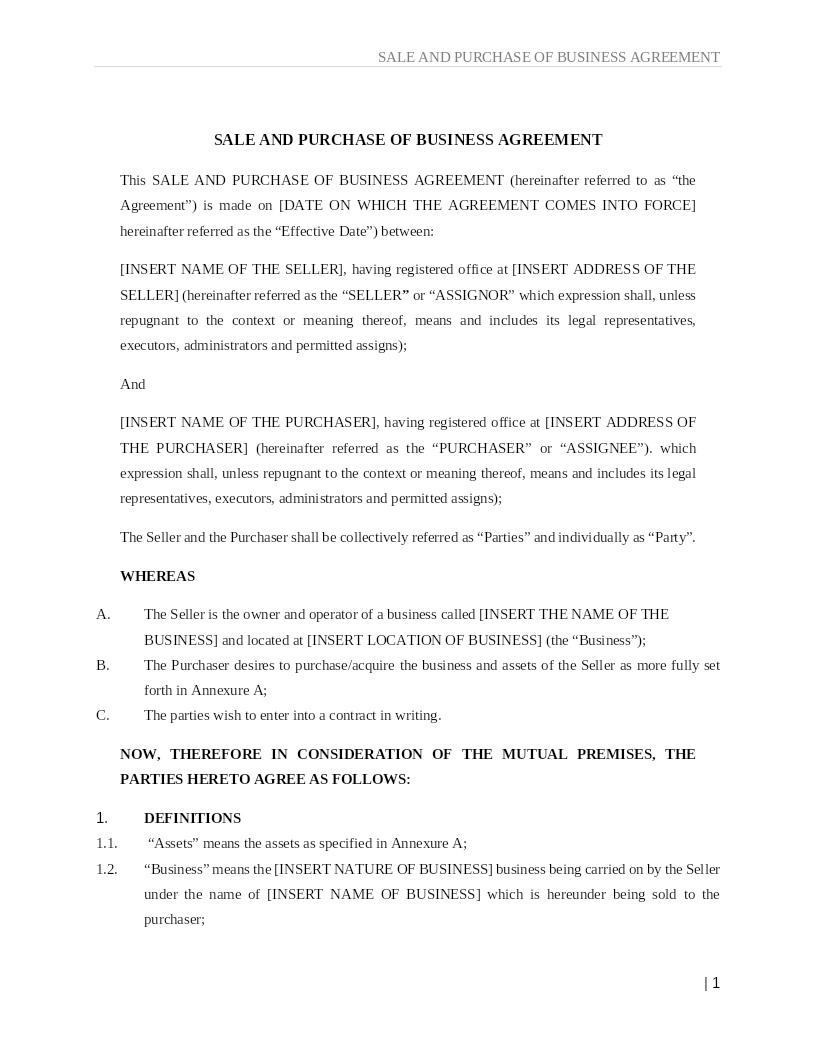
SALE AND PURCHASE OF BUSINESS AGREEMENT
How does it work?
1. Choose this template
Start by clicking on "Fill out the template"
2. Complete the document
Answer a few questions and your document is created automatically.
3. Save - Print
Your document is ready! You will receive it in Word and PDF formats. You will be able to modify it.
Understanding Sale and Purchase of Business Agreements
A Sale and Purchase of Business Agreement is a legally binding contract that outlines the terms under which a buyer acquires a business from a seller. The agreement clearly defines the purchase price, assets included, liabilities assumed, representations and warranties, closing conditions, due diligence requirements, payment terms, and post-closing obligations.
In the United States, Sale and Purchase Agreements are governed by state contract laws, the Uniform Commercial Code (UCC), federal business transfer regulations, tax laws, employment rules, and industry-specific compliance standards. Whether selling a small business or purchasing a large commercial operation, this agreement ensures transparency, reduces legal risks, and protects both parties throughout the transaction.
Where Sale and Purchase of Business Agreements Are Commonly Used
These agreements are widely used across all business sectors, including:
- Retail stores, restaurants, and local service businesses
- Online businesses, e-commerce stores, and digital enterprises
- Manufacturing units and distribution companies
- Professional service firms and consulting practices
- Hospitality, transport, and logistics companies
- Technology startups, software businesses, and IP-driven companies
- Franchise sales, business expansions, or multi-location acquisitions
Whenever a business is bought or sold, this agreement provides the structure and legal protection needed for a smooth transfer of ownership.
Different Types of Business Sale Structures You May Encounter
- Asset Purchase Agreement (APA): Buyer purchases specific assets, equipment, inventory, IP, contracts, without assuming all liabilities.
- Stock Purchase Agreement (SPA): Buyer acquires ownership of the company by purchasing its stock or membership units.
- Merger or Acquisition Agreement: Two entities combine, or one entity absorbs another, often requiring regulatory approvals.
- Hybrid Purchase Agreement: Combines elements of asset and stock purchases to meet tax, liability, or business needs.
When Legal Guidance Becomes Helpful
Legal assistance is strongly recommended when:
- The business includes intellectual property, trademarks, or proprietary technology
- The sale involves employees, contractors, or transferable contracts
- The buyer needs clarity on liabilities, tax consequences, or due diligence issues
- Regulatory approvals, licenses, or permits must be transferred
- The agreement requires indemnification, confidentiality, or non-compete terms
- The business has outstanding debts, leases, or vendor obligations
- The transaction includes financing arrangements or installment payments
Legal review ensures the transaction complies with U.S. laws and protects both parties from future disputes.
How to Work with This Template
- Identify the buyer and seller, including business entity information
- Define whether the sale is structured as an asset purchase or equity purchase
- List assets included in the sale, inventory, IP, equipment, contracts, goodwill
- Specify liabilities being transferred or excluded
- Outline the purchase price, payment terms, holdbacks, or escrow conditions
- Include due diligence procedures and inspection rights
- Establish closing conditions, deliverables, and transfer procedures
- Add warranties, indemnity clauses, non-competition terms, and confidentiality
- Choose the governing U.S. state law
- Sign electronically or in hard copy following applicable state guidelines
This template aligns with U.S. commercial transaction standards and works with all major e-signature platforms.
Frequently Asked Questions
Q1. What is a Sale and Purchase of Business Agreement?
It is a contract that outlines the terms under which a buyer acquires a business from a seller. It covers the purchase price, assets, liabilities, warranties, and closing procedures. The agreement ensures a smooth and legally compliant transfer of ownership.
Q2. What is the difference between an asset purchase and a stock purchase?
An asset purchase transfers selected assets and sometimes specific liabilities, giving the buyer more control over what they assume.
A stock purchase transfers ownership of the entire business entity, including all assets and liabilities, unless excluded.
Q3. Are these agreements legally enforceable in the U.S.?
Yes. They are enforceable under state contract laws, UCC provisions, and federal business transfer regulations. A written agreement protects both parties and ensures compliance with tax and regulatory requirements.
Q4. What due diligence is required before buying a business?
Due diligence typically includes reviewing financial statements, tax records, contracts, leases, licenses, inventory, equipment, employee data, intellectual property, and legal history. This helps buyers understand risks and valuation.
Q5. Can the buyer request warranties and representations?
Absolutely. Sellers typically provide warranties about ownership rights, financial accuracy, legal compliance, and absence of undisclosed liabilities. These protect the buyer if issues arise after closing.
Q6. Are taxes involved in selling a business?
Yes. Business sales may involve capital gains tax, sales tax on assets, franchise taxes, or transfer fees depending on the state and structure of the sale. Consulting a tax professional is recommended.
Q7. Can the seller stay involved in the business after the sale?
Yes, if both parties agree. Some sales include transition assistance, consulting terms, training periods, or temporary management support to ensure a smooth transition.
Q8. Is a non-compete clause allowed in a business sale?
Generally, yes. Non-competition clauses are common and enforceable in many U.S. states (with reasonable limits). They prevent the seller from opening a competing business immediately after selling.
Q9. Are electronic signatures valid for Sale and Purchase Agreements?
Yes. Under the U.S. ESIGN Act, electronic signatures are legally enforceable for business sale transactions unless state law requires notarization or in-person signing for certain documents.
Q10. Is this agreement appropriate for small business sales?
Definitely. Whether selling a small retail shop, a consulting practice, or an online business, this agreement ensures both parties understand the terms, helps avoid disputes, and protects the value of the business being transferred.