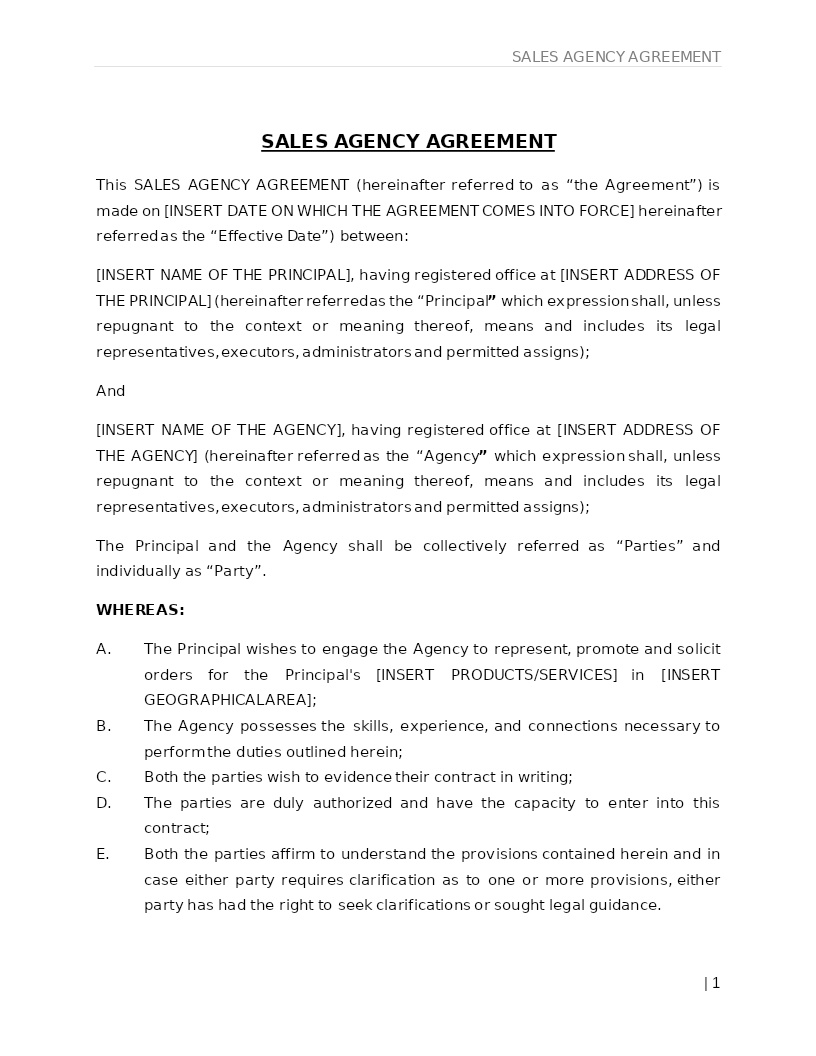
SALES AGENCY AGREEMENT
How does it work?
1. Choose this template
Start by clicking on "Fill out the template"
2. Complete the document
Answer a few questions and your document is created automatically.
3. Save - Print
Your document is ready! You will receive it in Word and PDF formats. You will be able to modify it.
Understanding a Sales Agency Agreement
When a business wants to expand its market presence, reach new customers, or scale its sales operations, it often partners with independent sales agents. A Sales Agency Agreement establishes the formal framework for this relationship. It outlines the agent’s authority to represent the company, defines sales responsibilities, sets commission structures, clarifies territory rights, and explains performance expectations.
Because the arrangement involves direct customer interactions, brand representation, and potential revenue impact, a written agreement ensures both parties understand their rights and obligations from the outset. It builds trust, prevents misunderstandings, and provides clear standards for how the partnership will operate.
Where Sales Agency Agreements Are Commonly Used
Sales agency agreements are widely used across industries, especially where companies rely on outside agents to generate business opportunities. Common scenarios include:
- Consumer goods, retail, and distribution
- Manufacturing and industrial equipment sales
- Real estate and property services
- Technology and SaaS products seeking channel resellers
- Pharmaceuticals, medical devices, and healthcare products
- Financial services, insurance, and consulting
- Hospitality, travel, and service-based sectors
Any time a company allows an external party to market, promote, or sell its products, a Sales Agency Agreement sets clear expectations for performance, payment, conduct, and brand protection.
Different Types of Sales Agency Agreements You May Encounter
- Exclusive Sales Agency Agreement: Grants one agent exclusive rights to sell within a specified territory or market segment.
- Non-Exclusive Sales Agency Agreement: Allows multiple agents to operate in the same territory, offering flexibility for the company.
- Commission-Based Agency Agreement: Compensates agents solely on commissions, often with performance incentives.
- Hybrid/Retainer + Commission Agreement: Provides a base retainer plus commission, typically used in high-value or specialized industries.
- Territorial or Market-Specific Agreements: Defines geographic boundaries, customer segments, or product lines the agent may target.
When Legal Guidance Becomes Helpful
Although basic sales agreements can be drafted using a template, legal assistance becomes especially valuable when:
- Agents operate across multiple states or countries
- Commission structures are complex or tied to special conditions
- Sales activities involve regulated industries such as healthcare, finance, or insurance
- Confidential information, trade secrets, or customer data will be shared
- The business wants enforceable non-compete, non-solicitation, or IP protection clauses
- Agents handle long-term accounts, recurring revenue, or renewals
- Liability or indemnity issues need to be clearly allocated
- The company requires strong brand protection standards or compliance oversight
A legal review ensures the agreement is enforceable, compliant, and tailored to the company’s operational realities.
How to Work with This Template
Identify the company and the sales agent
- Define the scope of authority, permitted activities, and limitations
- Outline commission rates, calculation rules, and payment timelines
- Specify sales targets, reporting obligations, and performance expectations
- Clarify territory assignments and account ownership
- Include confidentiality, IP, and conflict-of-interest protections
- Detail termination rights, renewal terms, and consequences of non-performance
- Choose governing state law
- Review together (legal review optional but recommended for revenue-impacting roles)
- Sign electronically or in hard copy
This template aligns with U.S. industry practices and works with major e-signature platforms.
Frequently Asked Questions
Q1. What is the purpose of a Sales Agency Agreement?
The purpose of a Sales Agency Agreement is to establish a clear legal and operational framework for the relationship between a company and an independent agent who sells its products or services. It defines exactly what the agent is authorized to do whether that includes prospecting, negotiating, closing deals, or simply generating leads. It also outlines commission rules, reporting requirements, confidentiality obligations, and performance expectations. This ensures both parties understand the boundaries of the arrangement, reducing confusion and improving accountability throughout the sales process.
Q2. Is a Sales Agency Agreement legally binding in the United States?
Yes. A Sales Agency Agreement is a legally enforceable contract once both parties sign it. Because agents often represent the company’s brand in the market, the agreement typically includes binding obligations regarding conduct, confidentiality, payment rights, and dispute resolution. U.S. courts enforce these agreements so long as they clearly define key terms such as compensation, responsibilities, duration, and termination rights. This makes the agreement a vital tool for protecting both the company and the agent.
Q3. Why is a Sales Agency Agreement important for setting commission and payment terms?
Commission structures can be complex, especially when tied to quotas, renewals, multi-product sales, or tier-based incentives. A Sales Agency Agreement outlines how commissions are earned, when they are paid, what qualifies as a “completed sale,” and how chargebacks or refunds are handled. This level of detail prevents payment disputes and ensures transparency. For agents, it provides confidence in how earnings are calculated. For companies, it ensures commission payouts align with genuine, revenue-producing outcomes.
Q4. Does a Sales Agency Agreement address territory rights and exclusivity?
Yes. Many agreements define specific geographic territories, industry segments, or customer accounts the agent may target. If the company offers exclusivity, the agreement outlines the scope, boundaries, and conditions under which exclusivity applies. Conversely, if the company wants flexibility, the agreement will specify that the agent operates in a non-exclusive capacity. Clear territorial definitions prevent agent conflicts, overlapping efforts, and customer confusion.
Q5. How does a Sales Agency Agreement protect a company’s intellectual property and confidential information?
Agents often gain access to product data, pricing strategies, marketing materials, customer lists, and proprietary tools. A Sales Agency Agreement typically includes strong confidentiality, IP protection, and non-disclosure clauses to safeguard this information. It restricts the agent from sharing, copying, or misusing company materials and ensures they are returned upon termination. This protects the company’s competitive advantage and prevents sensitive information from falling into the hands of competitors.
Q6. What happens if a sales agent fails to meet their sales targets or performance expectations?
The agreement generally includes performance metrics, reporting requirements, and minimum sales expectations. If the agent fails to meet these benchmarks, the company may reduce territory size, amend compensation terms, or terminate the agreement entirely depending on the contract’s terms. Having these expectations in writing ensures that performance issues are handled objectively, fairly, and consistently.
Q7. Can a Sales Agency Agreement be modified or updated later?
Yes. Most agreements include a clause specifying how amendments can be made, typically requiring mutual written consent. This allows terms to evolve as the business grows, new products are launched, or commission models change. Updates may also be needed when sales regions expand, performance rules shift, or regulatory requirements change. Written amendments keep the agreement clear, current, and enforceable.
Q8. What type of termination terms should be included in a Sales Agency Agreement?
A strong agreement defines the duration, renewal options, and termination procedures. This includes notice requirements, termination for breach, termination for non-performance, and termination for convenience (if allowed). It may also specify how post-termination commissions are handled and whether the agent retains rights to existing accounts. These terms help both parties plan their business activities and prevent abrupt disruptions.
Q9. Are electronic signatures valid for Sales Agency Agreements in the U.S.?
Absolutely. Under the ESIGN Act and UETA, electronic signatures are fully enforceable across the United States. Companies commonly execute Sales Agency Agreements through digital platforms, especially when working with agents in different states or countries. As long as both parties agree to electronic execution, the contract holds the same legal weight as a handwritten signature.
Q10. Is this Sales Agency Agreement template suitable for small businesses, startups, and large enterprises?
Yes. The structure works for any business that relies on independent sales representation. Startups benefit from clear compensation and territory rules, mid-sized companies gain protection for their IP and customer base, and larger enterprises can layer in detailed compliance, reporting, and performance requirements. The template is designed to accommodate both simple and complex agency relationships within U.S. commercial standards.