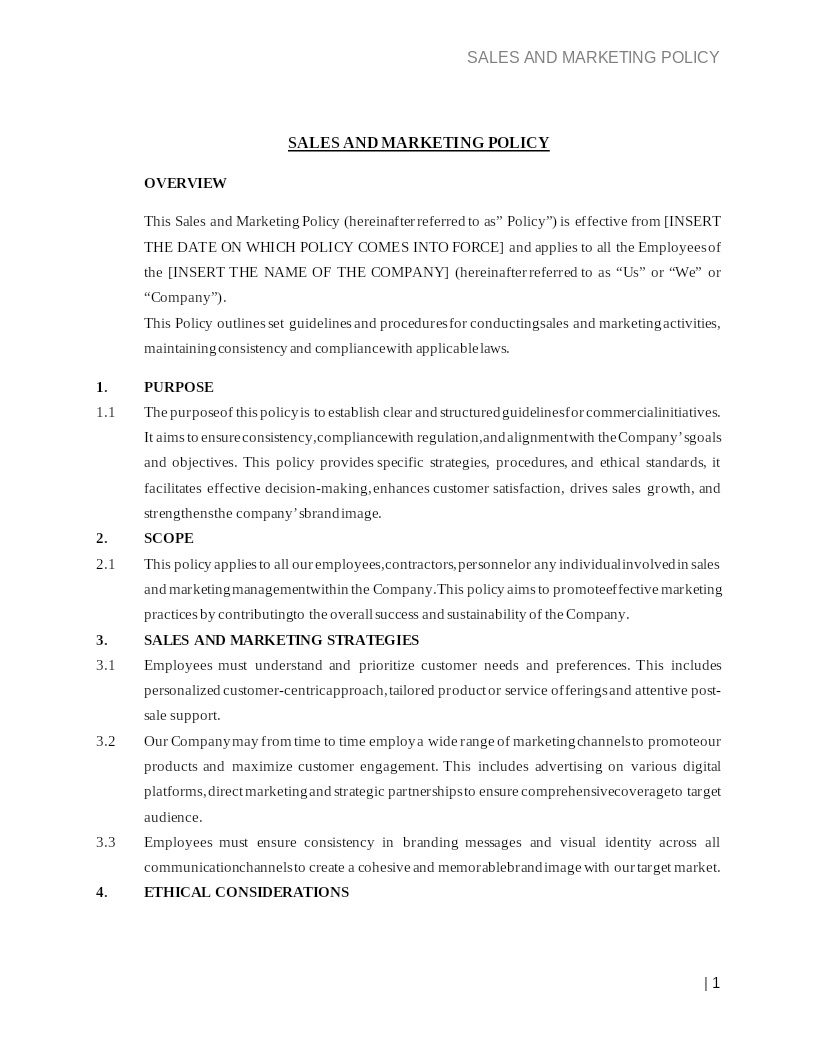
SALES AND MARKETING POLICY
How does it work?
1. Choose this template
Start by clicking on "Fill out the template"
2. Complete the document
Answer a few questions and your document is created automatically.
3. Save - Print
Your document is ready! You will receive it in Word and PDF formats. You will be able to modify it.
Understanding the Purpose of a Sales and Marketing Policy
A Sales and Marketing Policy establishes the framework a company uses to promote, sell, and distribute its products or services. It outlines standards for customer engagement, advertising practices, sales conduct, brand representation, and compliance expectations. This policy ensures that every communication, whether through sales teams, digital marketing, or external partners, aligns with the organization’s strategic goals and ethical standards.
A structured policy helps companies maintain consistent messaging, protect their reputation, and operate with transparency across all channels. It also supports teams in working collaboratively by clearly defining acceptable practices and the limits within which they must operate.
Where Sales and Marketing Policies Are Commonly Applied
Sales and marketing guidelines are essential across a variety of industries and operational contexts, including:
- Customer acquisition strategies and outbound sales campaigns
- Digital advertising, social media marketing, and content publishing
- Product demonstrations, lead generation, and promotional events
- Partner marketing programs, affiliate networks, and agency collaborations
- Cross-functional campaigns involving product, compliance, and support teams
- Internal reporting, performance tracking, and pipeline management
Whenever an organization connects with its target audience, distributes promotional content, or seeks new business, the policy defines how the interaction should be conducted.
Different Types of Sales and Marketing Policies You May Encounter
- Sales Conduct and Ethics Policy: Establishes standards for fair selling practices, customer communication, disclosures, and compliance requirements.
- Marketing and Advertising Policy: Governs use of brand assets, messaging standards, advertising claims, and content accuracy.
- Digital Marketing and Social Media Policy: Controls online interactions, digital advertising, influencer partnerships, and platform-specific compliance obligations.
- Lead Management and Data Handling Policy: Regulates how leads are collected, qualified, stored, and used—ensuring adherence to privacy laws and internal protocols.
- Channel or Partner Sales Policy: Sets expectations for distributors, affiliates, and resellers regarding territory boundaries, brand use, and reporting duties.
When Legal Guidance Becomes Helpful
Most day-to-day marketing efforts can operate within standard internal guidelines, but legal involvement becomes valuable when:
- Your campaigns include comparative or performance-based claims subject to advertising regulations
- Marketing involves health, financial, educational, or other regulated industries
- Data-driven campaigns require compliance with privacy laws like CCPA, GDPR, or sector-specific rules
- Cross-border promotions involve multiple jurisdictions and consumer protection frameworks
- Sales teams use customized commission structures, incentive plans, or non-typical contract terms
- The business collaborates with influencers, agencies, or strategic partners requiring formal agreements
- New intellectual property, creative assets, or proprietary data are involved in promotional materials
Legal review ensures that messaging is truthful, compliant, and defensible, reducing the risk of regulatory penalties or brand damage.
How to Use This Policy Template
- Identify the teams and departments governed by the policy
- Define sales practices, marketing standards, and approval workflows
- Clarify rules for branding, advertising claims, promotions, and lead handling
- Establish regulatory compliance requirements and state/federal advertising guidelines
- Outline reporting responsibilities, performance tracking, and conduct expectations
- Ensure consistent enforcement through training and documented procedures
The template aligns with widely accepted U.S. commercial standards and can be adapted to fit companies of any size or industry.
Frequently Asked Questions
Q1. What is a Sales and Marketing Policy and why do businesses need it?
A Sales and Marketing Policy is an internal framework that guides how a company promotes, advertises, and sells its products or services. Businesses need it to ensure consistent branding, ethical sales practices, and compliance with U.S. advertising laws. It also prevents misrepresentations, reduces customer disputes, and improves operational efficiency. With a clear structure in place, teams can work in alignment toward shared revenue goals.
Q2. How does a Sales and Marketing Policy support compliance with U.S. advertising laws?
U.S. regulators such as the FTC require advertisements to be truthful, substantiated, and non-deceptive. A policy helps ensure teams follow these standards across campaigns, social media, and promotional content. It outlines what claims can be made, how disclosures should be presented, and when legal review is necessary. This reduces risk, especially in industries with strict federal or state oversight.
Q3. Can this policy help reduce customer complaints or dispute risks?
Yes. By establishing transparent communication guidelines, ethical selling practices, and accurate product representations, the policy minimizes misunderstandings. It helps sales teams set proper expectations and prevents exaggerated claims that may lead to dissatisfaction. Strong documentation and approval workflows also provide protection if disagreements arise.
Q4. How does a Sales and Marketing Policy improve overall brand consistency?
The policy standardizes how a brand is presented across messaging, design, tone, and customer interactions. It ensures that marketing content aligns with brand values and approved positioning. Whether the communication is made by a salesperson, social media manager, or agency partner, consistency builds trust and strengthens recognition. This also prevents off-brand or misleading statements that could harm reputation.
Q5. Is this policy useful for companies working with external agencies or influencers?
Absolutely. External partners require clear rules on branding, claims, disclosures, and content approvals. The policy outlines these responsibilities and establishes boundaries for creative use and messaging accuracy. It also ensures compliance with FTC influencer guidelines and intellectual-property rules. This keeps agency-generated content aligned with company standards.
Q6. How does the policy support internal coordination between sales and marketing teams?
It clarifies roles, expectations, communication flows, and approval processes so both teams work cohesively. Sales teams get accurate marketing materials, and marketing teams receive feedback on customer behavior and market needs. This alignment helps improve campaign effectiveness, lead quality, and conversion rates. Structured collaboration ultimately results in more predictable revenue outcomes.
Q7. Does a company still need legal review if it follows a Sales and Marketing Policy?
Following the policy reduces risk, but legal review is beneficial when campaigns involve regulated claims, new markets, or complex promotional strategies. Legal teams ensure that advertisements comply with federal, state, and industry-specific rules. They can also flag potential liabilities and refine disclaimers or disclosures. Not every campaign needs review, but critical ones often do.
Q8. How does a Sales and Marketing Policy help with data-driven or digital marketing activities?
Data-driven campaigns involve privacy, consent, tracking, and storage considerations. The policy outlines how customer data must be collected, used, and protected in compliance with laws like CCPA and applicable federal regulations. It also sets guidelines for analytics, retargeting, and lead management. This ensures ethical practices while maximizing digital performance.