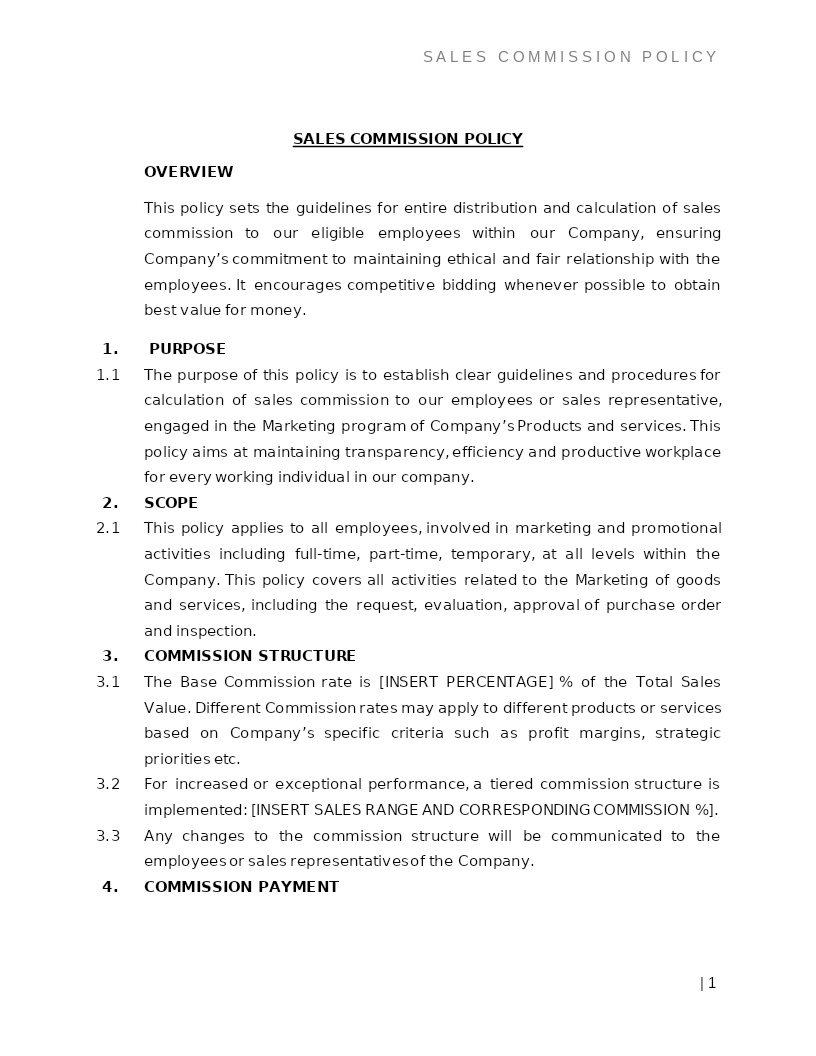
SALES COMMISSION POLICY
How does it work?
1. Choose this template
Start by clicking on "Fill out the template"
2. Complete the document
Answer a few questions and your document is created automatically.
3. Save - Print
Your document is ready! You will receive it in Word and PDF formats. You will be able to modify it.
Understanding the Purpose and Use of a Sales Commission Policy
When your organization relies on sales performance to drive revenue, it becomes essential to implement a structured framework that governs how commissions will be earned, calculated, and distributed. A Sales Commission Policy provides that structure. It defines eligibility, outlines commission calculation rules, clarifies payout schedules, and sets expectations for performance metrics and compliance.
A well-established policy builds trust between the company and its salesforce, ensures fairness, and allows employees to focus on achieving targets without ambiguity around how their earnings will be determined.
Where Sales Commission Policies Are Commonly Used
Commission-based compensation structures appear across a wide range of U.S. industries, including:
- Retail and e-commerce sales teams
- SaaS and technology service providers
- Real estate brokerages and leasing agencies
- Financial services and insurance advisors
- Manufacturing and distribution companies
- Telemarketing and call-center sales operations
- Independent sales agents and contractors
Any time an organization compensates individuals based on sales performance, a written policy creates consistency and prevents disputes.
Different Types of Sales Commission Policies You May Encounter
- Straight Commission Plans: Employees earn compensation solely from commissions without a fixed salary component.
- Base Salary + Commission Plans: A combination of guaranteed pay and variable incentive earnings tied to performance.
- Tiered Commission Structures: Higher commission rates apply as salespeople reach revenue thresholds or performance tiers.
- Residual or Recurring Commission Plans: Common in SaaS and subscription-based industries, where commissions recur monthly or annually.
- Draw Against Commission: Salespeople receive a draw (advance), which is later reconciled against earned commissions.
When Legal Guidance Becomes Helpful
Most standard commission structures can be implemented without extensive legal involvement, but professional guidance becomes essential when:
- Commission structures involve complex tiering, bonuses, accelerators, or clawback provisions.
- Your workforce includes independent contractors requiring compliance with U.S. worker classification laws.
- The policy interacts with multi-state wage regulations such as minimum pay standards, overtime rules, or final paycheck requirements.
- You operate in regulated sectors like finance, healthcare, or insurance.
- You need to include non-solicitation, confidentiality, or IP ownership protections tied to sales roles.
- Your sales team operates across multiple states with different labor laws and commission payout requirements.
Legal review ensures that the commission policy is enforceable, equitable, and compliant with U.S. federal and state labor standards.
How to Work with This Template
- Identify who is eligible for commissions (employees, contractors, teams, or departments).
- Clearly define commissionable activities, qualifying sales, and disqualification scenarios.
- Specify payout schedules, calculation methods, chargebacks, or clawbacks.
- Select governing state laws to ensure compliance with wage and employment regulations.
- Review the terms internally or with legal counsel (optional).
- Provide employees with written acknowledgment of the policy.
This policy follows widely recognized compensation standards used across the United States and supports integration with HR, payroll, and CRM systems.
Frequently Asked Questions
Q1. Why is a formal Sales Commission Policy important for U.S. businesses?
A documented policy minimizes disputes, provides transparency, and ensures every salesperson understands how their earnings are calculated. It also aligns the compensation structure with company goals and ensures compliance with wage and hour laws. Clear rules build trust and create a structured, performance-driven environment.
Q2. How does this policy support payroll accuracy and compliance?
By defining calculation methods, payout timelines, and eligibility rules, the policy reduces payroll errors and late payments. It ensures compliance with state wage laws requiring timely commission payouts. This protects the business from wage claims and safeguards employees’ financial expectations.
Q3. Can a company customize commission structures for different teams?
Yes. Many U.S. companies customize plans based on role, territory, or product line. Legal and HR teams ensure such distinctions comply with equal pay laws and are documented clearly. Customization allows businesses to reward specialized skills while promoting fairness across the workforce.
Q4. Are commission payments enforceable even without a written policy?
Yes, but not having a written policy creates risk. Employees may rely on verbal promises or inconsistent practices, leading to disputes or wage claims. A written, acknowledged policy serves as evidence of agreed compensation terms and protects both the employer and the employee.
Q5. How are disputes resolved under a Sales Commission Policy?
The policy defines internal resolution mechanisms, escalation steps, and documentation requirements. Many companies include mediation or HR review processes. Clear rules reduce the likelihood of litigation and help resolve disagreements based on recorded metrics and policy terms.
Q6. Can commissions be withheld if a client cancels or fails to pay?
Yes, if the policy includes chargeback or clawback provisions. These must be clearly stated to comply with state wage laws. Such terms prevent financial loss to the business while ensuring transparency for sales teams about scenarios affecting payout eligibility.
Q7. Does the policy apply to independent contractors?
Yes, but contractors are governed by contract law, not employment law. This means commission terms must be even clearer, especially regarding payment schedules and chargebacks. Ensuring correct worker classification is essential to avoid legal risks under federal and state labor rules.
Q8. How often should a Sales Commission Policy be reviewed?
Businesses typically review their policy annually or when launching new products, entering new states, or restructuring teams. Regular updates keep the policy aligned with evolving market conditions, legal requirements, and the company’s long-term revenue strategy.