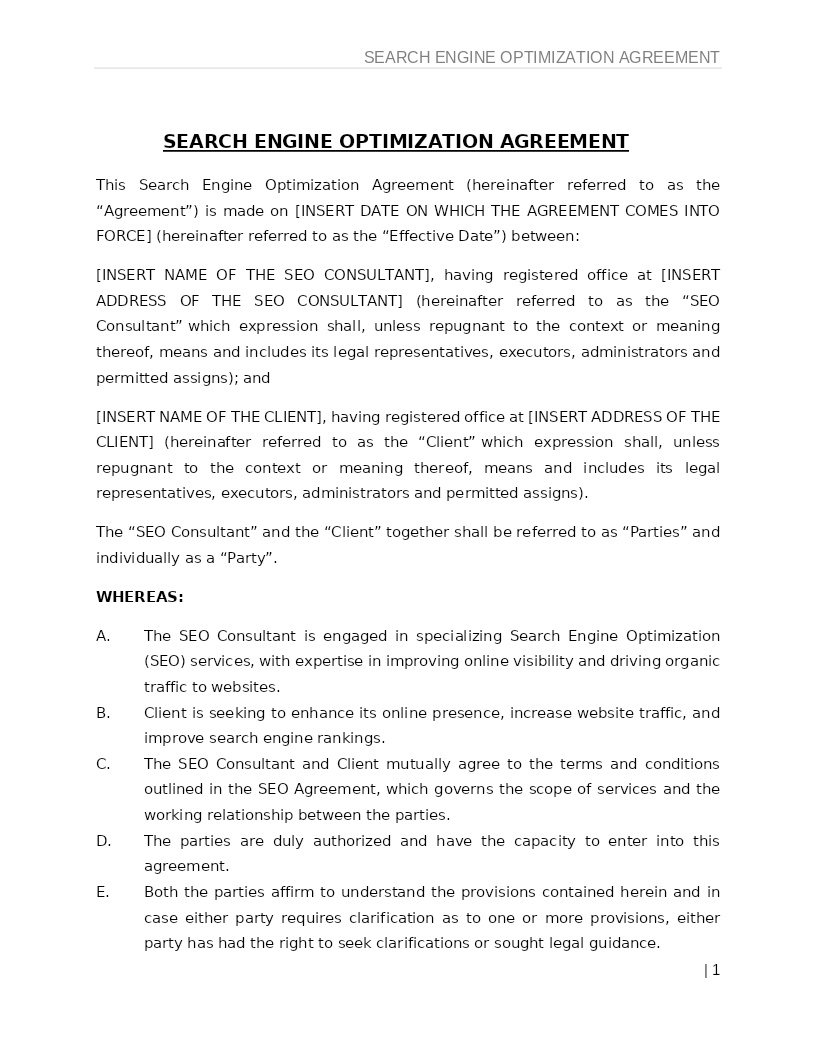
SEARCH ENGINE OPTIMIZATION AGREEMENT
How does it work?
1. Choose this template
Start by clicking on "Fill out the template"
2. Complete the document
Answer a few questions and your document is created automatically.
3. Save - Print
Your document is ready! You will receive it in Word and PDF formats. You will be able to modify it.
Providing Search Engine Optimization Services in Digital Marketing Engagements
When parties enter an arrangement under which a Service Provider delivers search engine optimization, digital visibility enhancement, content optimization, or website performance services, it is essential to create a clear contractual framework governing such activities. A Search Engine Optimization (SEO) Agreement serves this purpose. It outlines the terms under which the Service Provider provides SEO and related digital marketing services to the Client, establishing performance expectations, deliverables, compensation, confidentiality obligations, and limitations, all in accordance with U.S. contract law, advertising regulations, and applicable Federal Trade Commission (FTC) guidelines.
By executing an SEO Agreement, the parties create a legally enforceable understanding that governs the scope of services, data handling practices, intellectual property rights, reporting standards, and remedies for breach. The agreement allows both parties to collaborate effectively, ensuring transparency in digital marketing practices and protection of proprietary strategies and business data.
Where Search Engine Optimization Agreements Are Commonly Used
SEO agreements are widely implemented across the digital marketing and online business landscape, including:
- Professional SEO services for businesses, startups, and e-commerce platforms
- Content optimization, keyword research, and backlink development
- Website audits, technical SEO, and performance enhancement
- On-page and off-page SEO strategies
- Local SEO services targeting geographic-based search visibility
- Industry-specific optimization such as legal, medical, or real estate SEO
- Ongoing ranking maintenance and algorithm update monitoring
- Multi-channel digital marketing and integrated SEO strategies
Any time a business engages an SEO specialist to improve search rankings or online visibility, an SEO agreement governs the terms of that engagement.
Different Types of SEO Agreements You May Encounter
1. Monthly SEO Retainer Agreements: Cover ongoing optimization, monitoring, and support on a monthly service model.
2. Project-Based SEO Agreements: Apply to defined services such as website audits, migrations, or content optimization projects.
3. Local SEO Agreements: Focus on improving visibility on local listings, map searches, and regional keyword rankings.
4. Technical SEO Agreements: Address structural, performance, and indexing improvements to enhance search engine compatibility.
5. Full-Service Digital Marketing Agreements: Include SEO along with content creation, paid advertising, and analytics.
When Legal Guidance Becomes Helpful
While many SEO arrangements are straightforward, legal counsel may be recommended when:
- The agreement includes proprietary technology, algorithms, or custom-developed tools
- Extensive access to the Client’s website, CMS, analytics, or confidential data is required
- The arrangement involves regulated industries with strict advertising rules
- The SEO provider uses subcontractors or third-party vendors
- Payment is based on performance metrics or revenue impact
- Intellectual property ownership over deliverables or content must be clarified
- Penalties or termination rights depend on service outcomes
Legal review ensures that the agreement complies with U.S. advertising law, data protection rules, and contractual standards.
How to Work With This Template
- Identify the Service Provider and the Client
- Define the scope of SEO services and deliverables
- Specify reporting frequency, performance metrics, and communication expectations
- Set forth fees, billing cycles, and payment terms
- Outline confidentiality, data security, and non-disclosure requirements
- Establish IP rights for content creation, analytics, and optimization materials
- Select governing law and jurisdiction
- Review to ensure accuracy and compliance with U.S. regulations
- Execute the agreement electronically or physically
This template aligns with industry-recognized digital marketing contract practices and is compatible with major e-signature platforms.
Frequently Asked Questions
1. What is a Search Engine Optimization (SEO) Agreement, and why is it important?
An SEO agreement is a legally binding contract that defines the terms under which a Service Provider performs search engine optimization services for a client. It is important because it clarifies expectations, deliverables, payment obligations, confidentiality, and compliance with advertising rules, ensuring transparency and accountability.
2. Does an SEO agreement guarantee specific search rankings?
Generally, no. Due to changing algorithms and competitive markets, most agreements avoid ranking guarantees. However, the agreement may set performance expectations such as improved visibility, traffic increases, or KPI-based goals.
3. What services are typically included in SEO agreements?
SEO services commonly include keyword research, on-page optimization, technical SEO, backlink building, content strategy, website audits, and ongoing monitoring. The scope should be clearly described in the agreement.
4. How are payments structured under an SEO agreement?
Payments may be monthly retainer fees, project-based fees, or milestone-based payments. Some agreements include additional fees for tools, content creation, or third-party services.
5. Who owns the content or materials created under the agreement?
Ownership depends on contract terms. Many agreements grant the client full rights to content created specifically for their business, while the service provider retains rights to proprietary tools, templates, or methodologies.
6. Is data security addressed in SEO agreements?
Yes. Since SEO services often require access to analytics accounts, CMS systems, and online dashboards, the agreement should include confidentiality, security, and data protection clauses.
7. Can the service provider use subcontractors?
Only if the agreement permits it. Many SEO firms use subcontractors for content writing, link-building, or technical services. The agreement should require subcontractors to follow the same confidentiality and quality standards.
8. Are electronic signatures valid for SEO Agreements?
Yes. Under the U.S. ESIGN Act, digital signatures are legally enforceable and widely used for SEO and digital marketing contracts.
9. What happens if the client discontinues the agreement early?
Early termination terms should be defined in the contract. This may include notice periods, final invoice obligations, or forfeiture of prepaid amounts depending on the agreement’s language.
10. Does the agreement include reporting or transparency requirements?
Most SEO agreements require periodic reporting on KPIs such as rankings, traffic, conversions, and completed tasks. Reporting frequency (weekly, monthly, or quarterly) should be clearly stated.
11. Can SEO services violate U.S. advertising regulations?
They can, if improperly executed. Misleading claims, deceptive marketing practices, or unapproved advertising tactics may trigger FTC violations. Hence, SEO providers must follow ethical and compliant marketing practices.