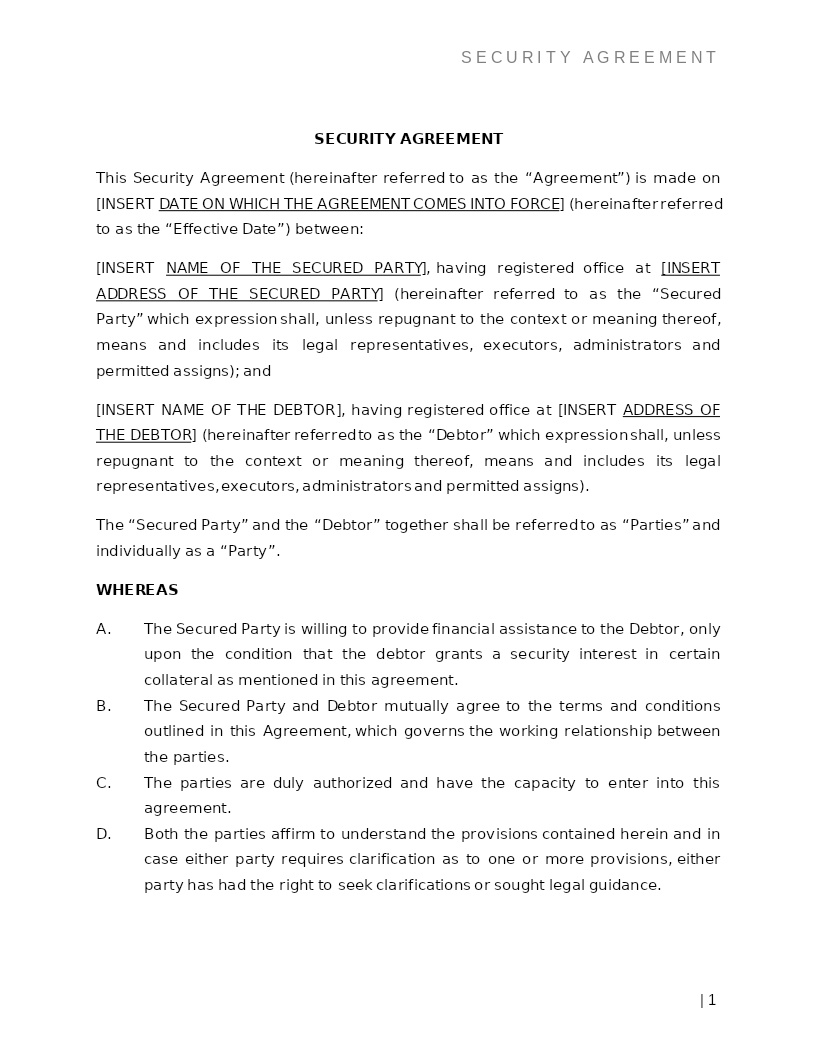
SECURITY AGREEMENT
How does it work?
1. Choose this template
Start by clicking on "Fill out the template"
2. Complete the document
Answer a few questions and your document is created automatically.
3. Save - Print
Your document is ready! You will receive it in Word and PDF formats. You will be able to modify it.
Understanding Security Agreement in U.S.
A Security Agreement is a legally binding document that grants a lender a security interest in specific collateral pledged by a borrower. This agreement outlines the terms under which the lender may claim or repossess that collateral if the borrower fails to meet repayment obligations. It provides clarity on the rights, duties, and remedies available to each party under U.S. secured transaction laws, primarily governed by Article 9 of the Uniform Commercial Code (UCC). By defining collateral details, repayment terms, and default consequences, a Security Agreement minimizes financial risk and ensures both parties’ interests are protected.
A well-drafted Security Agreement prevents misunderstandings, supports lawful debt recovery, and provides structure and certainty in personal, commercial, and business financing arrangements.
Where Security Agreements Are Commonly Used
Security Agreements are widely used in:
- Business loans and commercial financing transactions
- Personal loans secured by vehicles, equipment, or other personal property
- Inventory financing and accounts receivable financing
- Equipment leases, asset-based lending, and merchant financing
- Real estate-related secured transactions (excluding mortgages)
- Investment-backed loans or collateralized securities arrangements
- Startup and small-business funding requiring pledged assets
Any situation involving collateral to secure a debt typically requires a Security Agreement.
Different Types of Security Agreements You May Encounter
- Personal Property Security Agreement: Used to secure loans with movable assets such as vehicles, equipment, or inventory.
- Commercial Security Agreement: Applies to business loans involving accounts receivable, machinery, or business assets.
- Investment Collateral Agreement: Secures loans with stocks, bonds, or investment accounts.
- Future Advances Security Agreement: Covers collateral securing not only current but future credit extensions.
When Legal Guidance Becomes Helpful
Legal consultation becomes essential when:
- The collateral includes business assets, intellectual property, or high-value equipment
- The lender intends to file a UCC-1 Financing Statement to perfect their security interest
- Multiple lenders share collateral or priority disputes may arise
- The agreement involves cross-state or international transactions
- The collateral includes sensitive assets like customer data or trade secrets
- The borrower or lender is unsure about default remedies and repossession procedures
- There is a possibility of bankruptcy, restructuring, or insolvency
Legal review ensures the agreement complies with U.S. laws, is enforceable, and fully protects both parties.
How to Work With This Security Agreement
- Identify the lender, borrower, and collateral with clear descriptions
- Outline repayment terms, interest rates, and borrower obligations
- Define what constitutes a default and the lender’s remedies
- Specify rights for inspection, insurance, and maintenance of collateral
- Include UCC perfection steps, such as filing a UCC-1
- Address priority of interests, subordination, or multiple liens
- Review and sign electronically or in writing to validate the agreement
Frequently Asked Questions
Q1. Why is a Security Agreement important?
A Security Agreement protects the lender by granting legal rights to specified collateral in case the borrower defaults. It also benefits the borrower by establishing clear repayment terms and possibly lowering interest rates. Documentation reduces misunderstandings and provides structured remedies.
Q2. Is a Security Agreement legally enforceable in the U.S.?
Yes. Security Agreements are enforceable under Article 9 of the Uniform Commercial Code (UCC). Once properly executed, and often perfected by filing a UCC-1—the lender gains a legally recognized security interest, which can be enforced through repossession or legal action upon default.
Q3. What assets can be used as collateral?
Collateral may include vehicles, machinery, equipment, inventory, accounts receivable, intellectual property, investment accounts, or personal property. The key requirement is that the asset must be identifiable and capable of being legally pledged.
Q4. What is a UCC-1 Financing Statement?
A UCC-1 is a public filing that perfects the lender’s security interest, giving them priority over other creditors. Filing strengthens the lender’s legal position and is essential for enforcing rights against third parties or in bankruptcy situations.
Q5. What happens if the borrower defaults?
If the borrower fails to meet repayment terms, the lender may repossess or seize the collateral, sell it to recover the debt, or pursue legal remedies. The specific process depends on the agreement and relevant state laws governing secured transactions.
Q6. Can the collateral be used or sold by the borrower?
Most Security Agreements restrict the borrower from selling, transferring, or significantly altering the collateral without lender approval. Some business-oriented agreements (such as inventory financing) allow normal use but must follow specified conditions.
Q7. Does a Security Agreement affect credit or future financing?
Yes. Secured debts and UCC filings may appear on public records or credit reports, affecting the borrower’s ability to obtain future loans. However, properly managed secured loans can also improve credit reliability and reduce lender risk.
Q8. Can a Security Agreement be modified later?
Yes. Both parties may amend the agreement to change collateral, repayment terms, or creditor rights. Any modification must be in writing and may require updating UCC filings to ensure continued perfection of the security interest.