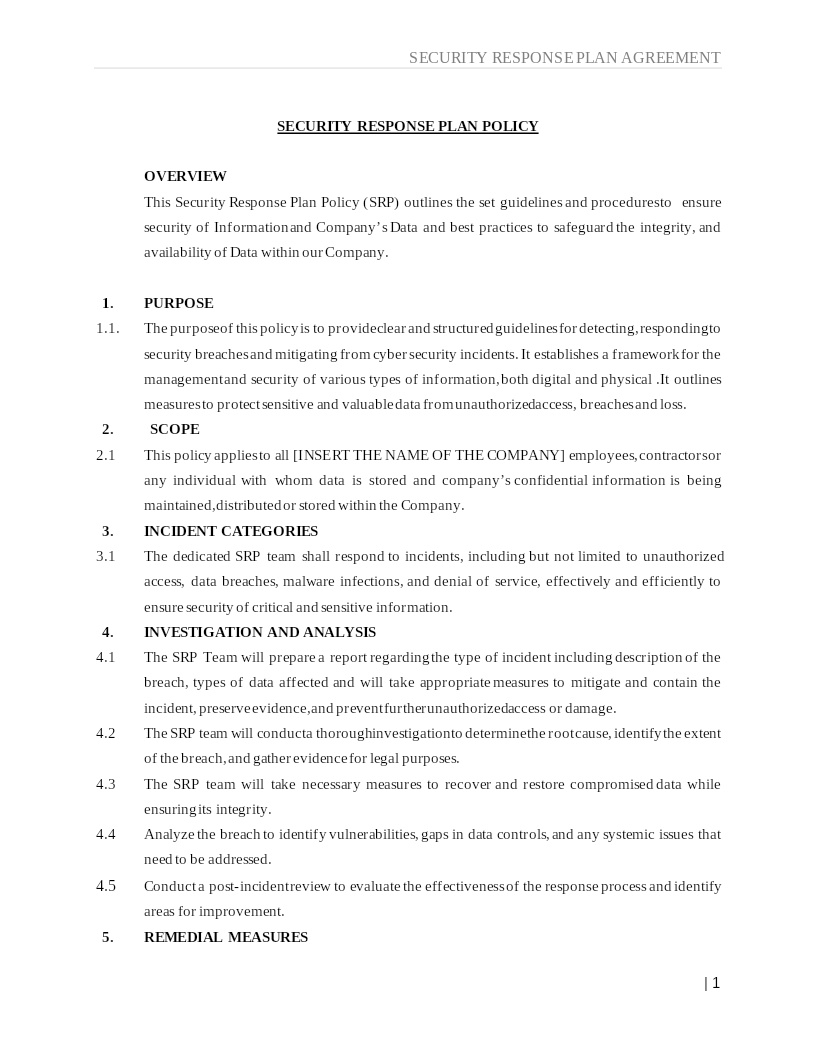
SECURITY RESPONSE PLAN POLICY
How does it work?
1. Choose this template
Start by clicking on "Fill out the template"
2. Complete the document
Answer a few questions and your document is created automatically.
3. Save - Print
Your document is ready! You will receive it in Word and PDF formats. You will be able to modify it.
Ensuring Incident Readiness and Regulatory Compliance Through a Security Response Plan
A Security Response Plan is a comprehensive organizational protocol designed to prepare for, detect, contain, investigate, and mitigate security incidents that threaten the confidentiality, integrity, or availability of systems and data. Developed in accordance with U.S. cybersecurity laws, including the Federal Trade Commission (FTC) Act, the Cybersecurity Information Sharing Act (CISA), state-specific data breach statutes (such as CCPA/CPRA and the New York SHIELD Act), and recognized industry frameworks such as NIST SP 800-61, this plan establishes formal procedures for responding to cyber threats and operational disruptions. It ensures that relevant personnel understand their duties, that incidents are handled promptly and lawfully, and that the organization maintains operational resilience while meeting its regulatory obligations.
A detailed Security Response Plan outlines the phases of incident response, including preparation, threat detection, incident classification, containment strategies, forensic investigation, system recovery, communication procedures, and post-incident review. It identifies critical assets requiring protection, assigns responsibility to internal response teams, and defines escalation paths for severe incidents. Through this structured framework, an organization can minimize the impact of cybersecurity breaches, comply with mandatory reporting timelines, protect sensitive information, maintain stakeholder confidence, and reduce legal exposure related to unauthorized access, data loss, or operational compromise. The plan serves as a formal demonstration of due diligence and responsible risk management.
Where Security Response Plans Are Commonly Used
Security Response Plans are critical across industries and organizational environments that handle sensitive or mission-critical data, including:
- Financial institutions regulated under GLBA, SEC rules, and federal banking guidance
- Healthcare entities managing electronic health records under HIPAA Security Rule requirements
- Technology companies offering cloud platforms, SaaS solutions, or digital infrastructure
- Government contractors subject to NIST 800-171 or CMMC cybersecurity standards
- Retail and e-commerce businesses processing payment card data and consumer information
- Manufacturing and industrial facilities reliant on digital control systems (ICS/OT networks)
- Educational institutions safeguarding student data under FERPA
- Corporate enterprises with distributed networks, remote workforces, or proprietary datasets
Wherever cybersecurity threats pose operational or legal risk, a Security Response Plan is essential.
Different Types of Security Response Plans You May Encounter
1. Cyber Incident Response Plans: Focus on system breaches, malware infections, phishing attacks, and unauthorized system access.
2. Data Breach Response Plans: Detail how organizations notify affected individuals and regulators following personal-data exposure.
3. Operational Disruption Response Plans: Address outages, system failures, denial-of-service attacks, or infrastructure compromise.
4. Forensic Investigation Response Plans: Establish procedures for evidence preservation, chain-of-custody requirements, and forensic analysis.
5. Regulatory-Compliant Security Response Plans: Developed to satisfy industry-specific mandates in healthcare, finance, energy, and defense.
When Legal Guidance Becomes Helpful
Legal review may be necessary when:
- A breach involves personal information subject to state or federal notification laws
- The organization must assess obligations under FTC, CISA, HIPAA, GLBA, or state breach statutes
- Cyber incidents may result in litigation, regulatory investigation, or contractual liability
- Evidence preservation and forensic analysis must meet legal standards
- The plan must integrate whistleblower protections or employee-privacy considerations
- The organization relies on third-party service providers with shared security responsibilities
- Incident reporting may trigger obligations under international laws (GDPR, PIPEDA, etc.)
- A breach involves ransomware demands or potential extortion
Legal counsel ensures the Security Response Plan aligns with U.S. legal standards, mitigating liability and strengthening defensibility.
How to Work with This Template
- Identify critical assets, systems, data categories, and risk areas
- Establish a designated incident response team with defined roles and responsibilities
- Detail the phases of incident response, including detection, classification, containment, and recovery
- Implement monitoring tools, incident-logging procedures, and threat-detection technologies
- Outline internal and external communication steps, including notifications to regulators, partners, and affected individuals
- Establish forensic protocols ensuring proper preservation and chain-of-custody handling
- Provide post-incident review procedures to evaluate root causes and implement corrective measures
- Incorporate training requirements and readiness exercises (e.g., tabletop simulations)
- Require alignment with federal, state, and industry cybersecurity mandates
- Ensure employees acknowledge the policy in writing or electronically
This template reflects established best practices for cybersecurity readiness and compliance across U.S. organizations.
Frequently Asked Questions
Q1. What is a Security Response Plan, and why is it important?
A Security Response Plan is a formal framework outlining how an organization detects, manages, and mitigates cybersecurity incidents. It is important because it reduces breach impact, supports legal compliance, and strengthens operational resilience.
Q2. Are Security Response Plans legally required in the U.S.?
Certain industries such as healthcare, finance, education, and government contracting must maintain documented incident-response procedures. Many states also require breach-notification compliance.
Q3. What types of incidents does a Security Response Plan address?
Incidents may include unauthorized access, malware infections, data breaches, ransomware, denial-of-service attacks, system failures, or suspicious activity.
Q4. Does the plan include breach-notification obligations?
Yes. A compliant plan defines when and how to notify affected individuals, regulators, and other stakeholders under U.S. state and federal laws.
Q5. Who should be part of the incident response team?
Typically, IT security personnel, legal counsel, compliance officers, HR representatives, communications staff, and executive leadership participate.
Q6. Should the plan address third-party or vendor breaches?
Absolutely. Vendor-related incidents must be included, especially if third parties manage sensitive systems or data.
Q7. How often should the Security Response Plan be updated?
At least annually, or whenever technology, legal requirements, or cyber-risk environments change.
Q8. Do employees need training on the plan?
Yes. Training ensures staff can recognize incidents, follow proper escalation procedures, and avoid actions that compromise evidence.
Q9. Is forensic documentation necessary?
Yes. Proper documentation preserves evidence integrity and supports legal, regulatory, or insurance-related processes.
Q10. Should legal counsel review a Security Response Plan?
Yes. Because breach-response requirements are complex and vary by state and industry, legal review ensures full compliance and reduces liability.