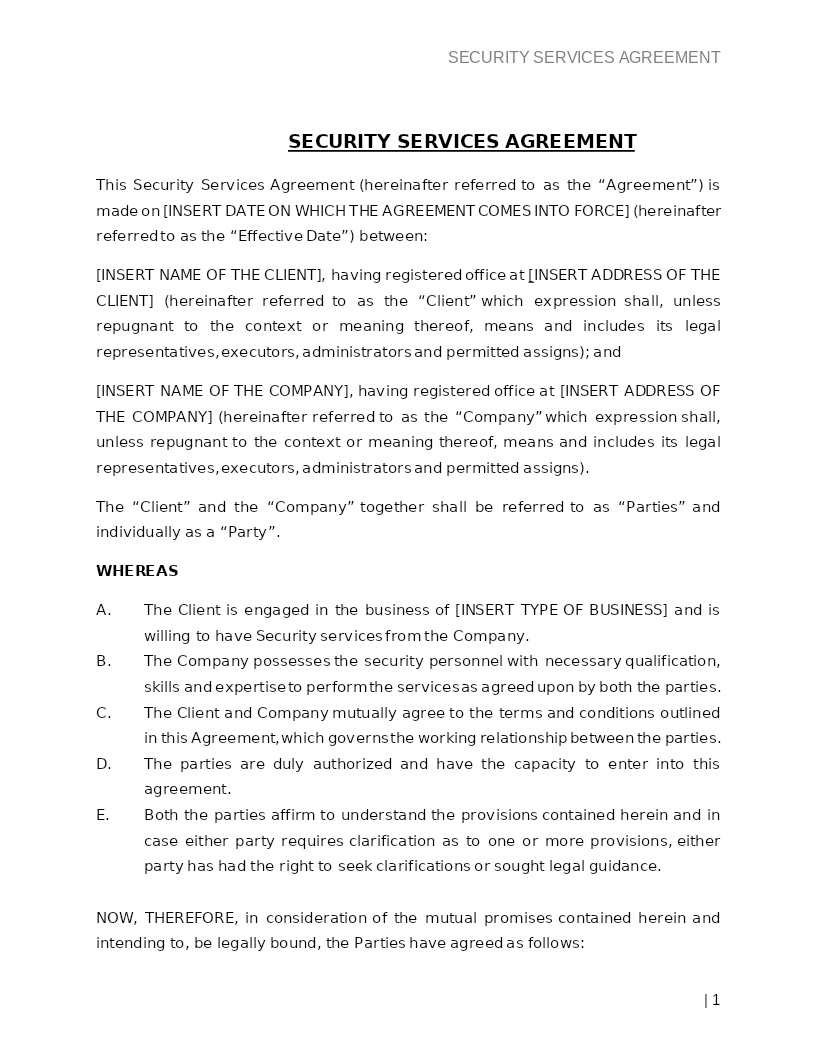
SECURITY SERVICES AGREEMENT
How does it work?
1. Choose this template
Start by clicking on "Fill out the template"
2. Complete the document
Answer a few questions and your document is created automatically.
3. Save - Print
Your document is ready! You will receive it in Word and PDF formats. You will be able to modify it.
Understanding Security Services Agreements
A Security Services Agreement is a legally binding contract between a business or property owner (the “Client”) and a licensed security services provider (the “Contractor”) outlining the terms under which security personnel, monitoring services, or safety operations will be provided. The agreement defines scope of security services, duties of officers, response protocols, equipment use, performance standards, liability limitations, confidentiality obligations, and compliance with U.S. security laws.
In the United States, Security Services Agreements are governed by state licensing laws for security companies, federal safety regulations, industry standards, private patrol operator rules, labor laws, and data protection requirements. These agreements help establish clear expectations, ensure professionalism, and protect both parties from risks associated with security operations.
Where Security Services Agreements Are Commonly Used
Security Services Agreements are widely used across commercial, residential, and institutional environments, including:
- Residential communities, HOAs, and gated properties
- Commercial buildings, offices, and shopping centers
- Warehouses, manufacturing facilities, and logistics centers
- Hospitals, schools, and educational institutions
- Hotels, event venues, and entertainment centers
- Construction sites and temporary project locations
- High-risk or high-traffic business environments
Any time an organization relies on a professional security provider, a Security Services Agreement ensures safety standards are upheld and legal responsibilities are clearly defined.
Different Types of Security Services You May Encounter
- On-Site Security Guards: Trained personnel stationed at a property to monitor and protect the premises.
- Mobile Patrol Services: Security team patrol multiple locations or large properties on a scheduled or on-demand basis.
- Event Security: Security services provided during concerts, conferences, corporate events, or public gatherings.
- Remote Monitoring & Surveillance: CCTV monitoring, alarm response, and digital surveillance services managed off-site.
- Armed or Unarmed Security Officers: Based on client needs, services may include licensed armed staff or unarmed safety personnel.
- Access Control & Screening Services: Managing entry points, visitor logs, ID checks, and security screening procedures.
When Legal Guidance Becomes Helpful
Legal review is recommended when:
- The project involves armed guards or weapons regulations
- The security provider handles sensitive data or surveillance footage
- The property is subject to special safety rules (e.g., healthcare or financial offices)
- The agreement includes complex liability, indemnity, or insurance requirements
- The contract covers multiple states with different licensing laws
- The Client needs clarity regarding performance expectations and emergency response obligations
- The security company uses subcontractors or third-party staffing
Legal guidance helps ensure the agreement complies with U.S. security regulations and sufficiently protects both parties.
How to Work with This Template
- Identify the Client and security service provider
- Define the scope of services, schedules, and staffing requirements
- Outline duties of security officers and reporting obligations
- Specify equipment and technology to be used (radios, vehicles, cameras, etc.)
- Address licensing requirements, training standards, and background checks
- Include confidentiality, data protection, and incident-reporting procedures
- Choose the governing state law
- Add liability limitations, insurance requirements, and indemnification clauses
- Set renewal terms, termination conditions, and service-level expectations
- Sign electronically or physically as allowed by U.S. contract laws
This template aligns with common U.S. security industry standards and is compatible with major electronic signature platforms.
Frequently Asked Questions
Q1. What is a Security Services Agreement and why is it important?
A Security Services Agreement outlines the terms under which a security provider delivers protection and monitoring services. It is important because it establishes clear expectations, ensures legal compliance, and protects both parties from liability in the event of incidents or disputes.
Q2. Are Security Services Agreements legally enforceable in the U.S.?
Yes. These agreements are enforceable under state contract law and must comply with state security licensing regulations. A well-written agreement helps prevent misunderstandings related to responsibilities, staffing, and emergency response.
Q3. What should be included in a Security Services Agreement?
A comprehensive agreement includes scope of duties, staffing schedules, response procedures, equipment use, confidentiality, insurance requirements, training standards, and liability limitations. These terms help ensure professional and reliable security services.
Q4. Do security guards need to be licensed?
Yes. Most U.S. states require security firms and personnel especially those carrying weapons, to hold valid state-issued licenses. The agreement may reference these requirements to ensure the Client receives legally compliant services.
Q5. Can a Security Services Agreement include surveillance or monitoring?
Absolutely. Many agreements include provisions for CCTV monitoring, alarm response, access control, and digital surveillance. These services must comply with privacy laws and data protection requirements.
Q6. Who is responsible if there is an incident or injury on the property?
Responsibility depends on the agreement. Typically, the security provider carries liability insurance and indemnifies the Client for negligent actions of its staff. Clear liability terms protect both parties and reduce risk exposure.
Q7. Can the agreement be terminated early?
Yes. Most agreements allow termination for reasons such as non-performance, breach of contract, safety concerns, or changes in business needs. Notice periods and termination procedures are detailed in the contract.
Q8. Are electronic signatures valid for Security Services Agreements?
Yes. Under the U.S. ESIGN Act, electronic signatures are legally enforceable. Most companies use digital signing platforms like Docu Sign for fast and secure contract execution.
Q9. Are subcontractors allowed under a Security Services Agreement?
They can be, but the agreement should specify whether subcontracting is permitted and ensure that all subcontractors meet licensing, training, and background-check requirements.
Q10. Is a Security Services Agreement suitable for small businesses?
Definitely. Small businesses frequently use security contracts to ensure safety, manage risks, and protect staff and customers. A written agreement ensures transparency and sets quality expectations for the security provider.