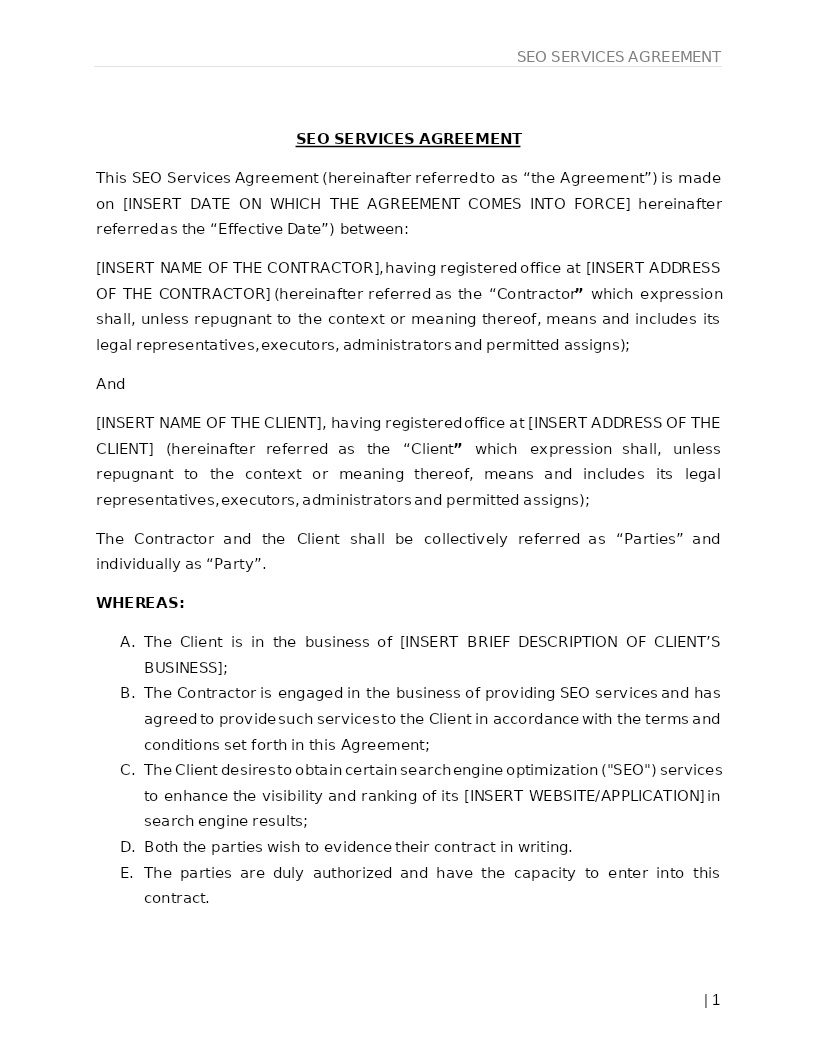
SEO SERVICES AGREEMENT
How does it work?
1. Choose this template
Start by clicking on "Fill out the template"
2. Complete the document
Answer a few questions and your document is created automatically.
3. Save - Print
Your document is ready! You will receive it in Word and PDF formats. You will be able to modify it.
Establishing Digital Marketing Obligations Through SEO Services Agreements
Businesses increasingly rely on search engine optimization (SEO) services to enhance online visibility, drive web traffic, and improve digital competitiveness. To ensure clarity of expectations, protect intellectual property, and mitigate compliance risks, the parties must formalize their engagement through a written SEO Services Agreement. This agreement defines the terms under which an SEO service provider performs optimization activities for the client, in accordance with U.S. contract law, data-privacy standards, Federal Trade Commission (FTC) advertising rules, electronic communications regulations, and applicable state and federal compliance requirements.
By entering into an SEO Services Agreement, both parties establish a comprehensive legal framework governing deliverables, keyword strategies, content obligations, backlink practices, reporting schedules, confidentiality duties, and payment terms. This agreement also outlines compliance parameters, ensuring that SEO practices adhere to ethical standards, search-engine guidelines, and legal restrictions on deceptive marketing practices. Through clear contractual terms, the parties can collaborate productively while safeguarding business interests and reducing the risk of regulatory violations or performance disputes.
Where SEO Services Agreements Are Commonly Used
SEO Services Agreements are utilized across diverse industries and digital platforms, including:
• E-commerce businesses seeking higher ranking and improved conversion rates
• Marketing agencies providing SEO, content optimization, or link-building services
• Startups and small businesses expanding digital presence and brand visibility
• Professional service firms improving online credibility and lead generation
• Enterprises coordinating multi-channel SEO, PPC, and digital marketing campaigns
• Content publishers aiming to enhance organic search performance
• Local businesses optimizing Google Business profiles and location-based rankings
• Companies integrating SEO with website redesigns or technical upgrades
Any business seeking skilled SEO support benefits from a formal agreement that governs the scope, responsibilities, and protections for both parties.
Different Types of SEO Services Agreements You May Encounter
1. Technical SEO Agreements: Focus on site performance, indexing, schema markup, crawlability, security, and structural optimization.
2. Content and On-Page SEO Agreements: Cover keyword research, content creation, metadata optimization, and editorial compliance.
3. Off-Page and Link-Building Agreements: Address outreach, backlink acquisition, reputation management, and authority enhancement.
4. Local SEO Agreements: Enhance local search visibility, map listings, reviews, and localized optimization.
5. Full-Service SEO or Retainer-Based Agreements: Provide ongoing SEO strategy, monthly reporting, multi-channel support, and continuous optimization.
When Legal Guidance Becomes Helpful
Legal review may be necessary when:
- The SEO provider engages in link-building or outreach that could raise compliance risks
- The contract includes performance guarantees that may be difficult to achieve
- The client handles consumer data subject to privacy laws such as CCPA, COPPA, or state equivalents
- The SEO relationship includes copyrighted content, proprietary systems, or licensing issues
- The parties negotiate complex compensation structures, bonuses, or revenue-sharing terms
- The agreement involves the transfer of domain names, analytics accounts, or digital assets
- FTC advertising and disclosure requirements impact content or influencer-related SEO
An attorney ensures the agreement is enforceable, compliant, and tailored to the digital marketing landscape.
How to Work with This Template
- Identify the SEO provider, client, and specific optimization services to be performed
- Outline project scope, timelines, content responsibilities, and reporting obligations
- Clarify ownership rights to content, data, metadata, and SEO deliverables
- Define acceptable SEO practices and prohibit black-hat tactics or deceptive strategies
- Establish performance metrics, analytical tools, and communication protocols
- Specify payment terms, milestones, renewal options, and termination rights
- Address confidentiality, data-security requirements, and access to web assets
- Ensure compliance with FTC rules, ISP terms, intellectual property laws, and privacy regulations
- Execute the agreement in writing or electronically under U.S. e-signature laws
This template reflects modern SEO industry practices and provides a legally sound foundation for digital marketing relationships.
Frequently Asked Questions
Q1. What is an SEO Services Agreement, and why is it important?
An SEO Services Agreement is a legally binding contract that outlines the terms under which an SEO provider performs optimization work for a client. It is important because it helps define project scope, prevents misuse of digital assets, ensures compliance with SEO best practices, and establishes clear expectations for performance and payment.
Q2. Do SEO Services Agreements guarantee specific rankings?
Most agreements avoid ranking guarantees due to the unpredictability of search engine algorithms. Instead, they focus on best-effort commitments, quality of work, and measurable performance indicators such as traffic growth or improved visibility.
Q3. Who owns the content created during SEO work?
Ownership depends on the contract. Many agreements state that content created by the SEO provider becomes the client’s property upon payment, while proprietary methodologies or templates may remain with the provider.
Q4. Are SEO tasks subject to FTC advertising rules?
Yes. FTC rules prohibit deceptive or misleading marketing practices. SEO content, endorsements, and influencer collaborations must be transparent and truthful.
Q5. Are electronic signatures valid for SEO Services Agreements?
Yes. Under the ESIGN Act, electronic signatures are fully enforceable for digital marketing and service agreements.
Q6. What happens if SEO involves collecting user data?
The agreement must ensure compliance with privacy laws such as CCPA, COPPA, and applicable state regulations. Data-handling responsibilities should be clearly defined.
Q7. Can an SEO provider subcontract part of the work?
Only if the agreement permits it. Subcontracting may require confidentiality assurances, approval rights, or compliance with the client’s brand guidelines.
Q8. How long does SEO work take to produce results?
SEO results typically require several months, depending on competition, site history, and strategy. The agreement may outline timeline expectations without making guaranteed promises.
Q9. What happens if the client terminates the agreement early?
Termination provisions govern whether fees are refundable, prorated, or due in full. Most SEO agreements allow termination with notice but require payment for completed work.
Q10. Does the agreement address prohibited SEO techniques?
Yes. A well-drafted SEO Services Agreement should prohibit black-hat tactics such as keyword stuffing, link farms, cloaking, or deceptive practices to protect both parties from search-engine penalties.