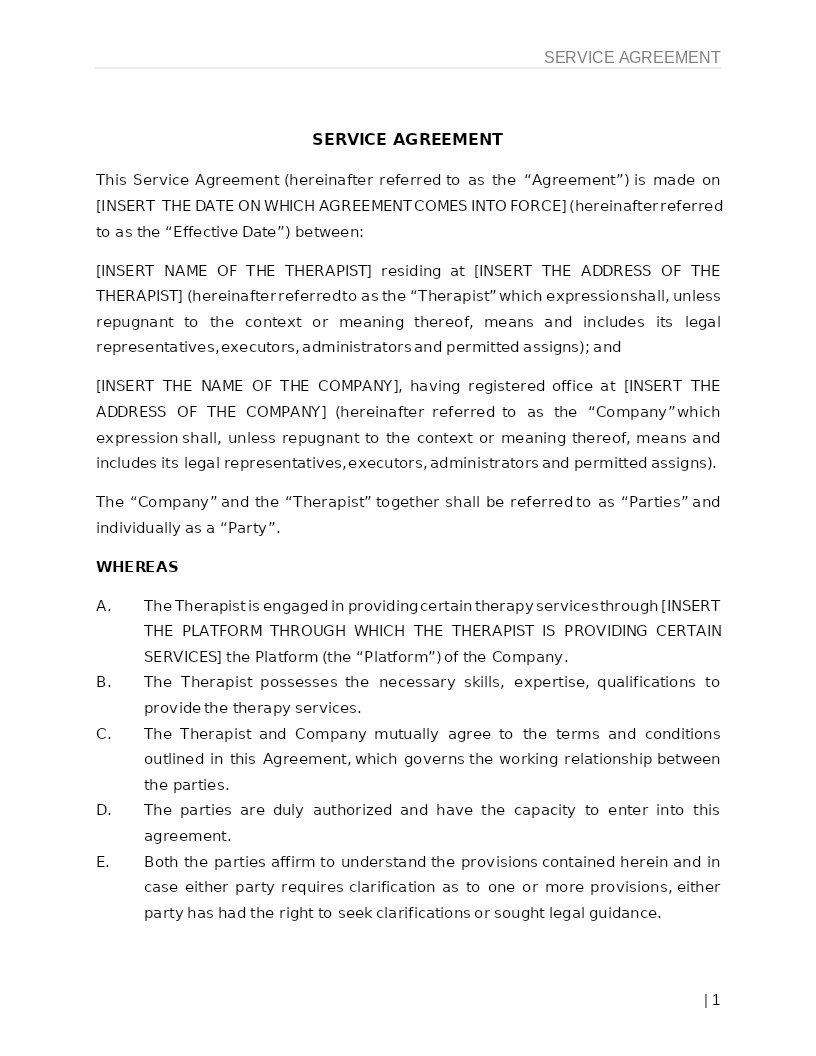
SERVICE AGREEMENT- THERAPIST
How does it work?
1. Choose this template
Start by clicking on "Fill out the template"
2. Complete the document
Answer a few questions and your document is created automatically.
3. Save - Print
Your document is ready! You will receive it in Word and PDF formats. You will be able to modify it.
Understanding Therapist Service Agreements
A Therapist Service Agreement is a legally binding contract that outlines the terms under which a licensed therapist, counselor, or mental health professional provides therapeutic services to a client. The agreement sets expectations for scope of treatment, confidentiality, fees, scheduling, communication boundaries, cancellations, and legal responsibilities.
In the United States, Therapist Service Agreements must comply with state mental health laws, HIPAA privacy regulations, informed consent requirements, telehealth statutes, and professional licensing standards. A clear written agreement helps establish trust, clarify boundaries, and ensure both the therapist and the client understand their rights and obligations throughout the therapeutic relationship.
Putting a Therapist Service Agreement in place protects both parties, promotes ethical practice, and provides a transparent foundation for a safe, supportive, and compliant therapeutic environment.
Where Therapist Service Agreements Are Commonly Used
Therapist agreements are standard across mental and behavioral health settings, including:
• Individual therapy sessions (in-person or telehealth)
• Couples, marriage, and relationship counseling
• Family therapy and group therapy settings
• Clinical psychologists, LCSWs, LMFTs, LPCs, and MSWs
• Trauma therapy, EMDR, CBT, DBT, and specialized modalities
• Mental health coaching with licensed practitioners
• E-therapy and online counseling platforms
• Employee wellness programs and corporate mental health services
Different Types of Therapist Agreements You May Encounter
- Individual Therapy Agreement: Covers one-on-one counseling for mental health, stress, trauma, or personal issues.
- Couples/Family Therapy Agreement: Defines expectations when multiple participants are involved in treatment.
- Teletherapy Agreement: Outlines online or virtual session procedures in compliance with state telehealth laws.
- Group Therapy Agreement: Sets rules for confidentiality and behavior in multi-client group settings.
- Clinical Supervision Agreement: Used between licensed therapists and interns or pre-licensed clinicians.
When Legal Guidance Becomes Helpful
Professional guidance can be useful when:
• Providing teletherapy across multiple U.S. states
• Working with high-risk clients or mandated reporting situations
• Handling minors, guardianship issues, or blended families
• Drafting HIPAA-compliant confidentiality and privacy terms
• Including late-fee, cancellation, or retainer provisions
• Using electronic health records or digital session notes
• Offering specialized treatment with added regulatory obligations
• Adding disclaimers for crisis situations or emergency contacts
How to Work with This Template
• Confirm the therapist’s licensed credentials and practice location
• Specify the scope of therapy services offered
• Define session frequency, duration, and communication boundaries
• Clearly outline payment terms, insurance rules, and cancellation policies
• Include HIPAA confidentiality language and informed consent details
• Select the governing U.S. state law
• Review expectations together (legal review is optional)
• Sign electronically or in person
Frequently Asked Questions
Q1. Why is a Therapist Service Agreement necessary?
A Therapist Service Agreement establishes clear expectations around treatment, confidentiality, scheduling, payments, communication boundaries, and responsibilities. It protects both the therapist and the client, and it supports a safe, ethical, and professional therapeutic relationship.
Q2. Does the agreement comply with U.S. mental health laws?
Yes. Therapist agreements follow state licensing rules, psychotherapy regulations, mandatory reporting laws, and HIPAA privacy requirements. Proper documentation ensures the therapist practices legally and ethically.
Q3. Does signing this agreement guarantee treatment outcomes?
No. Therapeutic progress varies from person to person. The agreement clarifies that therapy is a collaborative process and results cannot be guaranteed, which helps set realistic expectations.
Q4. What confidentiality protections does the agreement include?
The agreement includes HIPAA-compliant confidentiality terms, describing how personal information is stored, protected, and shared. It also explains exceptions, such as danger to self or others, court orders, and child-abuse reporting laws.
Q5. How are cancellations or missed sessions handled?
Short-notice cancellations, late arrivals, or no-shows are addressed in the agreement. Many therapists enforce a 24- or 48-hour cancellation policy and may charge a fee to maintain scheduling consistency and professional availability.
Q6. Does the agreement cover teletherapy sessions?
Yes. If the therapist offers remote sessions, the agreement includes telehealth requirements such as technology use, privacy expectations, location limits, and state licensing laws governing remote care.
Q7. Can clients use insurance for therapy sessions?
If the therapist accepts insurance, the agreement outlines billing practices, reimbursement procedures, and client obligations. If sessions are private-pay, the agreement provides clear fee and payment terms to avoid confusion.
Q8. Can the therapist terminate services?
Yes. Therapists may discontinue services ethically if treatment is no longer beneficial, if boundaries are violated, or if specialized care is needed. The agreement outlines the proper termination process and referral obligations.
Q9. Are minors allowed to participate in therapy under this agreement?
Yes, but additional rules apply. The agreement may require parental consent, clarify communication limits, and outline what information can be shared with guardians under state law.
Q10. Are electronic signatures valid for this type of agreement?
Yes. Under the U.S. ESIGN Act, electronic signatures are legally enforceable. Most therapists use digital platforms like Simple Practice, Doxy, or Doc Sign for secure signing and recordkeeping.