SERVICE LEVEL AGREEMENT
How does it work?
1. Choose this template
Start by clicking on "Fill out the template"
2. Complete the document
Answer a few questions and your document is created automatically.
3. Save - Print
Your document is ready! You will receive it in Word and PDF formats. You will be able to modify it.
Ensuring Accountability and Performance in Service Delivery
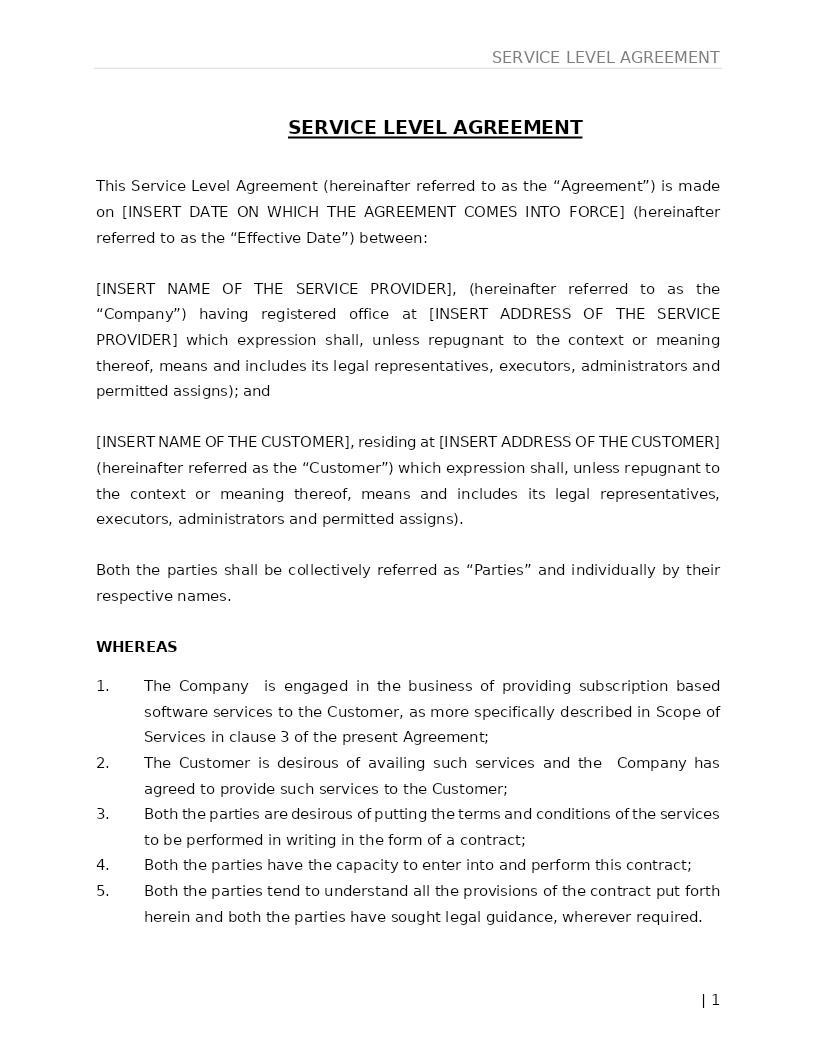
A Service Level Agreement (SLA) is a formal contract that outlines the specific level of service a provider must deliver to a client. It establishes measurable standards such as uptime, response time, support availability, and performance benchmarks to create clarity around what the client can expect on a day-to-day basis. An SLA protects the integrity of a service relationship by defining service quality, responsibilities, and remedies. By setting these expectations upfront, SLAs help both parties build a transparent and reliable working environment grounded in accountability.
Where Service Level Agreements Are Commonly Used
SLAs are widely used in industries where service reliability, speed, and technical precision are essential. They are common in IT support, cloud-hosting services, telecommunications, cybersecurity services, facility management, and outsourced operational functions. Businesses also rely on SLAs when engaging third-party vendors, software providers, or managed service teams to ensure that performance is clearly defined and consistently monitored. Any situation where continuous service delivery affects operations, productivity, or customer experience benefits significantly from a well-structured SLA.
Different Types of SLAs You May Encounter
- Service-Based SLAs define uniform performance standards for all clients receiving the same service—such as cloud storage uptime or tech support response times.
- Customer-Based SLAs set unique terms tailored for an individual client or organization, often used when service needs are specialized or mission-critical.
- Multi-Level SLAs break down commitments into layers, addressing enterprise-wide standards, department-specific obligations, and user-level expectations.
- Operational-Level Agreements (OLAs) work internally within an organization to support external SLAs, ensuring internal teams meet shared performance goals. Each type is structured to match the complexity and scale of the service relationship.
When Legal Guidance Becomes Helpful
Legal guidance is valuable when an SLA involves complex technical services, cross-border operations, regulated industries, or high-risk performance commitments. Lawyers help ensure that service metrics are realistic, enforceable, and aligned with federal or state laws, especially in sectors like healthcare, finance, education, or cybersecurity. They also assist in drafting remedies, escalation matrices, and liability limitations that hold up legally during performance failures. When multiple vendors, layered dependencies, or sensitive data are involved, legal review helps prevent loopholes and ensures the agreement truly protects the client’s operational continuity.
How to Work with This Template
Start by clearly identifying the service provider, the client, and the specific services that will be covered under the SLA. Define the purpose and scope of the service, including measurable standards like uptime percentages, response timelines, maintenance windows, and expected performance outcomes. Choose the governing state law and ensure that both parties understand how service failures will be handled, including credits, penalties, or dispute processes. Review the SLA together, ideally with legal consultation, to confirm that the terms reflect real-world operations. Once finalized, sign electronically or in hard copy to formalize the agreement.
Frequently Asked Questions
Q1. What is the main purpose of a Service Level Agreement?
The primary purpose of an SLA is to create a clear and enforceable understanding of the level of service a provider must deliver. It outlines performance expectations, response timelines, and the quality of support the client will receive. By documenting these commitments, the SLA minimizes uncertainty and creates a predictable working structure. This helps both parties maintain accountability and reduces the risk of service-related conflicts.
Q2. How does an SLA help prevent disputes between a client and service provider?
An SLA provides a detailed framework that outlines exactly what will happen if service standards are missed. Instead of relying on verbal assurances, the parties refer to measurable service metrics and agreed remedies. This clarity eliminates misunderstandings about responsibilities or expectations. As a result, disagreements are resolved more quickly and professionally because the contract already defines the steps to follow.
Q3. What happens if a service provider fails to meet the SLA standards?
If the provider falls short of their commitments, the SLA typically explains the consequences, which may include service credits, financial penalties, or required corrective actions. These remedies hold the provider accountable and ensure that issues are addressed promptly. Clear failure responses also help protect the client’s business continuity. In severe cases, repeated failures may even give the client the right to terminate the agreement.
Q4. Are SLAs only applicable to technology or IT services?
While commonly associated with IT and cloud services, SLAs are widely used in many other fields including logistics, facility management, customer support, telecom, and outsourced operations. Any service that requires consistent quality or timely performance can be governed by an SLA. Over time, they have become essential tools for any industry that depends on reliable service delivery and measurable performance outcomes.
Q5. Why is legal consultation recommended when drafting an SLA?
A lawyer helps ensure that the SLA is fair, enforceable, and fully aligned with industry regulations, especially in sectors with compliance requirements like HIPAA, GDPR, or financial oversight. They also help refine performance metrics, liability limits, and dispute resolution procedures to avoid loopholes. Legal guidance strengthens the contract by anticipating risks the parties may overlook on their own. This makes the agreement more protective and reliable in real-world scenarios.
Q6. Can an SLA be customized for a specific client or project?
Yes, SLAs can be tailored extensively to reflect the client’s unique operational needs, service priorities, and risk tolerance. A customized SLA may include specialized uptime guarantees, faster response times, enhanced support coverage, or project-specific deliverables. Customization ensures that the agreement fits the actual business environment rather than relying on generic terms. This leads to better performance and a more transparent partnership.
Q7. How often should an SLA be reviewed or updated?
SLAs should be reviewed periodically typically annually or whenever the service scope, technology, or business requirements change. Regular reviews ensure that the service levels remain realistic, competitive, and aligned with the client’s evolving needs. Updating the SLA also allows both parties to reflect improvements, new metrics, or additional services. This helps the agreement stay relevant and effective over time.