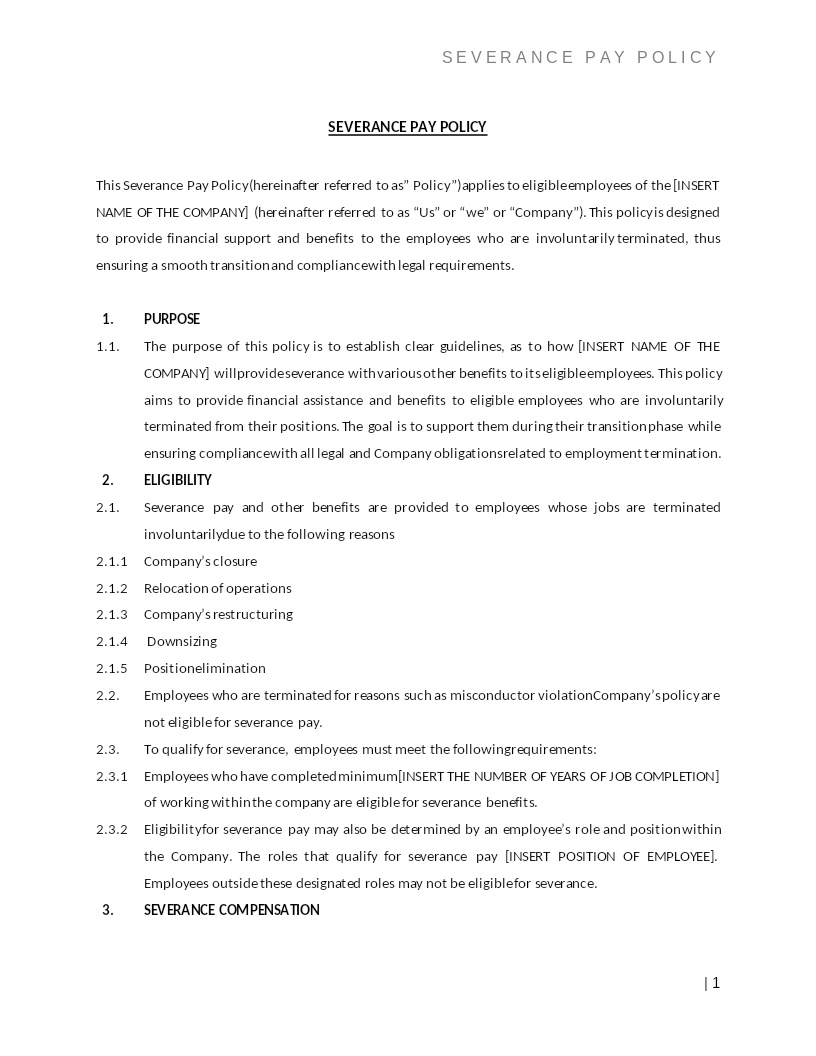
SEVERANCE PAY POLICY
How does it work?
1. Choose this template
Start by clicking on "Fill out the template"
2. Complete the document
Answer a few questions and your document is created automatically.
3. Save - Print
Your document is ready! You will receive it in Word and PDF formats. You will be able to modify it.
Establishing Clear Compensation Obligations Through a Severance Pay Policy
When an employment relationship ends, employers may offer severance pay to assist employees during the transition and to limit future disputes. A Severance Pay Policy serves as a formal statement of an organization’s guidelines for providing financial compensation, benefits continuation, and transitional assistance upon an employee’s separation from employment. Such a policy outlines eligibility, calculation methods, payment procedures, and conditions for receiving severance, all in accordance with U.S. employment law, wage-payment rules, federal regulations, ERISA considerations, and applicable state requirements.
A Severance Pay Policy ensures consistency, fairness, and transparency by describing when severance will be offered, how it is calculated, and what obligations employees must fulfill to receive it. This written policy protects both the employer and employee by establishing predictable standards, minimizing legal risk, and addressing important matters such as benefits continuation, release of claims, return-of-property requirements, and timelines for payment. It supports compliance with federal and state laws while promoting professional separation practices.
Where Severance Pay Policies Are Commonly Used
Severance Pay Policies are widely adopted in diverse employment settings, including:
- Corporate workplaces implementing reductions-in-force or restructuring
- Organizations offering severance after layoffs, downsizing, or job eliminations
- Companies seeking to manage employee transitions during mergers or acquisitions
- Employers offering voluntary separation packages
- Workplaces establishing uniform procedures for non-disciplinary terminations
- Businesses implementing severance as part of their employee compensation strategy
- Human resources departments handling separation agreements and release forms
- Employers seeking to avoid inconsistent or discretionary severance practices
A Severance Pay Policy provides clarity and legal protection whenever an employee’s service ends involuntarily or through negotiated separation.
Different Types of Severance Pay Policies You May Encounter
1. Standard Severance Pay Policies: Provide a predetermined formula based on years of service, pay level, or employment classification.
2. Enhanced Severance or Voluntary Separation Policies: Offer additional compensation during organizational restructuring or downsizing events.
3. Executive Severance Policies: Cover high-level employees and typically include additional benefits, extended salary continuations, and restrictive covenants.
4. Performance- or Position-Based Policies: Tailor severance eligibility to specific roles, business units, or contractual conditions.
5. Severance Linked to Release of Claims Policies: Condition payment on the employee signing a legally compliant general release or separation agreement.
When Legal Guidance Becomes Helpful
Legal review is advisable when:
- The severance policy interacts with federal laws such as the Age Discrimination in Employment Act (ADEA)
- Employers require a release of claims, which must meet strict statutory language
- The policy affects health benefits governed by COBRA continuation requirements
- Executive severance implicates ERISA, Section 409A, or compensation restrictions
- State wage-payment laws impose deadlines for final compensation
- The policy must align with collective-bargaining agreements or employment contracts
- Severance eligibility overlaps with protected categories, leave laws, or discrimination concerns
Legal counsel helps ensure the policy is enforceable, compliant, and tailored to the organization’s operational needs.
How to Work with This Template
- Identify eligibility categories, such as full-time employees or individuals involuntarily terminated
- Define the formula used to calculate severance pay (e.g., weeks per year of service)
- Specify payment timing, method (lump-sum or periodic), and payroll tax treatment
- Describe benefit continuation options, including healthcare and COBRA compliance
- Clarify any conditions for receiving severance, such as signing a release of claims
- Outline return-of-company-property and confidentiality requirements
- Address rehire eligibility, non-disparagement clauses, and dispute-resolution processes
- Update the policy to reflect changes in federal or state employment laws
- Have the policy reviewed, approved, and communicated through HR channels
This template aligns with widely accepted U.S. employment practices and is suitable for corporate HR teams, small businesses, and organizations seeking standardized separation procedures.
Frequently Asked Questions
Q1. What is a Severance Pay Policy, and why is it important?
A Severance Pay Policy is a written document that outlines the circumstances under which employees receive severance pay upon separation from employment. It is important because it establishes consistency, protects employers from legal risk, and helps employees transition financially.
Q2. Are employers legally required to provide severance pay in the U.S.?
Generally, no. U.S. employers are not required to offer severance unless mandated by company policy, employment contracts, or collective-bargaining agreements.
Q3. How is severance pay typically calculated?
Severance is often based on years of service, such as one or two weeks of pay per year employed. Executive severance may involve enhanced formulas or additional benefits.
Q4. Does severance require signing a release of claims?
Most employers condition severance payments on the employee signing a legally compliant release of claims. This protects the employer from lawsuits following separation.
Q5. Are severance payments taxable?
Yes. Severance is considered taxable income and must be processed through payroll with proper withholding.
Q6. Does the policy address continuation of health benefits?
Yes. Many severance policies incorporate COBRA requirements, allowing employees to continue health coverage at their own or employer-subsidized cost.
Q7. Are electronic signatures valid for severance-related documents?
Yes. Under the ESIGN Act, electronic signatures are legally enforceable for separation agreements and related documents.
Q8. Can employers modify or terminate a severance pay policy?
Yes. Employers may revise or discontinue severance policies, but changes should not violate contractual commitments or discriminatory practices.
Q9. Does severance affect unemployment benefits?
Possibly. Some states delay or reduce unemployment eligibility if severance is paid as a continuation of salary. The employee should consult state rules.
Q10. Should employees seek legal advice before signing a severance agreement?
Yes. Because a release of claims is typically required, legal review ensures that employees understand the rights they are waiving and the terms they are accepting.