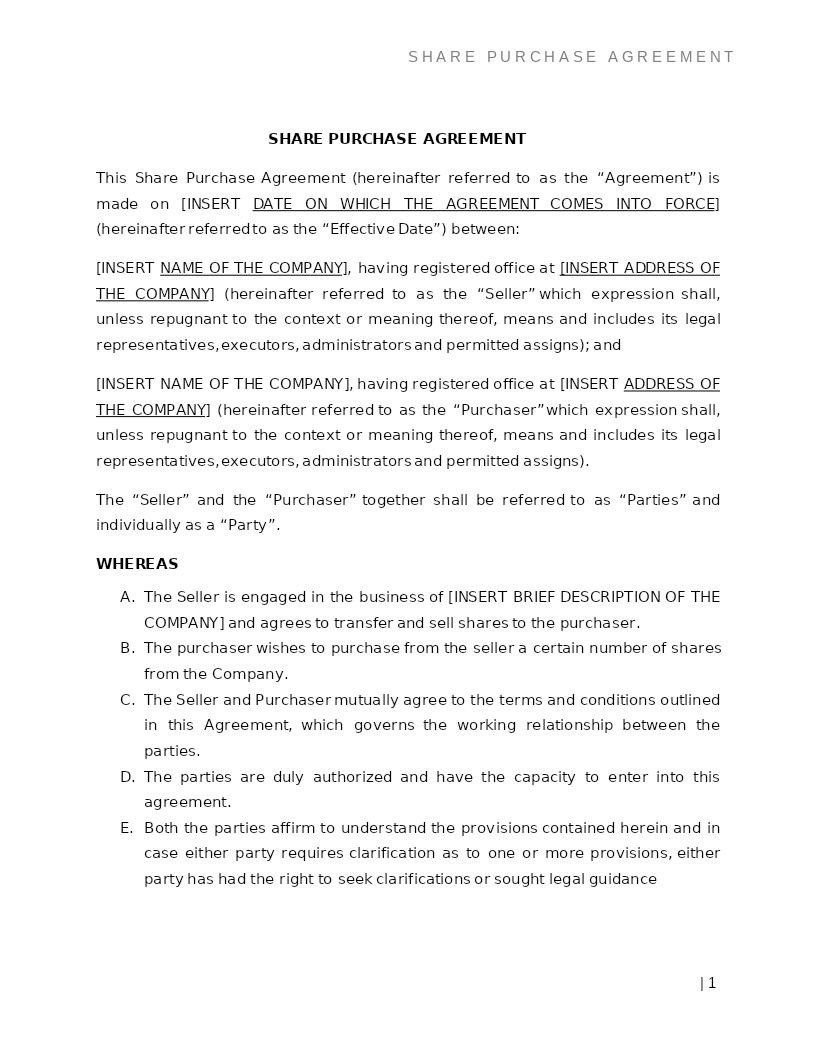
SHARE PURCHASE AGREEMENT
How does it work?
1. Choose this template
Start by clicking on "Fill out the template"
2. Complete the document
Answer a few questions and your document is created automatically.
3. Save - Print
Your document is ready! You will receive it in Word and PDF formats. You will be able to modify it.
Formalizing Equity Transfers and Investor Rights Through a Share Purchase Agreement
A Share Purchase Agreement is a legally binding transactional document that governs the sale, transfer, and acquisition of shares in a corporation. Prepared in accordance with U.S. federal securities laws, state corporate statutes, due-diligence obligations, and common transactional practices, this agreement sets forth the essential terms under which a buyer acquires ownership interests from a seller. It defines the representations, warranties, covenants, purchase conditions, and closing obligations necessary to complete an enforceable share transfer.
A comprehensive Share Purchase Agreement addresses the economic structure of the transaction, including purchase price, payment terms, prorations, closing adjustments, escrow arrangements, and post-closing obligations. It also includes extensive legal protections for both parties, such as representations concerning corporate authority, financial statements, tax compliance, capitalization tables, intellectual property rights, liabilities, and litigation risks. By executing this agreement, both parties memorialize their obligations, reduce transactional uncertainty, and ensure compliance with relevant U.S. regulations governing the lawful transfer of corporate equity.
Where Share Purchase Agreements Are Commonly Used
Share Purchase Agreements are utilized in a wide range of business and investment scenarios, including:
- Acquisitions involving privately held companies or startups
- Venture-capital and angel-investment transactions requiring equity transfers
- Buyouts of minority or majority shareholders
- Transfers of ownership interest between founders, partners, or family members
- Mergers, restructuring, or recapitalization activities
- Corporate governance changes necessitating shareholder reallocation
- Strategic business purchases involving intellectual property or operational transfer
- Cross-border investor arrangements requiring compliance with U.S. securities laws
Wherever corporate ownership interests are transferred, a Share Purchase Agreement ensures clarity, legal compliance, and enforceable rights.
Different Types of Share Purchase Agreements You May Encounter
1. Private Company Share Purchase Agreements: Governs the transfer of privately held shares, often involving extensive due diligence.
2. Public-Company Share Purchase Agreements: Used for regulated transactions subject to SEC filing, disclosure, and compliance requirements.
3. Founder or Internal Share Purchase Agreements: Address transfers between founders, partners, or employees within a closely held corporation.
4. Minority/Controlling Stake Purchase Agreements: Specify rights, protections, and governance requirements for minority or majority investments.
5. Cross-Border or International Share Purchase Agreements: Require compliance with foreign-investment rules, export controls, and federal securities laws.
When Legal Guidance Becomes Helpful
Legal counsel is essential when:
- The transaction involves large-scale investment or ownership transfer
- Federal securities laws (e.g., Securities Act of 1933, Exchange Act of 1934) apply
- The company has outstanding liabilities, tax exposure, or complex financial statements
- Intellectual property, employment contracts, or licensing rights are material to the transaction
- Multi-party negotiations, escrow requirements, or earn-out provisions are involved
- The buyer or seller requires indemnification against future claims
- The corporation operates in a regulated industry (finance, healthcare, tech, energy, etc.)
- Transaction documents must satisfy state corporate formalities, board approvals, and shareholder consents
Legal review ensures full compliance with U.S. corporate, tax, and securities regulations.
How to Work with This Template
• Identify the parties, including the buyer, seller, and issuing corporation
• Define the number of shares being transferred, class of shares, and purchase price
• Include representations and warranties confirming corporate authority, valid issuance, financial accuracy, tax compliance, and absence of undisclosed liabilities
• Establish the closing conditions, including required consents, resolutions, and regulatory approvals
• Explain the payment arrangements cash, escrow, installment, or equity consideration
• Detail indemnification rights, survival periods, dispute-resolution procedures, and governing law
• Address post-closing obligations such as transition assistance, confidentiality, or non-compete restrictions
• Integrate compliance with U.S. e-signature laws for electronic execution
• Maintain all supporting documentation as part of the official corporate records
This template follows widely accepted U.S. transactional standards and is suitable for buyers, sellers, investors, founders, and corporate entities.
Frequently Asked Questions
Q1. What is a Share Purchase Agreement, and why is it important?
A Share Purchase Agreement is a contract documenting the sale and transfer of corporate shares. It is important because it legally defines the transaction terms, protects both parties from risk, and ensures compliance with U.S. securities and corporate laws.
Q2. Is a Share Purchase Agreement required for every share sale?
While small internal transfers may be informal, a written agreement is strongly recommended, especially for significant or regulated transactions.
Q3. Does the agreement need to comply with federal securities regulations?
Yes. Most share transfers are subject to some level of federal or state securities regulation, even for private-company shares.
Q4. What due diligence is typically required?
Due diligence may include review of financial records, corporate documents, capitalization tables, litigation matters, intellectual property, tax filings, and employment obligations.
Q5. Can shares be transferred electronically?
Yes. Many corporations maintain electronic share ledgers, and transfers can occur digitally in accordance with state corporate statutes and company bylaws.
Q6. What is the difference between a Share Purchase Agreement and a Stock Purchase Agreement?
In practice, the terms are often used interchangeably, though “stock” is more common for corporations and “shares” for broader equity designations.
Q7. Does the buyer assume company liabilities when purchasing shares?
Generally, yes, because buying shares means acquiring ownership of the entity—including its assets and liabilities—unless indemnified otherwise.
Q8. Can a Share Purchase Agreement include non-compete or confidentiality provisions?
Yes. These are commonly included to protect business value post-transaction.
Q9. Do minority shareholders need special protections?
Often, yes. Rights such as tag-along, drag-along, and information rights may be included in the agreement or related shareholder documents.
Q10. Should legal counsel review a Share Purchase Agreement?
Absolutely. Because these transactions affect corporate ownership, legal review is essential to prevent regulatory violations, hidden liabilities, or unenforceable terms.