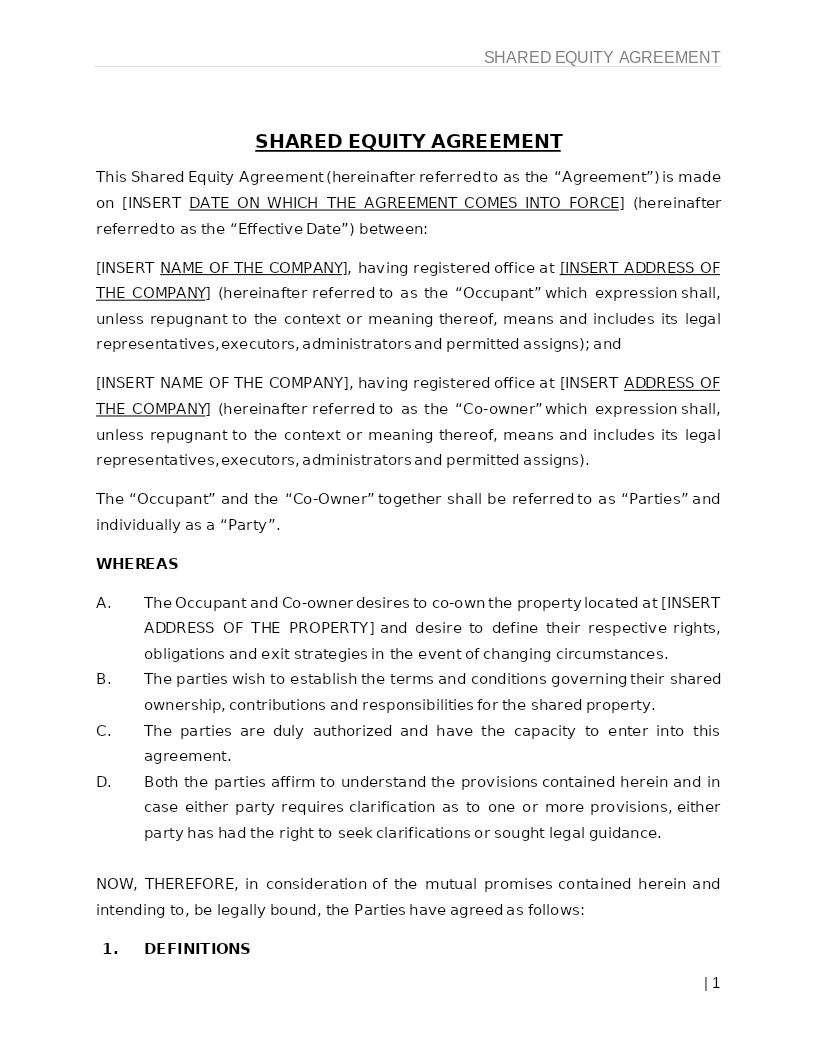
SHARED EQUITY AGREEMENT
How does it work?
1. Choose this template
Start by clicking on "Fill out the template"
2. Complete the document
Answer a few questions and your document is created automatically.
3. Save - Print
Your document is ready! You will receive it in Word and PDF formats. You will be able to modify it.
Understanding Shared Equity Agreements
A Shared Equity Agreement is a legally binding contract between two or more parties who jointly invest in and share ownership of a property or asset. These agreements define each party’s financial contributions, ownership percentages, rights, obligations, maintenance responsibilities, and profit-sharing structure when the property is sold or refinanced.
In the United States, Shared Equity Agreements are governed by state contract law, real estate ownership rules, property financing regulations, federal tax laws, and housing compliance standards. They are commonly used when multiple parties such as co-buyers, family members, investors, or housing programs collaborate to purchase a home or asset without relying solely on traditional lending.
This agreement protects all parties by clearly outlining how equity is shared, how decisions are made, and how proceeds or losses will be divided.
Where Shared Equity Agreements Are Commonly Used
Shared Equity Agreements are commonly used in real estate and investment arrangements, including:
- First-time homebuyers partnering with investors or family members
- Friends or relatives purchasing property together
- Real estate investors co-owning rental properties
- Affordable housing programs offering shared equity homeownership
- Private equity investors supporting buyers in exchange for profit participation
- Businesses purchasing commercial assets with shared ownership
- Homeowners using shared equity financing to access equity without taking on debt
Any time multiple parties jointly own and invest in real estate or other high-value assets, a Shared Equity Agreement ensures fairness, clarity, and legal protection.
Different Types of Shared Equity Arrangements You May Encounter
- Co-Investment Agreements: Two parties contribute funds to purchase a property and share ownership proportionally.
- Equity Sharing for Homebuyers: An investor provides a portion of the down payment in exchange for equity appreciation.
- Family Shared Equity Agreements: Family members jointly invest in property for shared living or long-term ownership goals.
- Shared Appreciation Agreements: One party provides capital, and the other provides occupancy or management, sharing future appreciation gains.
- Investor–Homeowner Partnerships: Used when investors help buyers qualify for a home in exchange for a share of future profits.
When Legal Guidance Becomes Helpful
Legal review is especially beneficial when:
- The agreement involves large financial contributions or uneven ownership stakes
- Parties want a clear process for selling, refinancing, or exiting the investment
- There are concerns about property taxes, capital gains, or IRS reporting
- The property will be rented, renovated, or used as an investment
- The agreement includes occupancy rights, maintenance duties, or cost-sharing
- Parties need guidance on transferring ownership or handling disputes
- The arrangement must comply with state real estate laws and lending rules
Because real estate and equity ownership rules vary by state, legal guidance ensures long-term protection and enforceability.
How to Work with This Template
- Identify the parties entering into the shared equity arrangement
- Define each party’s financial contribution and ownership percentage
- Clarify occupancy rights, maintenance responsibilities, and decision-making procedures
- Outline how expenses (taxes, insurance, repairs) will be shared
- Establish rules for selling, refinancing, or transferring ownership
- Include profit-sharing or appreciation-sharing terms
- Choose the governing U.S. state law
- Add dispute resolution, termination conditions, and exit strategies
- Sign electronically or in hard copy following state requirements
This template follows standard U.S. real estate and investment practices and is compatible with common e-signature platforms.
Frequently Asked Questions
Q1. What is a Shared Equity Agreement and why is it used?
A Shared Equity Agreement outlines how two or more parties jointly invest in and share ownership of a property. It is used to make homeownership or investment more affordable and accessible while clearly defining each party’s financial contributions and rights.
Q2. Is a Shared Equity Agreement legally enforceable in the U.S.?
Yes. These agreements are enforceable under state contract and real estate laws. A clear, written agreement helps protect all parties by defining ownership percentages, profit-sharing, and rules for managing or selling the property.
Q3. How is ownership divided in a Shared Equity Agreement?
Ownership is usually divided based on each party’s financial contribution, but parties may agree to any percentage split. The agreement documents these percentages and explains how proceeds or losses will be handled upon sale.
Q4. Can one party live in the property while the other invests?
Yes. Many agreements allow one party to occupy the property while the other contributes funding. The agreement outlines occupancy rights, responsibilities, and how appreciation will be shared in the future.
Q5. What happens when the property is sold?
When the property is sold, profits or losses are divided based on the ownership percentages set in the agreement. Some arrangements also include shared appreciation clauses, investor returns, or repayment schedules.
Q6. Does a Shared Equity Agreement affect taxes?
It can. Parties may need to consider capital gains tax, property tax obligations, and IRS reporting requirements. It is recommended to consult a tax professional to understand the financial implications.
Q7. Can Shared Equity Agreements be used for investment properties?
Absolutely. Investors often use shared equity structures to co-own rental properties, split rental income, and share expenses. The agreement outlines how profits, losses, and responsibilities are distributed.
Q8. Can the agreement be terminated early?
Yes. Most agreements include exit strategies such as buyouts, refinancing, sale options, or mutual termination. Clear termination terms help prevent disputes and protect each party’s investment.
Q9. Are electronic signatures valid for Shared Equity Agreements?
Yes. Under the U.S. ESIGN Act, electronic signatures are legally enforceable. Parties commonly use platforms like Docu Sign for real estate and investment agreements.
Q10. Is a Shared Equity Agreement suitable for first-time homebuyers?
Definitely. Many first-time buyers use shared equity financing to afford a home with the help of investors or family members. It reduces upfront costs and allows buyers to share future property appreciation instead of taking on traditional debt.