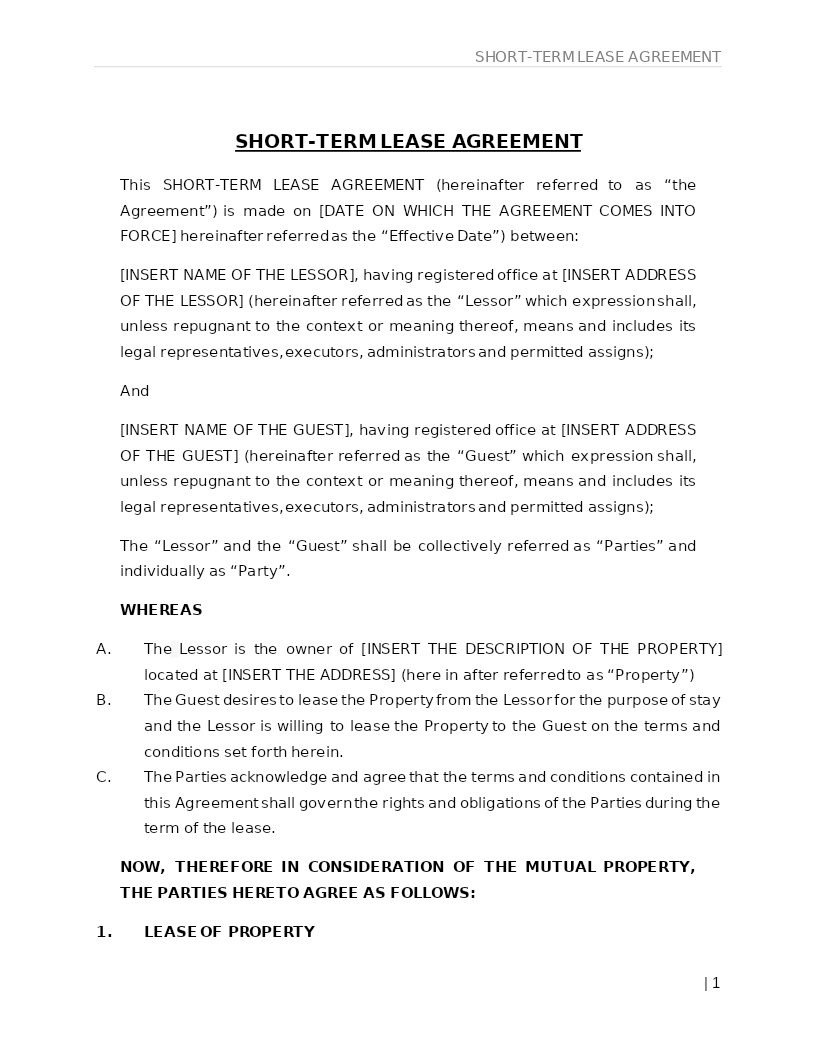
SHORT-TERM LEASE AGREEMENT
How does it work?
1. Choose this template
Start by clicking on "Fill out the template"
2. Complete the document
Answer a few questions and your document is created automatically.
3. Save - Print
Your document is ready! You will receive it in Word and PDF formats. You will be able to modify it.
Understanding Short-Term Lease Agreements
A Short-Term Lease Agreement is a legally binding contract that outlines the rental terms between a landlord (the “Lessor”) and a tenant (the “Lessee”) for a temporary rental period, typically ranging from a few days to several months. Unlike long-term residential leases, short-term leases offer flexibility, simplified terms, and limited commitments, making them ideal for vacation rentals, temporary housing, business travel, or transitional living.
In the United States, Short-Term Lease Agreements operate under state landlord-tenant laws, local housing regulations, safety requirements, and consumer protection standards. This agreement clarifies expectations related to payment, occupancy, property use, maintenance obligations, deposits, and termination, ensuring both parties are protected during the rental period.
Where Short-Term Lease Agreements Are Commonly Used
Short-Term Lease Agreements are widely used in residential and commercial scenarios, including:
- Vacation homes, Airbnb, and short-stay rentals
- Corporate housing or temporary employee accommodation
- Student housing for short academic terms
- Transitional housing during relocation or renovation
- Subleases and room rentals
- Furnished apartments for business travel
- Seasonal rentals in coastal or resort areas
Any time a property is rented for a limited duration, a Short-Term Lease Agreement provides clarity and legal protection.
Different Types of Short-Term Leases You May Encounter
- Nightly or Weekly Rentals: Ideal for vacation stays, tourism, or travel accommodations.
- Monthly or Multi-Month Leases: Common for students, professionals on assignment, or relocation housing.
- Furnished Rentals: Include furniture, appliances, and household items for temporary living.
- Corporate or Executive Rentals: Designed for business travelers who need comfort and flexibility.
- Seasonal Rentals: Used for summer homes, winter cabins, beach houses, or other seasonal properties.
When Legal Guidance Becomes Helpful
Legal review is recommended when:
- The rental involves local permitting, occupancy limits, or zoning rules
- The property is used as a vacation rental requiring tax compliance
- Insurance coverage and liability protections must be clarified
- The rental involves furnished property or valuable items
- The agreement includes security deposits, cleaning fees, or damage assessments
- The lease is part of a commercial or corporate housing arrangement
- The landlord wants clarity on cancellation or early termination rules
Legal guidance helps ensure compliance with state and local laws while protecting both the landlord and tenant.
How to Work with This Template
- Identify the landlord and tenant details
- Describe the property, including furnishings and included amenities
- Specify the lease duration, check-in/check-out dates, and renewal terms
- Outline rent amount, payment schedule, deposits, and additional fees
- Include house rules, occupancy limits, and maintenance responsibilities
- Add liability, safety, and insurance requirements
- Choose the governing U.S. state law
- Include cancellation, refund, and termination policies
- Sign electronically or in hard copy following state requirements
This template follows standard U.S. short-term rental practices and works well with most e-signature platforms.
Frequently Asked Questions
Q1. What is a Short-Term Lease Agreement and when is it used?
A Short-Term Lease Agreement is a rental contract for a temporary stay, typically shorter than 12 months. It is used for vacation rentals, corporate housing, temporary relocations, or any situation where long-term leasing is not necessary.
Q2. Are Short-Term Lease Agreements legally enforceable in the U.S.?
Yes. These agreements are enforceable under state landlord-tenant laws. A written short-term lease ensures that both parties understand the rental terms, obligations, fees, and property rules.
Q3. What should be included in a Short-Term Lease Agreement?
A well-structured agreement includes rental dates, payment terms, deposits, property rules, maintenance responsibilities, cancellation policies, and liability clauses. This helps avoid disputes and ensures a hassle-free rental experience.
Q4. Do tenants need to pay a security deposit for a short-term rental?
Often, yes. Landlords typically require a security deposit to cover potential damage, cleaning, or unpaid rent. The agreement will specify the deposit amount, refund conditions, and inspection process.
Q5. Can a Short-Term Lease Agreement include furnished property?
Absolutely. Many short-term rentals are fully furnished. The agreement may include an inventory list, condition report, or terms for using provided furniture and household items.
Q6. Are utilities included in a short-term rental?
This varies. Some short-term leases include utilities such as electricity, water, Wi-Fi, and trash services, while others require tenants to pay separately. Terms should be clearly stated in the agreement.
Q7. Can the tenant cancel the short-term lease early?
Cancellation policies depend on the agreement. Some short-term leases allow early termination with fees, while others may offer flexible refund terms. Clear cancellation rules help avoid misunderstandings.
Q8. Is subleasing allowed under a short-term lease?
Usually not, unless explicitly permitted. Most landlords restrict subleasing to maintain control over who occupies the property. If allowed, conditions should be clearly specified.
Q9. Are electronic signatures valid for Short-Term Lease Agreements?
Yes. Under the U.S. ESIGN Act, electronic signatures are legally valid and commonly used for rental contracts, especially for vacation or online bookings.
Q10. Is a Short-Term Lease Agreement suitable for Airbnb or vacation rentals?
Definitely. Short-Term Lease Agreements ensure that hosts and guests understand expectations, protect property owners from misuse, and outline important terms like house rules, deposits, and liability protections.