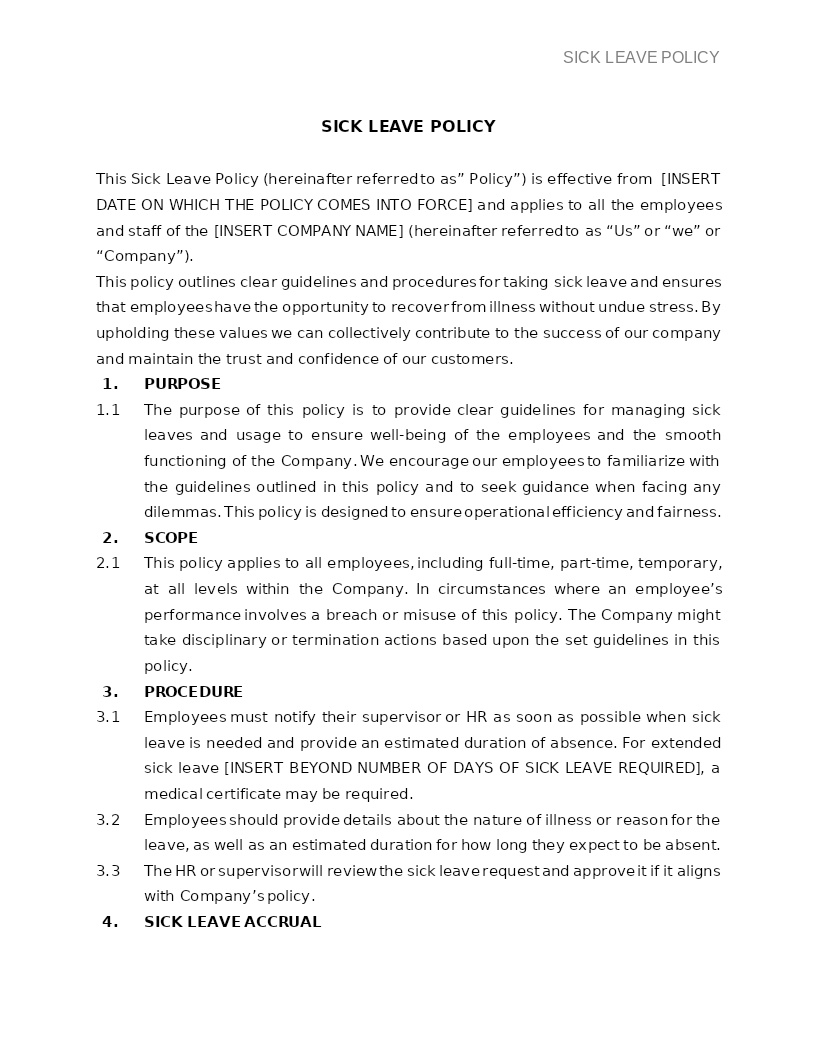
SICK LEAVE POLICY
How does it work?
1. Choose this template
Start by clicking on "Fill out the template"
2. Complete the document
Answer a few questions and your document is created automatically.
3. Save - Print
Your document is ready! You will receive it in Word and PDF formats. You will be able to modify it.
Supporting Employee Well-Being and Workplace Continuity
A Sick Leave Policy provides a clear framework that guides how employees may take time off when they are ill, injured, or need medical care. It helps ensure fairness, transparency, and compliance with applicable U.S. laws such as the Family and Medical Leave Act (FMLA), state paid sick leave statutes, and workplace safety obligations. By defining how sick leave can be used, how it should be reported, and what documentation may be required, the policy protects both employees and the organization.
A well-structured Sick Leave Policy promotes a healthy work environment, reduces the spread of illness, and supports business continuity by setting clear expectations for all team members.
Where Sick Leave Policies Are Commonly Used
Sick Leave Policies are standard in nearly every employment setting, including:
• Corporate offices, professional services, and administrative workplaces
• Healthcare facilities, clinics, and care organizations
• Retail businesses, hospitality operations, and customer-facing environments
• Manufacturing plants, warehouses, and production facilities
• Remote and hybrid work arrangements
• Nonprofits, educational institutions, and government organizations
Different Types of Sick Leave Policies You May Encounter
- Paid Sick Leave Policies: Employees receive compensation during medical absences.
- Unpaid Sick Leave Policies: Leave time is permitted but not compensated, often used when required by law or when paid leave is not available.
- Short-Term Sick Leave: Used for minor illnesses and short medical appointments.
- Long-Term Sick Leave / Medical Leave: Covers extended absences due to serious health conditions; often coordinated with FMLA.
- Flexible or Unlimited Sick Leave: Employees take time off as needed without strict caps, common in modern workplaces.
When Legal Guidance Becomes Helpful
Legal review is beneficial when:
• The business operates in a state with specific paid sick leave laws
• The policy interacts with federal regulations such as FMLA or ADA
• Employees work across multiple states with varying sick leave requirements
• The employer wants to combine sick leave with PTO or wellness programs
• The policy includes disciplinary action for misuse
• Medical documentation, privacy protections, and HIPAA concerns arise
How to Work with This Template
• Customize eligibility rules for full-time, part-time, and temporary employees
• Specify how sick leave is accrued, carried over, or paid out
• Define acceptable uses of sick leave, such as personal illness or medical appointments
• Set expectations for reporting absences and providing documentation
• Choose the governing U.S. state law
• Ensure confidentiality when handling medical information
• Provide employees with clear access to the policy
• Enable electronic or written acknowledgment
Frequently Asked Questions
Q1. Why does my workplace need a Sick Leave Policy?
A Sick Leave Policy ensures employees understand their rights when they are ill and helps employers maintain productivity and compliance. It encourages transparency, reduces confusion, and promotes a healthy work environment by discouraging employees from working while sick.
Q2. Is sick leave required by law in the United States?
It depends on the state. Several states and cities mandate paid sick leave, while federal law (FMLA) provides job-protected unpaid leave for serious health conditions. A policy helps align company practices with all applicable legal requirements.
Q3. What can employees use sick leave for?
Sick leave can be used for personal illness, injury, medical appointments, recovery time, or mental health care. Many policies also allow sick leave to care for an immediate family member, depending on state laws and employer guidelines.
Q4. Do employees need a doctor’s note?
Some employers require medical documentation for extended absences or if misuse is suspected. A policy outlines when documentation is required to keep standards fair and consistent.
Q5. How is sick leave accrued?
Accrual can be hourly, monthly, or annual depending on the employer’s structure and state laws. The policy clearly explains how much leave employees earn and when they can start using it.
Q6. Can unused sick leave be carried over to the next year?
Many organizations allow carryover to comply with state requirements, while others may cap the amount of unused leave. The policy specifies carryover rules so employees can plan ahead.
Q7. Are remote workers covered under the Sick Leave Policy?
Yes. Remote and hybrid employees are typically covered under the same policy as on-site staff, though reporting or documentation procedures may differ.
Q8. Can employees take sick leave for mental health reasons?
Yes. Most modern Sick Leave Policies treat mental health the same as physical health, allowing leave for therapy, treatment, burnout recovery, or mental health conditions.
Q9. What happens if an employee repeatedly misuses sick leave?
A policy may outline disciplinary steps, such as counseling or corrective action. Clear expectations help prevent conflict while ensuring fair treatment for all employees.
Q10. Is sick leave paid out when employment ends?
In most states, employers are not required to pay out unused sick leave unless company policy states otherwise. The policy clarifies payout rules to avoid misunderstandings during offboarding.