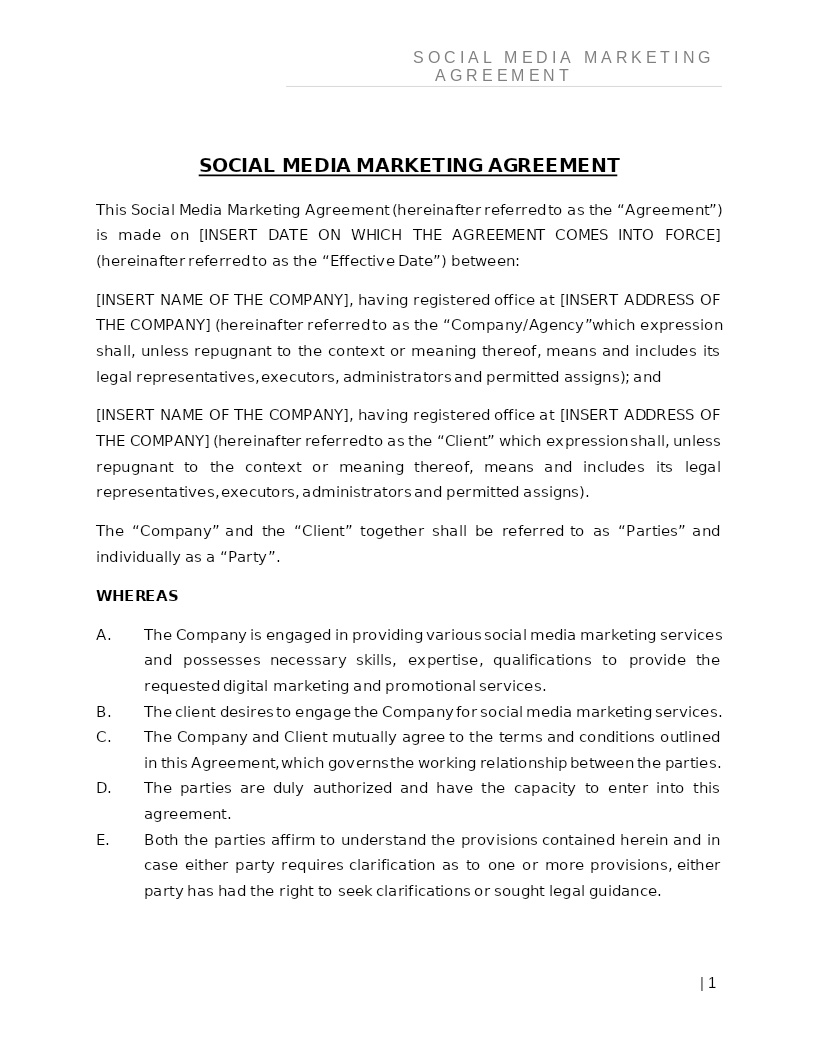
SOCIAL MEDIA MARKETING AGREEMENT
How does it work?
1. Choose this template
Start by clicking on "Fill out the template"
2. Complete the document
Answer a few questions and your document is created automatically.
3. Save - Print
Your document is ready! You will receive it in Word and PDF formats. You will be able to modify it.
Understanding Social Media Marketing Agreements
When businesses engage a marketing agency, consultant, or freelancer to manage their social media presence, it’s essential to have a clear framework outlining how the services will be delivered, who owns the content, how campaigns will be executed, and what results are expected. A Social Media Marketing Agreement provides this structure. It defines campaign strategies, deliverables, timelines, metrics, payment terms, and intellectual property ownership, while setting boundaries for communication, reporting, and performance expectations.
Putting a Social Media Marketing Agreement in place creates a professional foundation that allows both parties to collaborate confidently. It enables marketers to implement effective campaigns and clients to rely on transparent processes without concerns about unclear responsibilities, content misuse, brand misrepresentation, or financial disputes.
Where Social Media Marketing Agreements Are Commonly Used
Social Media Marketing Agreements are standard across a wide variety of U.S. businesses and industries, including:
- Digital marketing agencies managing multi-platform campaigns for clients
- Small businesses outsourcing content creation, scheduling, or promotional campaigns
- Influencer partnerships and brand ambassador programs
- E-commerce brands running paid social media advertising
- Corporate brands needing ongoing community management and crisis response
- Startups outsourcing growth marketing, branding, and online visibility
- Professional services firms using social media for lead generation and thought leadership
Any time a business relies on external professionals to manage its social media presence or advertising activities, this agreement provides clarity and legal protection.
Different Types of Social Media Marketing Agreements You May Encounter
- General Social Media Marketing Agreement: Covers overall management of content creation, posting schedules, analytics, and community engagement on designated platforms.
- Platform-Specific Agreement: Tailored for services focused on a single platform, such as Instagram, TikTok, LinkedIn, Facebook, or YouTube.
- Paid Advertising Management Agreement: Designed specifically for campaigns involving paid ads, budget allocation, A/B testing, performance tracking, and ad spend reporting.
- Influencer or Creator Collaboration Agreement: Outlines deliverables, content usage rights, FTC disclosure requirements, and compensation for influencer partnerships.
- Campaign-Specific Agreement: Used for short-term or seasonal campaigns such as product launches, holiday promotions, or lead-generation initiatives.
Why Businesses Need a Social Media Marketing Agreement
A Social Media Marketing Agreement is essential for creating a structured working relationship that prevents confusion, protects intellectual property, and ensures consistent brand representation. The agreement defines responsibilities, sets performance expectations, outlines payment terms, and clarifies ownership of creative assets. It also ensures the parties comply with U.S. advertising laws, platform policies, and data-handling requirements. For businesses investing in social media marketing as part of their growth strategy, the agreement serves as a legally enforceable roadmap aligned with the project’s goals.
When Legal Guidance Becomes Helpful
Most standard marketing engagements begin with a contract template, but legal guidance becomes important when:
- The campaign involves large budgets, paid advertising, or performance-based compensation
- The project includes influencer collaborations, talent licensing, or public-facing brand content
- The business operates in a regulated industry such as healthcare, finance, or education
- User-generated content or customer data is collected during campaigns
- The engagement spans multiple jurisdictions or relies on cross-platform advertising
- The agreement must include complex IP ownership terms, resale rights, or content licensing
- The parties negotiate exclusivity, non-solicitation, or advanced confidentiality protections
- There are risks of reputational harm, brand misuse, or regulatory violations
Legal review ensures that the agreement complies with U.S. contract law, platform-specific policies (such as Meta, TikTok, and LinkedIn rules), and FTC marketing guidelines.
How to Work with This Template
- Identify the marketing service provider and client, including business entities if applicable
- Clearly describe the scope of services content creation, scheduling, community management, analytics, or paid ads
- Define campaign goals, KPIs, reporting methods, and timelines
- Set payment terms, invoicing schedules, ad spend responsibilities, and performance incentives
- Clarify ownership and licensing of created content, including graphics, videos, captions, and ad creatives
- Include confidentiality obligations, brand guidelines, and compliance with FTC disclosure rules
- Establish dispute resolution procedures and select a governing state law
- Review the agreement together; legal review is optional but recommended
- Sign electronically or in hard copy both formats are enforceable throughout the United States
This template follows U.S. marketing standards and aligns with the operational, creative, and legal needs of modern social media campaigns.
Frequently Asked Questions
Q1. What is a Social Media Marketing Agreement?
A Social Media Marketing Agreement is a legally binding contract that outlines how a marketing professional or agency will manage a client’s social media presence. It defines the services to be provided, expected deliverables, content ownership, timelines, performance metrics, and payment terms. This ensures that both parties understand their responsibilities and helps establish a clear, structured working relationship.
Q2. Why is a Social Media Marketing Agreement important for businesses?
Businesses depend on social media for visibility, branding, and lead generation. A well-drafted agreement protects the business by outlining how content will be created, approved, and used, while defining the marketer’s role and performance expectations. This protects against disputes, unauthorized content use, financial misunderstandings, and compliance failures related to advertising regulations or platform policies.
Q3. Who owns the content created under this agreement?
Ownership depends on the terms negotiated in the contract. Typically, marketing agencies or creators retain copyright ownership but grant the client a license to use the content for business purposes. Some clients may negotiate full ownership (a “buyout”) of graphics, photos, videos, or advertising materials. Clear IP provisions ensure that both parties know exactly how content can be used and by whom.
Q4. Does the agreement cover paid advertising and ad spend?
Yes. Social media marketing contracts often include detailed terms on managing paid ads, budget allocations, optimization strategies, and reporting. The agreement can specify which party funds the ad spend and how performance will be tracked. These provisions help maintain transparency and prevent disputes over budgeting, billing, or ROI expectations.
Q5. How does the agreement address compliance with FTC and platform rules?
U.S. advertising laws especially FTC endorsement and disclosure rules require clear guidelines for influencer marketing, sponsored posts, and paid collaborations. The agreement typically includes clauses requiring all parties to follow platform policies and legal regulations. This prevents compliance issues and protects both the business and the service provider from penalties or reputational risks.
Q6. Can the agreement define KPIs and performance metrics?
Yes. Many agreements include specific metrics such as engagement levels, follower growth, conversion rates, or campaign reach. While marketers cannot guarantee results due to changing algorithms, defining measurable expectations ensures clearer communication and more structured reporting.
Q7. Are confidentiality and data protection clauses included?
They should be. Social media marketing often involves access to brand strategies, customer data, login credentials, advertising dashboards, and proprietary tools. Confidentiality obligations protect this sensitive information and ensure that it is used only for authorized campaign purposes.
Q8. Do businesses need a lawyer to draft or customize a Social Media Marketing Agreement?
Although not mandatory, legal consultation is beneficial, especially when campaigns involve paid advertisements, influencers, regulated industries, cross-border platforms, or complex IP ownership. Lawyers help ensure the agreement is enforceable, aligns with U.S. advertising laws, and protects long-term brand interests.