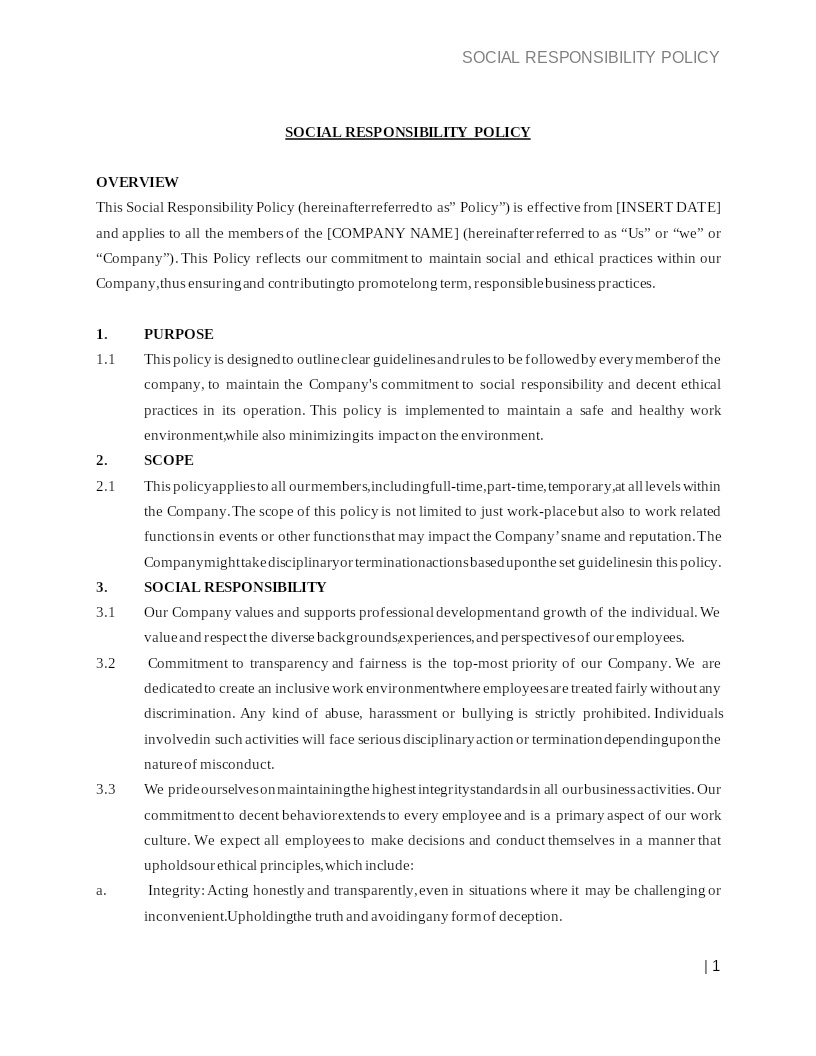
SOCIAL RESPONSIBILITY POLICY
How does it work?
1. Choose this template
Start by clicking on "Fill out the template"
2. Complete the document
Answer a few questions and your document is created automatically.
3. Save - Print
Your document is ready! You will receive it in Word and PDF formats. You will be able to modify it.
Strengthening Ethical Governance and Sustainable Practices Through a Social Responsibility Policy
A Social Responsibility Policy is a formal organizational declaration that articulates the company’s ethical, environmental, and community-focused obligations, grounded in applicable U.S. federal and state laws as well as recognized industry standards. This policy sets forth the company’s commitment to lawful conduct, ethical decision-making, environmental stewardship, human-rights protections, workforce fairness, and socially responsible business operations. Developed in reference to regulatory principles enforced by agencies such as the Environmental Protection Agency (EPA), the Equal Employment Opportunity Commission (EEOC), the Occupational Safety and Health Administration (OSHA), the Department of Labor (DOL), and guidance relating to modern ESG frameworks, this policy serves as a foundational governance instrument that aligns operational conduct with societal expectations and legal compliance mandates.
A comprehensive Social Responsibility Policy outlines the organization’s standards regarding labor practices, diversity and inclusion, workplace protections, environmental impact reduction, community engagement, and supply-chain ethics. It describes how the company monitors compliance, evaluates risks, and conducts oversight to ensure that its activities are carried out in a manner that respects individuals, communities, and the environment. The policy further establishes mechanisms for internal reporting, outlines consequences for noncompliance, and promotes transparency through periodic assessments and public communication. By implementing this policy, the organization not only enhances corporate governance but also affirms its commitment to sustainable, socially conscious business practices that safeguard its reputation and long-term operational stability.
Where Social Responsibility Policies Are Commonly Used
Social Responsibility Policies apply broadly across industries, including:
- Corporations with multi-state or global operations subject to environmental and labor compliance
- Technology companies addressing data ethics, workforce diversity, and digital-safety standards
- Retail, manufacturing, and distribution companies managing complex supply chains
- Healthcare, biotech, and research institutions with human-rights and ethical-review obligations
- Nonprofit organizations seeking to maintain public trust and mission integrity
- Government contractors subject to human-rights and ethical-sourcing requirements
- Financial institutions evaluating ESG-related investment and lending risks
- Educational institutions promoting equal opportunity and community involvement
Any organization engaging with employees, consumers, or communities benefits from adopting a Social Responsibility Policy.
Different Types of Social Responsibility Policies You May Encounter
1. Environmental Sustainability Policies: Focus on reducing emissions, conserving resources, and complying with EPA regulations.
2. Fair Labor and Human-Rights Policies: Establish protections consistent with EEOC rules, anti-harassment laws, and human-rights expectations.
3. Ethical Sourcing and Supply-Chain Policies: Ensure suppliers adhere to labor, environmental, and anti-corruption standards.
4. Community Engagement Policies: Encourage volunteerism, charitable activities, and local community support initiatives.
5. Governance and Ethical Conduct Policies: Promote ethical leadership, compliance reporting, and responsible corporate governance.
When Legal Guidance Becomes Helpful
Legal counsel may be required when:
- ESG-related statements may be subject to FTC advertising and truth-in-marketing rules
- Human-rights, labor, or anti-discrimination commitments must align with federal and state laws
- Environmental claims or sustainability programs involve EPA or state regulatory oversight
- Supply-chain operations intersect with forced-labor prohibitions or international trade laws
- The organization must prepare public ESG disclosures for investors or regulators
- Cross-border operations involve varying labor, safety, or environmental standards
- The company handles sensitive community-impact issues or requires formal ethical-review processes
Legal review ensures the policy complies with U.S. legal standards, manages risk exposure, and supports defensible governance practices.
How to Work with This Template
- Define the organization’s commitments to ethical conduct, sustainability, and social responsibility
- Integrate requirements imposed by U.S. labor, environmental, and anti-discrimination laws
- Establish clear expectations of employees, managers, and third-party vendors
- Provide mechanisms for reporting ethical concerns, violations, or misconduct without retaliation
- Describe environmental practices, waste-reduction methods, and resource-conservation goals
- Clarify diversity, equity, inclusion, and fair-treatment standards
- Include responsible-sourcing expectations for suppliers and contractors
- Outline oversight procedures, compliance monitoring systems, and corrective-action protocols
- Require periodic updates to reflect changes in law, industry standards, or organizational objectives
- Ensure employees acknowledge receipt and understanding of the policy
This template helps organizations align with ethical standards, regulatory compliance, and contemporary stakeholder expectations.
Frequently Asked Questions
Q1. What is a Social Responsibility Policy, and why is it important?
A Social Responsibility Policy outlines an organization’s ethical, environmental, and community-based commitments. It is important because it supports legal compliance, strengthens corporate reputation, and ensures that business decisions reflect responsible and sustainable practices.
Q2. Does U.S. law require companies to adopt a Social Responsibility Policy?
Not universally. However, many industries are bound by environmental regulations, labor-law protections, and anti-discrimination requirements. A written policy helps organizations formalize compliance efforts and promote transparency.
Q3. Does this policy address environmental sustainability?
Yes. Most policies include environmental standards such as emission reduction, waste management, and energy-conservation initiatives, consistent with EPA expectations.
Q4. Does a Social Responsibility Policy apply to vendors and suppliers?
Often yes. Many companies require suppliers to comply with ethical-sourcing, labor-law, and environmental-protection standards.
Q5. How does this policy protect employees?
The policy supports equal opportunity, anti-harassment rules, ethical workplace conduct, and protections aligned with EEOC requirements and federal labor laws.
Q6. Can this policy support ESG reporting?
Yes. Social Responsibility Policies serve as foundational documents for ESG disclosures, corporate-citizenship statements, and stakeholder communication.
Q7. How does the organization ensure compliance with the policy?
Through training, internal audits, reporting tools, leadership oversight, and corrective-action procedures.
Q8. Can employees report violations anonymously?
Yes. Many organizations provide anonymous reporting channels to encourage good-faith disclosure of unethical conduct.
Q9. Should the policy include community-engagement initiatives?
Many organizations incorporate charitable programs, volunteer opportunities, and community partnerships as part of their social-impact efforts.
Q10. Should legal counsel review the Social Responsibility Policy?
Yes. Legal review ensures the policy accurately reflects federal and state compliance requirements and prevents inconsistent or misleading claims.