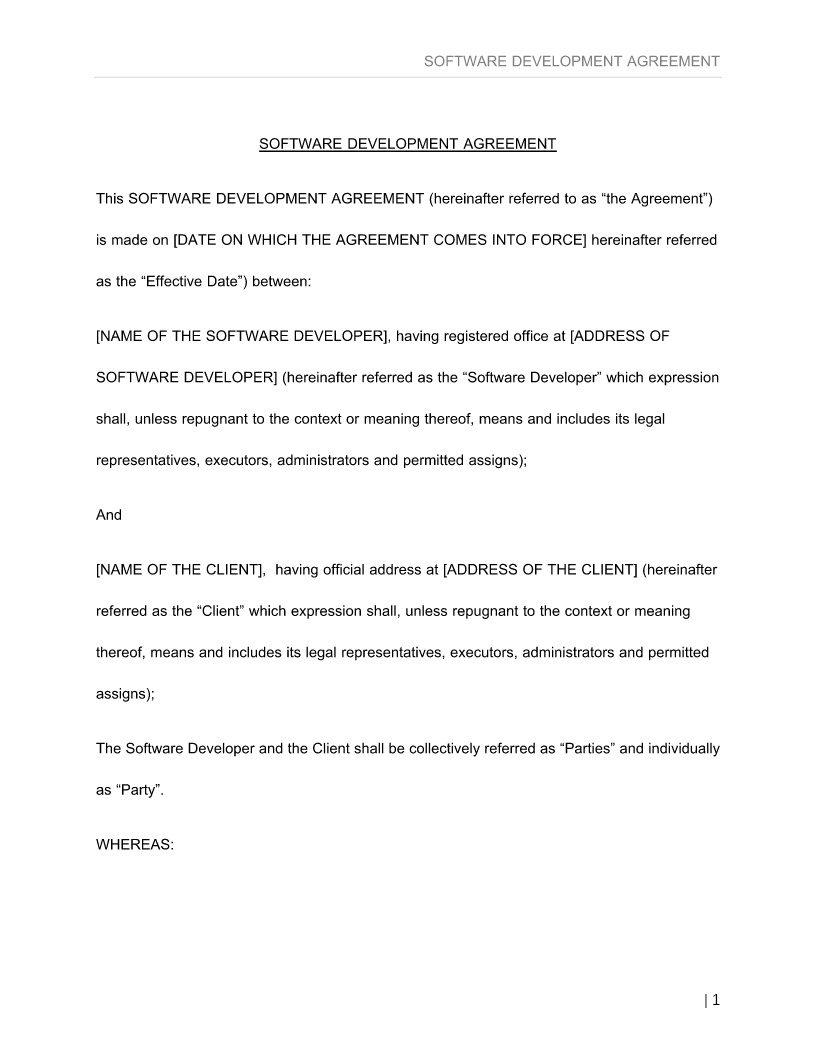
SOFTWARE DEVELOPMENT AGREEMENT
How does it work?
1. Choose this template
Start by clicking on "Fill out the template"
2. Complete the document
Answer a few questions and your document is created automatically.
3. Save - Print
Your document is ready! You will receive it in Word and PDF formats. You will be able to modify it.
Creating Clear, Professional, and Legally Secure Software Development Relationships
When a business needs custom software, applications, or digital tools, it becomes essential to have a clear framework that governs how the project will be designed, developed, delivered, and supported. A Software Development Agreement (SDA) provides that structure. It clearly defines the scope of the project, deliverables, ownership rights, payment milestones, confidentiality obligations, and other critical terms that shape the development lifecycle.
Putting a Software Development Agreement in place allows both parties to collaborate confidently, share technical information securely, and prevent misunderstandings, ensuring that the project progresses smoothly from concept to completion.
Where Software Development Agreements Are Commonly Used
Software Development Agreements are standard across nearly every industry where customized digital solutions are required, including:
- Web application development, mobile app creation, and SaaS platforms
- Enterprise software integrations and backend system development
- UI/UX design, prototyping, and digital product engineering
- E-commerce platforms, CRM systems, and automation tools
- AI/ML development, data analytics, and cloud-based applications
- Freelance, agency, and outsourcing development engagements
- Joint development projects, technical collaborations, and hybrid models
Any time code, technology, or intellectual property is created for a client, a Software Development Agreement ensures clarity and establishes legal protections for both sides.
Different Types of Software Development Agreements You May Encounter
- Fixed-Scope Development Agreement: Used when the project requirements, deliverables, and deadlines are clearly defined upfront.
- Time and Materials Agreement: Ideal for ongoing or evolving projects where tasks may shift over time.
- Dedicated Developer or Team Agreement: Provides the client with full-time or part-time development resources.
- Maintenance and Support Agreement: Focuses on ongoing system updates, bug fixing, and post-launch improvements.
- Joint Ownership or Co-Development Agreement: Used when both parties contribute to building proprietary software or shared IP.
When Legal or Technical Guidance Becomes Helpful
Many software projects involve complex details, so professional guidance becomes valuable when:
- IP rights, licensing, or ownership of code must be clearly established
- Proprietary algorithms, trade secrets, or innovative technologies are involved
- The software integrates with third-party APIs, databases, or regulated systems
- Data privacy laws (such as GDPR or CCPA) apply to user data
- Payment milestones depend on deliverables or testing phases
- Multiple developers, subcontractors, or international teams are engaged
- There are high risks related to delays, security flaws, or system failures
Expert review helps avoid disputes and ensures compliance with U.S. legal and technical standards.
How to Work with This Template
- Specify the scope, features, and functional requirements of the software
- Define development phases, milestones, and acceptance criteria
- Select governing state law and include confidentiality and IP terms
- Outline payment schedules, testing procedures, and review timelines
- Clarify maintenance, support, documentation, and update responsibilities
- Address data privacy, security standards, and third-party libraries
- Review terms jointly (legal review optional) and execute electronically or in hard copy
This format aligns with widely recognized software development standards across the United States.
Frequently Asked Questions
Q1. Why is a Software Development Agreement important for software projects?
A Software Development Agreement ensures both parties have a shared understanding of the project’s goals, deliverables, and timelines. It protects against misunderstandings by clearly defining responsibilities, acceptance criteria, and expected outcomes. The agreement also secures intellectual property rights and outlines payment terms. This structured approach reduces risks and helps maintain a smooth development process. It also provides legal protection throughout the project lifecycle.
Q2. What types of services are typically included in a Software Development Agreement?
Services may include coding, design, prototyping, testing, project management, deployment, and post-launch support. The agreement outlines each service in detail to avoid ambiguity. Additional tasks such as integration, API development, or cloud configuration may also be included. Documenting these ensures both parties understand the full scope. This promotes transparency and prevents unexpected obligations.
Q3. How does the agreement handle intellectual property ownership?
The agreement specifies whether the client receives full ownership, a license, or joint rights to the developed software. It also outlines rights to source code, documentation, and related materials. This prevents future disputes about who controls or can use the software. Clear IP terms are essential in protecting both parties’ interests. They also ensure compliance with copyright and licensing laws.
Q4. Are payment milestones included in a Software Development Agreement?
Yes. Software Development Agreements typically include milestone-based payments tied to delivering specific phases such as design, development, testing, or final deployment. This ensures financial clarity and reduces risk for both parties. Clients only pay when progress is demonstrated, and developers receive compensation for completed work. Milestones help track project advancement. They also support better budget planning.
Q5. Does the agreement include confidentiality protections?
Absolutely. Most Software Development Agreements include confidentiality clauses that protect sensitive information such as proprietary algorithms, business strategies, or user data. Developers and clients must safeguard all shared materials. These protections help prevent unauthorized use or disclosure. Confidentiality terms build trust and preserve the integrity of the project. They also support compliance with privacy regulations.
Q6. What happens if the project timeline is delayed?
The agreement outlines how delays will be handled, including revised timelines, extensions, or additional fees if applicable. It may also define circumstances considered force majeure. Clear delay provisions help prevent disputes and ensure accountability. Both parties understand their obligations during unforeseen challenges. This supports realistic planning and adaptability.
Q7. How are disputes resolved under a Software Development Agreement?
Most Software Development Agreements include mechanisms such as mediation, arbitration, or structured negotiation. These methods help resolve conflicts without lengthy litigation. Clear dispute procedures provide both parties with predictable solutions. They also minimize disruptions to ongoing work. Establishing these pathways upfront reduces stress and uncertainty.
Q8. Can the agreement be terminated before the project is completed?
Yes. Termination clauses define the conditions under which the agreement may be ended by either party. They outline notice periods, final payments, return of materials, and handling of partially completed work. Clear termination terms protect both sides from financial or operational harm. These provisions help ensure a smooth transition if the partnership ends. They also reduce legal risks.