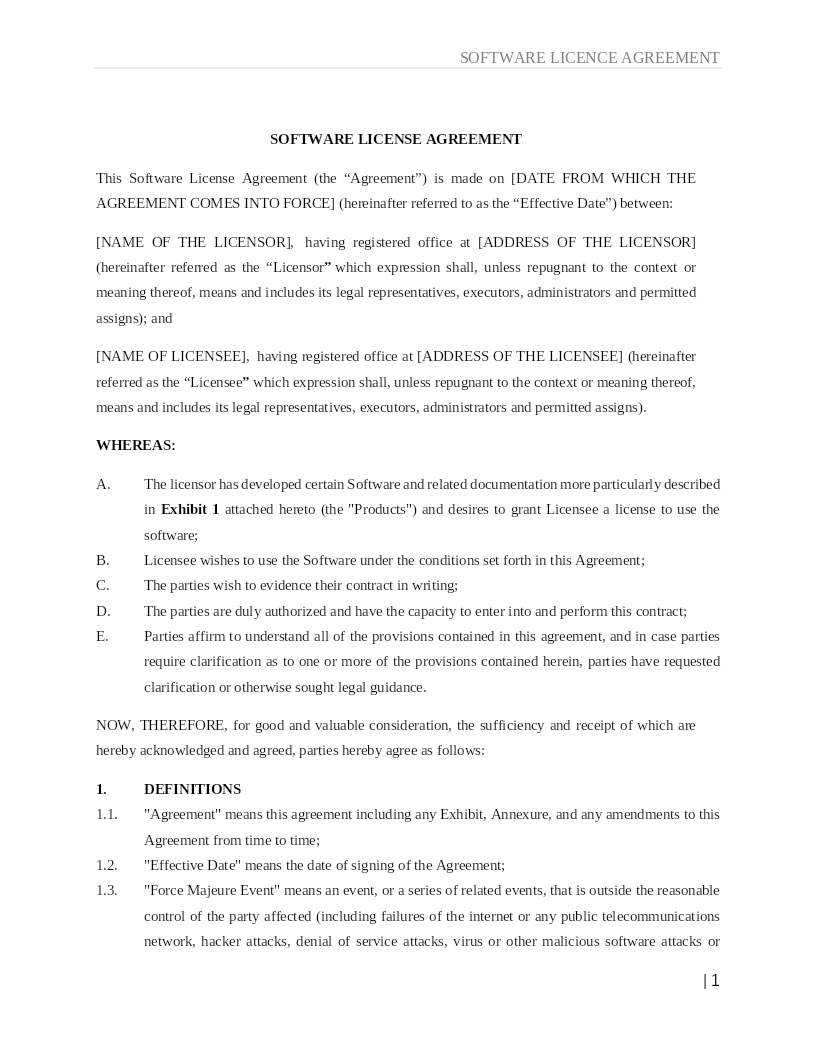
SOFTWARE LICENSE AGREEMENT
How does it work?
1. Choose this template
Start by clicking on "Fill out the template"
2. Complete the document
Answer a few questions and your document is created automatically.
3. Save - Print
Your document is ready! You will receive it in Word and PDF formats. You will be able to modify it.
Understanding Software License Agreements
A Software License Agreement is a legally binding contract that outlines how a user, business, or organization may access and use a software program. Instead of transferring ownership, the agreement grants limited rights to use the software under specific conditions, protecting the creator’s intellectual property while ensuring that the end user understands what is permitted and what is restricted.
A well-structured Software License Agreement establishes clear rules for usage rights, installation limits, updates, data handling, prohibited activities, and intellectual property protections. It provides a foundation of trust and compliance that enables businesses and developers to distribute software securely while safeguarding their proprietary code and digital assets.
Where Software License Agreements Are Commonly Used
Software licensing terms are standard across nearly all types of software distribution, including:
• Cloud-based and SaaS platforms
• Desktop applications and productivity tools
• Mobile apps, games, and digital services
• Enterprise software solutions
• API access and developer tools
• Custom software developed for businesses
• Subscription-based and pay-per-use software
• Trial versions, beta releases, and limited-access programs
Different Types of Software Licenses You May Encounter
- End User License Agreement (EULA): The most common form, defining how individual users may use the software.
- SaaS License Agreement: Used for cloud-hosted platforms accessed online rather than installed locally.
- Enterprise or Multi-User License: Allows organizations to install and use the software across multiple devices or users.
- Open-Source License: Provides usage rights aligned with open-source standards (MIT, GPL, Apache).
- Subscription License: Grants rights to use the software while the subscription is active.
When Legal Guidance Becomes Helpful
Software licensing generally does not require extensive legal oversight, but professional advice can be valuable when:
• The software includes proprietary algorithms, sensitive data, or trade secrets
• Licensing spans multiple jurisdictions or international users
• You need custom restrictions, such as non-competition or API usage limits
• The software collects personal data and must comply with privacy laws
• You are negotiating enterprise-level or large-scale licensing terms
• The licensing terms affect revenue models such as subscriptions, royalties, or renewals
How to Work with This Template
• Identify the licensor (software provider) and licensee (user)
• Clearly describe the software being licensed
• Define what usage is permitted and prohibited
• Include installation limits, user caps, and access controls
• Specify payment terms, subscription details, or renewal policies
• Choose the governing state law
• Add restrictions on copying, modifying, or redistributing the software
• Sign electronically or in hard copy
Frequently Asked Questions
Q1. What is a Software License Agreement and why is it necessary?
A Software License Agreement defines how users may access and use software without transferring ownership. It is necessary to protect the developer’s intellectual property, prevent unauthorized distribution, and ensure the user follows proper usage guidelines.
Q2. Does a software license mean I own the software?
No. A license grants permission to use the software under specific conditions. Ownership of the software and its source code remains with the licensor.
Q3. Are Software License Agreements legally enforceable in the U.S.?
Yes. These agreements are enforceable under U.S. contract and intellectual property laws. Courts recognize digital licenses, click-wrap agreements, and electronic acceptance as valid forms of consent.
Q4. What restrictions are normally included in a software license?
Common restrictions include prohibiting users from copying, modifying, reverse-engineering, reselling, or redistributing the software. These protections ensure the software remains secure and legally protected.
Q5. Can a business use one license for multiple employees?
Only if the license explicitly allows it. Many software licenses require a separate user seat or enterprise plan for multi-user access.
Q6. How does a subscription-based license work?
Users pay a recurring fee (monthly or yearly) to access the software. Once the subscription ends, the user typically loses access unless renewed.
Q7. Does the agreement cover updates and technical support?
Yes. Many Software License Agreements specify whether updates, patches, and customer support are included, and under what conditions these services are provided.
Q8. Can the license be transferred to another person or company?
Some agreements allow license transfers, while others restrict them. The contract will specify whether transferring or assigning the license is permitted.
Q9. What happens if someone violates the Software License Agreement?
Violations may lead to license termination, restricted access, legal action, or financial liability. Developers may also demand removal of unauthorized copies.
Q10. Are electronic signatures valid for Software License Agreements?
Yes. Under the U.S. ESIGN Act, electronic signatures and click-to-accept agreements are fully enforceable, making digital software licensing seamless and legally compliant.