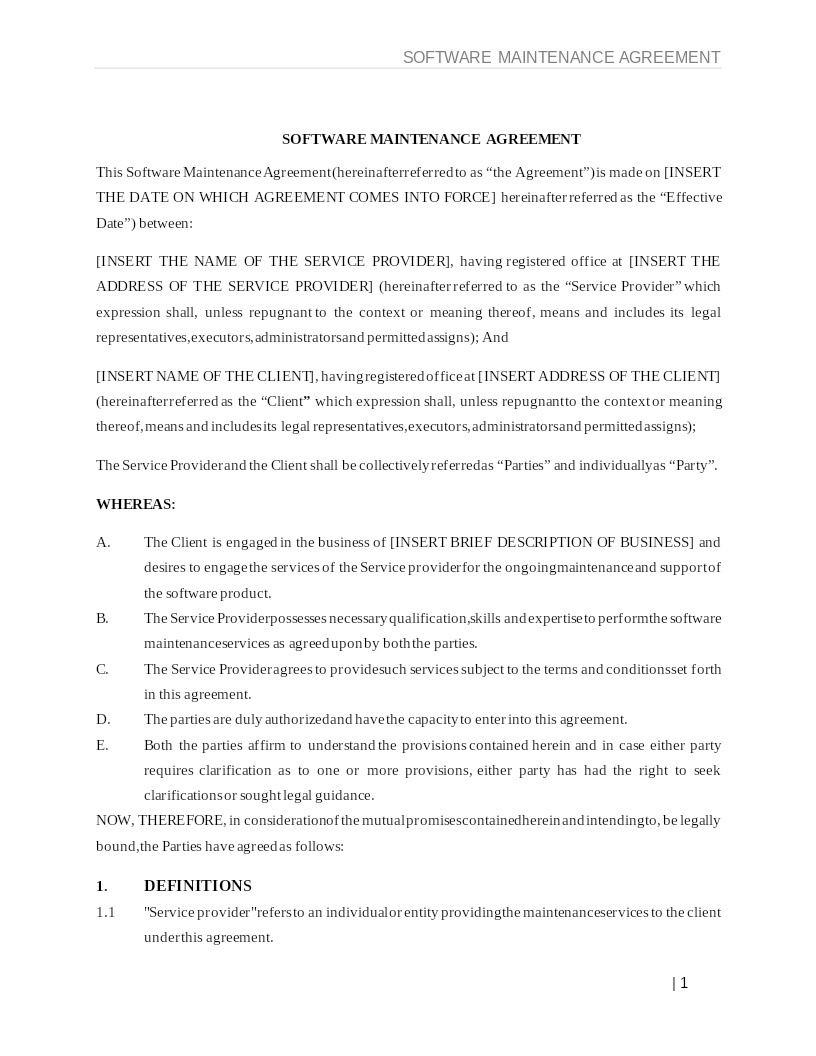
SOFTWARE MAINTENANCE AGREEMENT
How does it work?
1. Choose this template
Start by clicking on "Fill out the template"
2. Complete the document
Answer a few questions and your document is created automatically.
3. Save - Print
Your document is ready! You will receive it in Word and PDF formats. You will be able to modify it.
Understanding Software Maintenance Agreements
A Software Maintenance Agreement is a legally binding contract that outlines how a service provider will support, update, and maintain a client’s software after delivery or deployment. It establishes clear expectations regarding bug fixes, updates, security patches, performance improvements, support hours, response times, and service levels.
In the United States, Software Maintenance Agreements operate under state contract law, federal data protection rules, software licensing regulations, and industry compliance standards. This agreement ensures ongoing functionality, reduces system downtime, and protects the client’s investment in software by guaranteeing timely and professional maintenance.
Where Software Maintenance Agreements Are Commonly Used
Software maintenance arrangements are standard across industries relying on digital systems, including:
- Businesses using custom-built software or enterprise tools
- SaaS providers supporting cloud-based applications
- Government or regulated organizations requiring secure system upkeep
- E-commerce platforms, payment systems, and CRM software
- Healthcare, finance, and education institutions with compliance needs
- Startups maintaining evolving applications and new feature updates
- Companies migrating legacy systems or improving existing software
Whenever software must remain secure, functional, and up to date, a maintenance agreement provides structure and assurance.
Different Types of Software Maintenance You May Encounter
- Corrective Maintenance: Fixing bugs, errors, or defects reported by users.
- Adaptive Maintenance: Updating software to stay compatible with new operating systems, browsers, or third-party integrations.
- Perfective Maintenance: Enhancing performance, user interface, or overall functionality.
- Preventive Maintenance: Strengthening security, improving code quality, and preventing future issues.
- Support & Helpdesk Services: Providing user assistance, troubleshooting, and technical support.
When Legal Guidance Becomes Helpful
Professional legal review is recommended when:
- The software supports sensitive data governed by HIPAA, FERPA, GDPR, or FINRA
- The agreement includes uptime commitments, SLAs, or penalty clauses
- Third-party integrations and dependencies are involved
- Intellectual property ownership or licensing rights need clarification
- The provider requires remote access to client systems
- Custom software enhancements or feature requests may impact scope or pricing
- • The project spans multiple states or international jurisdictions
Legal advice ensures compliance, protects intellectual property, and reduces operational risk.
How to Work with This Template
- Identify the service provider and client
- Define the scope of maintenance, including covered and excluded services
- Establish response and resolution times based on issue severity
- Specify pricing, billing cycles, and renewal terms
- Include data protection, confidentiality, and remote-access conditions
- Add IP ownership details for updates or enhancements
- Choose governing U.S. state law
- Set procedures for reporting issues and requesting support
- Sign electronically or in hard copy
The template follows widely recognized U.S. software service standards and works with all major e-signature platforms.
Frequently Asked Questions
Q1. What is a Software Maintenance Agreement?
It is a contract that outlines how a service provider will maintain, update, and support software after launch, ensuring security, stability, and long-term usability.
Q2. Why is a software maintenance contract important?
It prevents downtime, ensures timely bug fixes, and protects the client from security vulnerabilities, outdated components, and unexpected failures.
Q3. Are software maintenance services legally required in the U.S.?
Not legally required but strongly recommended. Businesses handling customer data or regulated information often need ongoing maintenance for compliance and cybersecurity.
Q4. Do maintenance agreements include new features?
Not always. Many agreements separate new feature development from maintenance. However, some plans include minor enhancements or performance improvements.
Q5. Can a maintenance agreement include SLAs and performance guarantees?
Yes. Many contracts include uptime commitments, response times, and penalties for failure to meet service levels.
Q6. Who owns updates and improvements to the software?
Ownership depends on the agreement. Some clients retain all IP rights, while others license updates from the provider. The contract should clearly define ownership.
Q7. Is remote access allowed under the agreement?
Most providers use secure remote tools to deliver support. Agreements outline access levels, confidentiality, and data security controls.
Q8. Can either party terminate the agreement early?
Yes. Most contracts allow termination with prior notice or for breach, non-payment, or persistent service failures.
Q9. Are emergency or after-hours services included?
Some agreements include 24/7 support, while others offer emergency maintenance for additional fees. Terms should be clearly defined.
Q10. Can the agreement cover third-party software or integrations?
Only if specified. Many providers exclude external tools unless explicitly covered to avoid liability for issues outside their control.