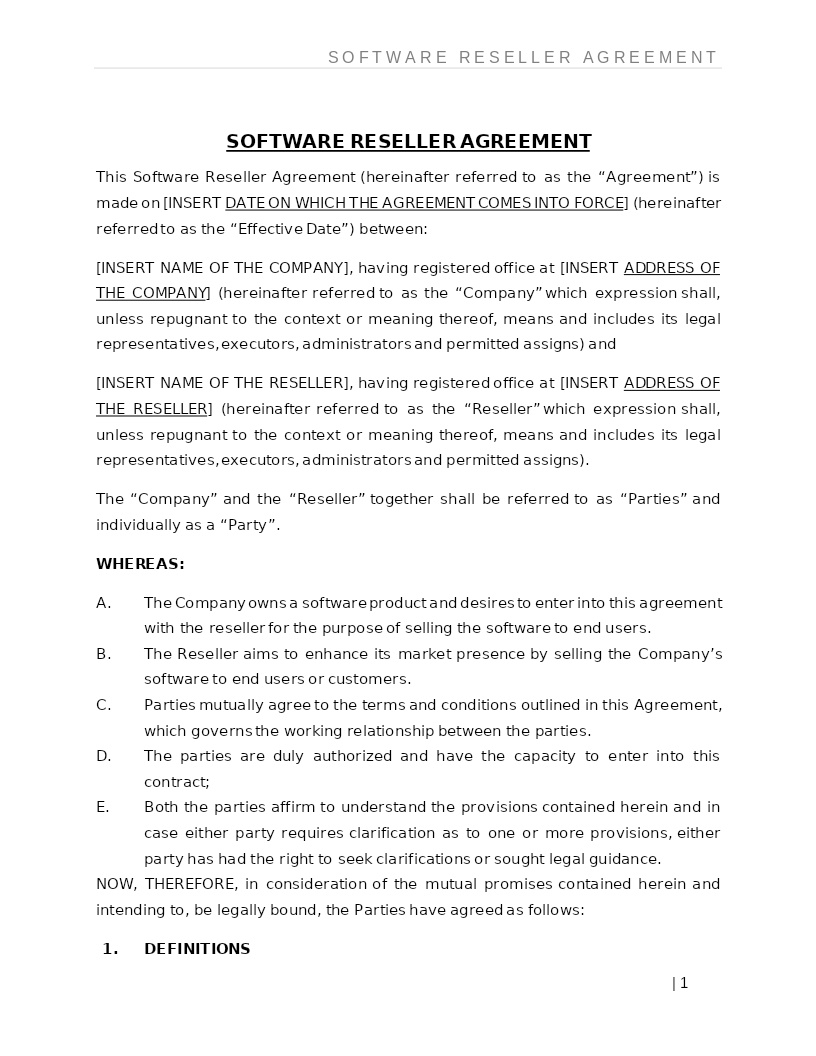
SOFTWARE RESELLER AGREEMENT
How does it work?
1. Choose this template
Start by clicking on "Fill out the template"
2. Complete the document
Answer a few questions and your document is created automatically.
3. Save - Print
Your document is ready! You will receive it in Word and PDF formats. You will be able to modify it.
Building Strong, Compliant, and Scalable Software Distribution Partnerships Through Software Reseller Agreements
A Software Reseller Agreement is a legally binding contract between a software owner (licensor) and a reseller, granting the reseller the authority to market, promote, distribute, and sell the software to end users within approved territories or markets. In the United States, these agreements play a crucial role in protecting intellectual property, defining reseller rights, establishing revenue models, and ensuring compliance with licensing and regulatory frameworks.
This agreement formally outlines what the reseller can and cannot do with the software, such as permitted marketing channels, branding usage, customer onboarding, pricing obligations, and technical support expectations. By documenting these responsibilities, the agreement protects the software owner’s IP while enabling the reseller to grow their business confidently under clear legal guidelines.
Where Software Reseller Agreements Are Commonly Used
Software reseller agreements are widely used across U.S. industries, including:
- SaaS companies expanding through channel partners
- Cybersecurity firms distributing software via certified resellers
- IT service providers offering bundled software solutions
- Enterprise or B2B software companies building value-added reseller (VAR) programs
- Cloud service platforms forming multi-tier distribution networks
- License-based software companies creating regional or global sales channels
Any software business seeking to scale through third-party sales partners benefits from a structured and enforceable reseller arrangement.
Different Types of Software Reseller Agreements You May Encounter
- Authorized Reseller Agreement: Grants permission to sell or distribute software under predefined terms. Common for SaaS and subscription software businesses.
- Value-Added Reseller (VAR) Agreement: Allows the reseller to bundle, integrate, or enhance the software with additional services or features before distributing it to end users.
- Exclusive or Territory-Based Reseller Agreement: Provides exclusive resale rights within specific geographic regions or industries, often in exchange for higher performance obligations.
- Non-Exclusive Reseller Agreement: Allows multiple resellers to operate simultaneously, offering broad market coverage without exclusivity restrictions.
- Master Reseller / Distributor Agreement: Enables a reseller to appoint sub-resellers or downstream partners, forming layered channels for large-scale distribution.
Each type ensures compliance, protects IP, and enables software owners to scale distribution efficiently while managing risk.
When Legal Guidance Becomes Helpful
Legal consultation is especially important when:
- The software involves sensitive data (healthcare, fintech, education, cybersecurity)
- Pricing tiers, revenue splits, or commissions are complex
- Resellers operate across multiple states or countries
- IP licensing terms require customization
- The reseller wants exclusive rights or territorial protection
- Compliance with U.S. privacy laws like CCPA or COPPA is required
- The agreement includes white-labeling or branded resale
Legal review ensures enforceability, avoids licensing violations, and safeguards long-term business interests.
How to Work With This Template
- Identify licensor and reseller, along with territory and scope of rights
- Specify licensing permissions, sales channels, and restrictions
- Define reseller compensation: wholesale pricing, commissions, or revenue share
- Outline marketing, branding, training, and technical support obligations
- Include IP protection, confidentiality, and restrictions on modifications
- Add indemnities, warranties, liability limits, and security compliance terms
- Choose dispute resolution methods and governing U.S. state law
- Provide clear termination rights and post-termination transition steps
This template follows standard U.S. software distribution practices and supports compliant, scalable reseller partnerships.
Frequently Asked Questions
Q1. Why is a Software Reseller Agreement important in the U.S.?
A Software Reseller Agreement defines the reseller’s rights and obligations, ensuring legal clarity and protecting the software owner’s intellectual property. It prevents unauthorized distribution, establishes payment terms, and supports compliant, scalable software sales.
Q2. Does a reseller own the software under this agreement?
No. The reseller receives permission to market and sell the software but never owns the intellectual property. Ownership stays with the licensor, ensuring full protection of branding, code, licensing, and proprietary technology.
Q3. How does a reseller earn revenue under a Software Reseller Agreement?
Resellers typically earn revenue through commissions, wholesale pricing, or a defined revenue-sharing model. The agreement outlines payment terms clearly to prevent disputes and ensure transparent financial reporting.
Q4. Can a reseller modify or bundle the software?
Only if the agreement allows it. Standard reseller agreements prohibit modification, while VAR agreements may permit bundling or integration under strict IP and branding controls to protect the licensor’s technology.
Q5. Are software reseller agreements enforceable with electronic signatures?
Yes. Under the U.S. ESIGN Act and UETA, electronic signatures are legally valid, making it easy for companies to execute reseller agreements digitally across states and jurisdictions.
Q6. What happens if a reseller violates the agreement?
Violations may lead to termination, loss of reseller rights, and legal claims for damages or IP infringement. The agreement clearly defines breach consequences to protect the software owner’s business and brand.
Q7. Can software reseller agreements include exclusive territories?
Yes. Exclusive arrangements grant the reseller sole rights to sell within designated regions or markets, but they usually come with performance metrics and stricter compliance requirements.