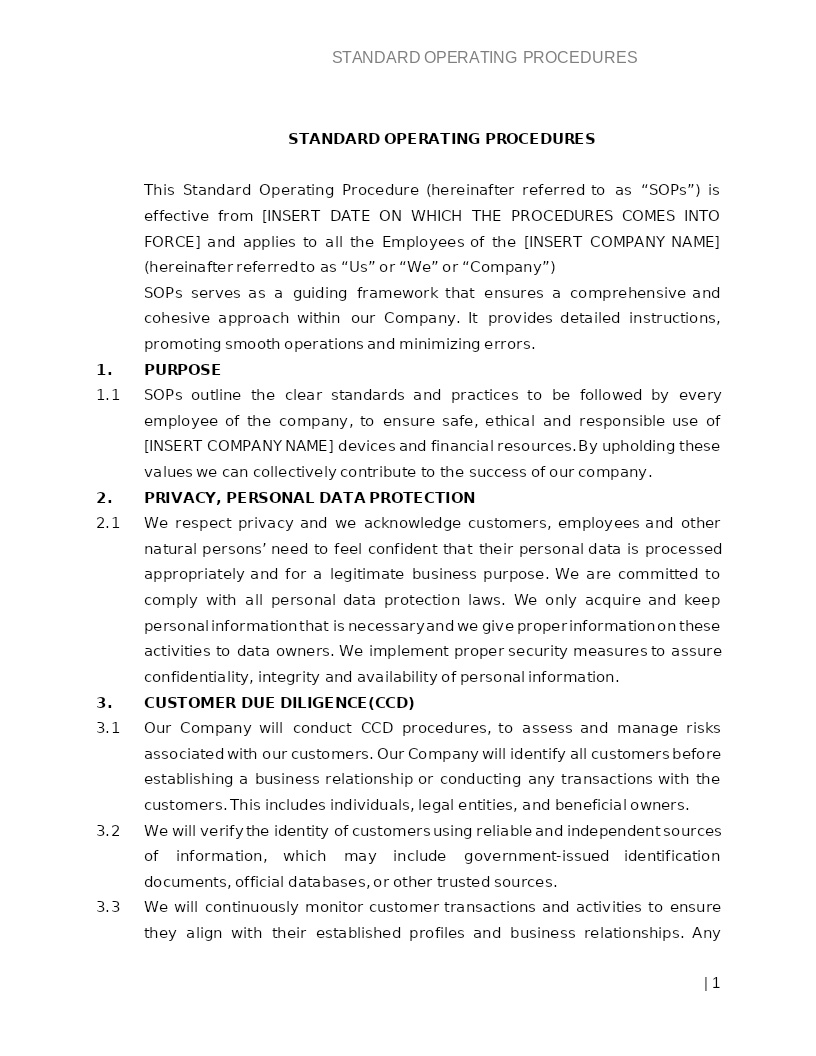
STANDARD OPERATING PROCEDURES
How does it work?
1. Choose this template
Start by clicking on "Fill out the template"
2. Complete the document
Answer a few questions and your document is created automatically.
3. Save - Print
Your document is ready! You will receive it in Word and PDF formats. You will be able to modify it.
Enhancing Organizational Consistency and Compliance Through Standard Operating Procedures
Standard Operating Procedures (SOPs) are formal, written directives that establish the step-by-step instructions employees must follow to perform specific tasks, processes, or operational functions within an organization. Developed in accordance with U.S. regulatory requirements, industry-specific compliance standards, workplace-safety rules, and internal governance policies, SOPs ensure consistency, reduce operational risks, and help organizations maintain accountability across all levels of operation. These procedures are vital for businesses seeking to achieve uniform performance, reduce errors, streamline workflows, and demonstrate adherence to legal or regulatory expectations.
A comprehensive SOP framework provides detailed instructions governing how work must be performed, identifies the personnel responsible for carrying out each step, and outlines safety, quality, and documentation requirements. SOPs help ensure that employees understand their duties, minimize deviations that could cause compliance violations, and support training, auditing, and quality-control programs. Whether addressing manufacturing processes, information technology operations, customer service, laboratory procedures, or administrative workflows, SOPs serve as the backbone of an organization’s operational integrity.
Where Standard Operating Procedures Are Commonly Used
SOPs are utilized across a broad spectrum of industries and organizational environments, including:
- Manufacturing facilities implementing OSHA safety rules and quality-control requirements
- Healthcare and laboratory environments governed by FDA, HIPAA, and CLIA regulations
- Financial services firms bound by SEC, FINRA, and anti-fraud compliance rules
- Government contractors and defense organizations adhering to federal operational standards
- Corporate offices seeking consistency in HR, IT, procurement, and administrative processes
- Food processing, hospitality, and retail businesses ensuring health and sanitation compliance
- Technology companies executing cybersecurity, software deployment, and system management procedures
- Educational institutions managing accreditation, classroom protocols, and administrative tasks
SOPs ensure that operations remain precise, efficient, and legally compliant in any setting where standardized task execution is critical.
Different Types of Standard Operating Procedures
1. Process-Based SOPs: Detail multi-step processes, outlining responsibilities and order of operations.
2. Procedural SOPs: Provide specific instructions for performing a defined task from start to finish.
3. Checklist SOPs: Summarize required actions in list format for fast, consistent task completion.
4. Hierarchical SOPs: Break processes into sub-steps, ideal for complex or technical workflows.
5. Regulatory Compliance SOPs: Ensure processes comply with U.S. legal standards, including OSHA, FDA, and environmental laws.
When Legal Guidance Becomes Helpful
Legal assistance may be required when:
- SOPs must comply with federal regulations governing safety, privacy, labor, or industry-specific operations
- Procedures relate to hazardous materials, controlled substances, or regulated activities
- The organization is subject to audits, inspections, or certification reviews
- SOPs involve employee monitoring, data handling, or privacy-sensitive tasks
- Workplace safety or OSHA compliance is implicated
- SOP deviations could result in litigation, liability, or regulatory penalties
- The business must incorporate whistleblower protections or mandatory reporting requirements
- SOPs interact with contractual obligations imposed on government contractors or regulated entities
Legal review helps ensure that SOPs align with U.S. regulatory frameworks, protect the organization from liability, and support defensible compliance practices.
How to Work with This Template
- Identify each task or process requiring standardized instructions
- Break down tasks into clearly defined steps and assign responsibility to specific employees
- Incorporate applicable federal and state legal requirements, quality standards, and safety protocols
- Include definitions, performance measures, documentation requirements, and escalation procedures
- Outline the equipment, tools, or software required for each step
- Provide detailed instructions for handling exceptions, emergencies, or deviations
- Establish training requirements and competency-verification procedures
- Require periodic SOP reviews to reflect changes in law, technology, or business needs
- Ensure employees acknowledge their understanding of SOPs through written or electronic means
- Maintain SOP documentation in secure and accessible repositories for audit and inspection
This template aligns with standard U.S. operational and compliance expectations, making it suitable for businesses of all industries and sizes.
Frequently Asked Questions
Q1. What are Standard Operating Procedures, and why are they important?
Standard Operating Procedures are detailed instructions that guide employees in completing tasks consistently and correctly. They are important because they ensure operational accuracy, compliance with U.S. laws, and uniformity across organizational functions.
Q2. Are SOPs required by law?
In certain industries such as healthcare, pharmaceuticals, aviation, manufacturing, or food processing SOPs are legally required under federal and state regulations.
Q3. Do SOPs need to be updated regularly?
Yes. SOPs should be reviewed and updated periodically to reflect new laws, safety guidelines, technologies, or business changes.
Q4. Do employees need training on SOPs?
Absolutely. Proper training ensures that employees understand and can perform required procedures accurately and safely.
Q5. Can digital or electronic SOPs be used?
Yes. Electronic SOPs are valid and commonly used, provided they are accessible, secure, and comply with documentation-retention laws.
Q6. Are SOPs legally enforceable in employment settings?
Yes. SOPs may be incorporated into employment policies and used to evaluate performance or enforce disciplinary measures.
Q7. What happens if employees fail to follow SOPs?
Failure to follow SOPs can lead to operational errors, safety incidents, regulatory penalties, or disciplinary action.
Q8. Should SOPs include safety instructions?
Yes. Safety protocols especially when dealing with machinery, hazardous materials, or regulated environments are essential.
Q9. Can SOPs help during audits or inspections?
Yes. Auditors rely on SOPs to verify compliance, operational consistency, and adherence to regulatory standards.
Q10. Should legal counsel review SOPs?
Yes. In regulated industries or environments with high liability risks, legal review ensures SOPs conform to U.S. regulations and protect the organization.