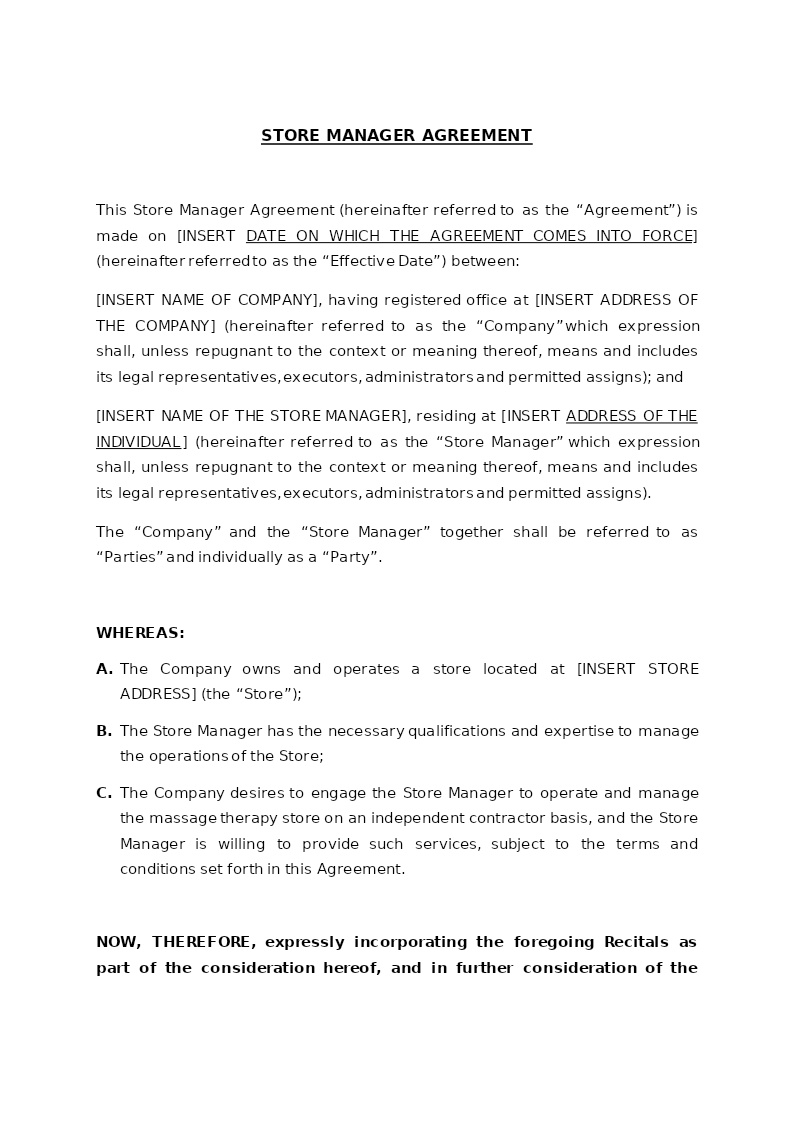
STORE MANAGER AGREEMENT
How does it work?
1. Choose this template
Start by clicking on "Fill out the template"
2. Complete the document
Answer a few questions and your document is created automatically.
3. Save - Print
Your document is ready! You will receive it in Word and PDF formats. You will be able to modify it.
Understanding the Purpose of a Store Manager Agreement
When a business appoints an individual to manage store operations, it is essential to define expectations, duties, and employment terms clearly. A Store Manager Agreement provides this structure. It outlines the manager’s responsibilities, authority levels, performance expectations, working hours, compensation, and conduct requirements to ensure smooth store management.
Putting this agreement in place strengthens accountability, improves operational consistency, and ensures both parties share an understanding of their rights and obligations. It also serves as a formal reference that supports compliance with employment laws and helps prevent misunderstandings throughout the manager’s tenure.
Where Store Manager Agreements Are Commonly Used
Store Manager Agreements are standard in various retail and service-based environments, such as:
- Retail stores, boutiques, supermarkets, and franchise locations
- Restaurants, cafés, and hospitality operations
- Warehouses, specialty shops, and outlet stores
- Multi-location chains that require standardized managerial roles
- Service-based businesses with in-person customer engagement
- Seasonal or high-traffic businesses requiring structured leadership
Any time a business relies on a manager to oversee customers, staff, inventory, and store performance, this agreement establishes clear expectations and operational guidelines.
Different Types of Store Manager Agreements You May Encounter
- Employment-Based Store Manager Agreement: Used when the manager is hired as a full-time or part-time employee with salary, benefits, and defined duties.
- Contractual Store Manager Agreement: Used for independent contractors or temporary managers hired for specific operational periods.
- Franchise Store Manager Agreement: Tailored for franchise-based operations that require strict adherence to brand standards and corporate policies.
- Performance-Based Manager Agreement: Used when compensation includes incentives tied to sales goals, store performance, or customer satisfaction metrics.
- Multi-Store Manager Agreement: Designed for managers who oversee multiple locations and require broader authority and operational control.
When Legal Guidance Becomes Helpful
While many Store Manager Agreements follow standard frameworks, professional legal guidance becomes important when:
- Compensation includes bonuses, commissions, or profit-sharing
- The store operates across multiple states or jurisdictions
- The agreement includes non-compete, non-solicitation, or confidentiality obligations
- Managers handle sensitive business information or financial reporting
- Termination, disciplinary, or performance-related procedures require careful legal wording
- The business operates in a regulated industry such as alcohol, cannabis, or pharmaceuticals
- The manager oversees large teams, high-value inventory, or multi-location operations
Legal review ensures the agreement is enforceable, fully compliant with U.S. employment laws, and tailored to the company’s operational structure.
How to Work with This Template
- Identify the parties and clearly define the manager’s role and authority
- Specify work hours, compensation, performance metrics, and reporting structures
- Define operational duties such as staff supervision, customer service, inventory control, and sales management
- Add provisions for confidentiality, company policies, and disciplinary procedures
- Choose a governing state law and ensure compliance with employment regulations
- Review the terms with HR and legal teams before finalizing
This template follows widely recognized U.S. employment and operational standards and can be adapted for retail, service-based, or franchise environments.
Frequently Asked Questions
Q1. What is a Store Manager Agreement and why is it important?
A Store Manager Agreement formally defines the store manager’s duties, performance expectations, compensation, and workplace responsibilities. It helps ensure both the manager and the company understand their obligations. The agreement reduces conflicts by setting clear rules. It also creates accountability and supports efficient store operations.
Q2. What key elements should be included in a Store Manager Agreement?
Important elements include job duties, reporting structure, salary, work hours, performance standards, confidentiality requirements, disciplinary actions, and termination terms. These components help set clear expectations from day one. A complete agreement also outlines benefits and employer policies. This ensures fairness and operational clarity.
Q3. How does a Store Manager Agreement protect business interests?
The agreement safeguards business assets by including confidentiality, non-solicitation, and conduct requirements. It prevents misuse of proprietary information, customer data, or internal systems. Clear rules help protect inventory, revenue, and brand reputation. Legal protections ensure the manager adheres to company standards.
Q4. Does a Store Manager Agreement help reduce workplace disputes?
Yes. The agreement acts as a reference document for resolving disagreements. When conflicts arise regarding responsibilities, pay, or performance, both parties can rely on the written terms. This reduces misunderstandings and supports fair decision-making. Clear documentation helps avoid escalation.
Q5. Can a Store Manager Agreement include performance-based incentives?
Absolutely. Many businesses link manager compensation to store performance metrics such as sales targets, customer satisfaction, or operational efficiency. The agreement can outline bonus structures, incentive plans, and performance criteria. This motivates managers and aligns their goals with the company’s objectives.
Q6. Is it necessary for a Store Manager Agreement to comply with state employment laws?
Yes. Employment laws, wage rules, overtime regulations, and workplace safety requirements vary by state. Ensuring the agreement complies helps reduce legal risks and protects both parties. Legal review also ensures enforceability. Compliance is crucial for multi-location businesses.
Q7. Can the agreement be modified after signing?
Yes, modifications can be made if both parties agree in writing. Updates may be necessary when job responsibilities change, store operations expand, or company policies evolve. Documenting changes ensures transparency. This keeps the agreement aligned with business needs.
Q8. Who should sign a Store Manager Agreement?
Both the store manager and an authorized representative of the business must sign the agreement. Signing acknowledges that both parties understand and accept the terms. Signatures also make the agreement legally binding. Digital signatures are acceptable and legally enforceable under U.S. law.