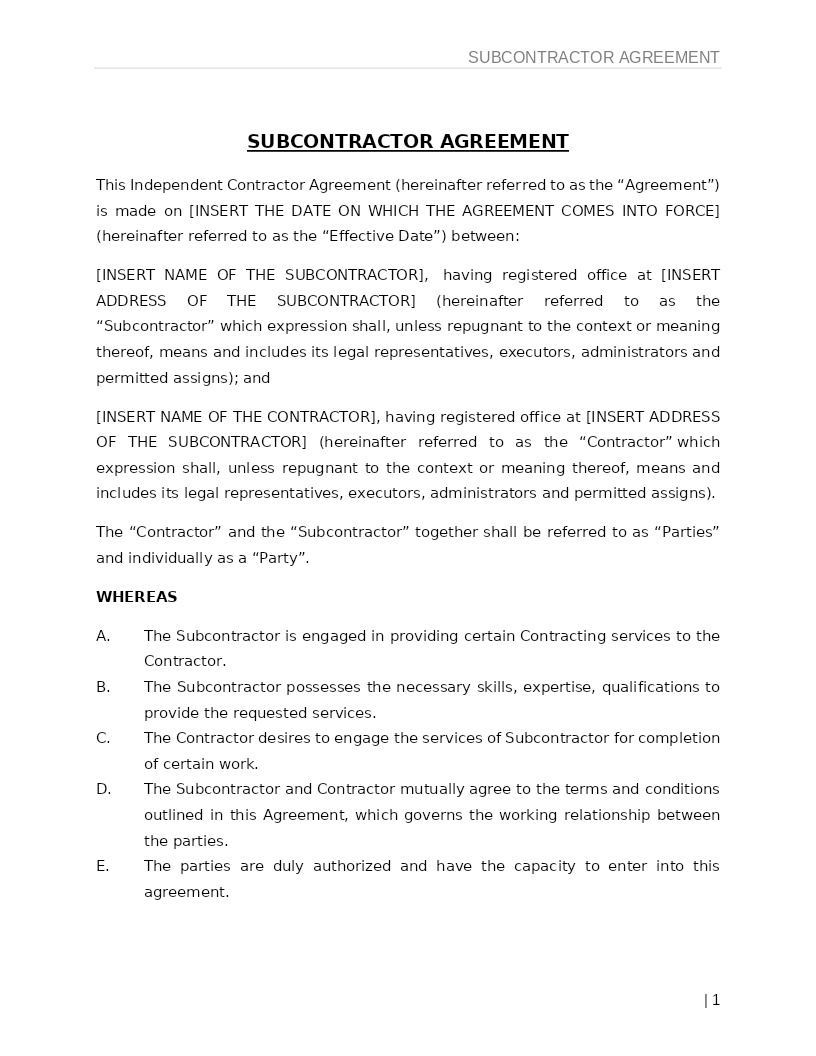
SUBCONTRACTOR AGREEMENT
How does it work?
1. Choose this template
Start by clicking on "Fill out the template"
2. Complete the document
Answer a few questions and your document is created automatically.
3. Save - Print
Your document is ready! You will receive it in Word and PDF formats. You will be able to modify it.
Understanding Subcontractor Relationships in the United States
A Subcontractor Agreement is a legally binding contract between a primary contractor and a subcontractor that defines the work to be performed on a project. It outlines critical details such as the scope of services, performance standards, payment terms, deliverables, compliance requirements, and liability responsibilities.
In the United States, these agreements play a key role in construction, technology, manufacturing, professional services, and various project-based industries. They ensure that subcontractors operate in alignment with the contractor’s obligations, industry regulations, and client expectations.
A well-drafted Subcontractor Agreement helps protect both parties by ensuring quality work, maintaining safety standards, clarifying responsibilities, and reducing risks associated with subcontractor performance.
Where Subcontractor Agreements Are Commonly Used
Subcontractor Agreements are standard in a wide variety of U.S. industries, including:
- Construction, real estate development, and renovation projects
- IT services, software development, and cybersecurity
- Marketing, content creation, and digital media services
- Logistics, warehousing, and transportation
- Manufacturing and product assembly
- Engineering, architecture, and design consulting
- Maintenance, repair, and trade services
- Healthcare, biotech, and laboratory support work
Any time a contractor outsources specialized work or requires additional expertise, a Subcontractor Agreement provides a clear operational framework.
Different Types of Subcontractor Agreements You May Encounter
- General Subcontractor Agreement: Covers labor, materials, or general project tasks performed under the contractor’s supervision.
- Trade-Specific Subcontractor Agreement: Used for specialized trades such as electrical, plumbing, HVAC, welding, or engineering.
- Professional Services Subcontractor Agreement: Covers services like consulting, design work, IT development, content creation, or administrative support.
- Independent Contractor/Subcontractor Hybrid Agreement: Used when a subcontractor provides remote or non-site-specific work in addition to project-related tasks.
- Labor-Only Subcontractor Agreement: Applies when labor is provided without materials or equipment.
- Turnkey or Deliverable-Based Agreement: Subcontractor provides a finished product, software module, or completed deliverable rather than ongoing labor.
When Legal Guidance Becomes Helpful
While many subcontracting relationships seem straightforward, legal guidance is often essential because subcontractors are bound by the contractor’s obligations to the client. Legal review is especially valuable when:
- The project involves federal or state regulations, such as OSHA, EPA, DOT, or building codes
- The subcontractor handles confidential or proprietary information
- The work involves construction risk, safety issues, or hazardous materials
- Complex intellectual property, software development, or licensing is involved
- The contractor must flow down obligations from a prime contract
- Insurance, indemnity, or bonding requirements are significant
- Multistate or remote work introduces jurisdictional considerations
- Strict timelines or deliverables could cause financial penalties
Legal involvement ensures the agreement is enforceable, compliant, and protective, reducing risk for both parties.
How to Work With This Template
- Identify the contractor and subcontractor with complete details
- Define the scope of work, deliverables, and milestones clearly
- Specify performance standards, quality requirements, and deadlines
- Outline payment terms, rates, and invoicing procedures
- Include insurance, indemnity, and liability obligations
- Add confidentiality, IP ownership, and non-disclosure terms
- Reference any prime contract requirements that must be followed
- State applicable federal, state, and industry regulations
- Select the governing U.S. state law
- Review terms together (legal consultation recommended)
- Sign electronically or in hard copy
This template aligns with U.S. commercial contracting standards and is compatible with all major digital signature platforms.
Frequently Asked Questions
1. What is a Subcontractor Agreement used for in the U.S.?
A Subcontractor Agreement outlines tasks a subcontractor must perform for a contractor on a project. It clarifies responsibilities, manages expectations, and ensures compliance with U.S. industry regulations, safety standards, and contractual obligations.
2. Is a Subcontractor Agreement legally enforceable?
Yes. When properly drafted, signed, and compliant with applicable federal and state laws, a Subcontractor Agreement is fully enforceable in U.S. courts. Clear terms greatly reduce disputes.
3. Does a subcontractor become an employee?
No. A subcontractor is an independent contractor unless otherwise classified. The agreement should clearly state independent contractor status to avoid misclassification issues under IRS and state laws.
4. What key details must be included to protect both parties?
Essential elements include: the scope of work, payment terms, insurance requirements, safety obligations, deadlines, indemnity clauses, and dispute resolution procedures.
5. Can this agreement include confidentiality and IP ownership terms?
Absolutely. Many U.S. projects require subcontractors to sign confidentiality clauses and assign IP ownership to the contractor or client, especially in technology, design, and engineering fields.
6. Are subcontractors required to carry insurance?
Most U.S. subcontractors must carry liability insurance, workers’ compensation (if applicable), and sometimes professional liability coverage. The agreement should specify the required insurance limits.
7. What happens if the subcontractor does not complete the work?
The agreement may allow for corrective work, withholding payment, termination, or legal remedies. Clear performance standards reduce the risk of non-completion or unsatisfactory work.
8. Can this agreement be used for remote or out-of-state subcontractors?
Yes. Subcontractor Agreements work across all U.S. states. However, the contract should specify governing law, jurisdiction, and compliance with the subcontractor’s local regulations.
9. Is a written Subcontractor Agreement necessary for small jobs?
Yes. Even small projects benefit from a written agreement to prevent misunderstandings, document expectations, and protect both parties from liability or payment disputes.
10. Can the agreement be modified later?
Definitely. Amendments can be added at any time if both parties agree in writing. This is common when project scopes expand or additional tasks are assigned.