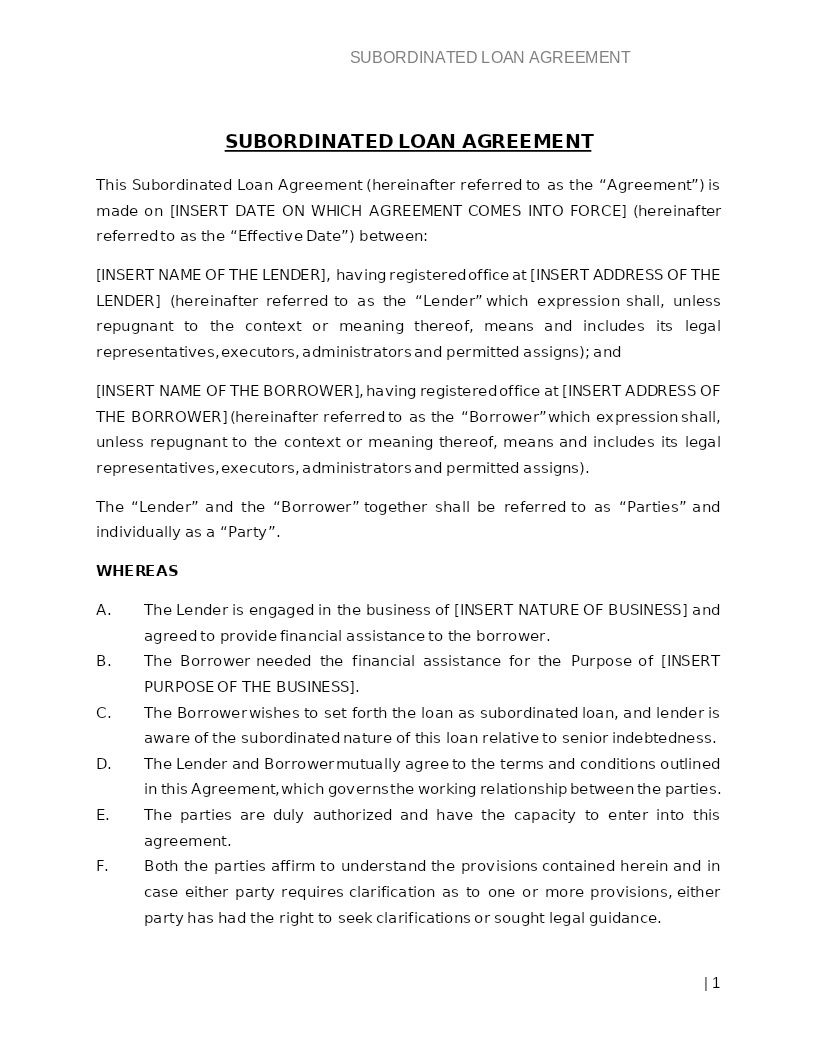
SUBORDINATED LOAN AGREEMENT
How does it work?
1. Choose this template
Start by clicking on "Fill out the template"
2. Complete the document
Answer a few questions and your document is created automatically.
3. Save - Print
Your document is ready! You will receive it in Word and PDF formats. You will be able to modify it.
Understanding Subordinated Debt in Business and Real Estate Financing
A Subordinate Loan Agreement is a legally enforceable contract that sets the terms of a loan that is junior in priority to other existing debts. In a financial structure, subordinated loans sit below senior loans, meaning they are repaid only after senior creditors have been satisfied. These agreements are widely used in U.S. commercial financing, real estate development, private lending, mergers, leveraged buyouts, and layered capital structures.
For borrowers, subordinated loans offer an opportunity to raise additional capital without disrupting existing financing arrangements. For lenders, subordinated positions come with higher risk but also often feature higher interest rates and favorable returns. A clear, well-drafted Subordinate Loan Agreement ensures transparency in repayment order, interest obligations, default procedures, and lender rights, allowing both parties to manage financial risk strategically.
Where Subordinate Loan Agreements Are Commonly Used
Subordinate Loan Agreements are often used in complex financial structures, including:
- Business expansions requiring layered financing
- Real estate development projects with multiple lenders
- Corporate acquisitions, leveraged buyouts, or recapitalizations
- Start-ups raising capital alongside senior bank funding
- Investor-backed financing arrangements
- Infrastructure or capital-intensive project funding
- Refinancing strategies that maintain senior lender protections
These agreements help coordinate multiple lenders while giving borrowers access to additional capital beyond traditional senior loans.
Different Types of Subordinate Loan Agreements You May Encounter
- Mezzanine Loans: Hybrid debt-equity structures that offer higher returns in exchange for higher risk.
- Junior Term Loans: Traditional loans ranking below senior debt in repayment hierarchy.
- Subordinated Notes or Bonds: Debt securities issued by corporations that are legally junior to other obligations.
- Intercreditor Subordination Agreements: Contracts between multiple lenders explaining how repayment priority and enforcement will be handled.
- Real Estate Subordinated Loans: Used when developers or investors need secondary financing behind a primary mortgage.
When Legal Guidance Becomes Helpful
Subordinated loans can involve complex legal and financial risks, making legal review particularly valuable when:
- Multiple lenders must agree on repayment hierarchy
- The borrower has significant existing debt or liens
- The loan includes equity kickers, warrants, or convertible features
- The project involves high-value real estate or commercial financing
- The parties negotiate intercreditor or subordination terms
- The loan is part of a merger, acquisition, or private equity transaction
- There are concerns about bankruptcy priority or enforceability
Legal counsel ensures that the rights of both senior and subordinated lenders are properly documented and that the borrower understands the long-term implications of subordinate debt.
How to Work with This Template
- Identify the borrower, senior lender(s), and subordinate lender(s)
- Outline the loan amount, repayment schedule, and interest structure
- Set clear subordination terms and repayment priority
- Define events of default and lender remedies
- Clarify whether prepayment is allowed and under what conditions
- Include intercreditor terms or cross-default provisions if needed
- Specify governing state law and dispute resolution procedures
- Sign electronically or in hard copy
This template follows commonly accepted U.S. lending practices and can be adapted for corporate, real estate, or investor-backed financing transactions.
Frequently Asked Questions
Q1. How does a Subordinate Loan Agreement work in U.S. financing?
A Subordinate Loan Agreement clearly defines that the subordinated lender will be repaid only after the senior lender’s debts are fully satisfied. This repayment hierarchy becomes especially important if the borrower defaults, sells assets, or undergoes bankruptcy. By acknowledging this lower priority upfront, both parties enter the arrangement with transparency, reducing conflict and helping lenders assess risk and potential return.
Q2. Why would a borrower choose a subordinated loan instead of traditional financing?
Subordinated loans give borrowers access to additional funding when senior lenders are unwilling to lend more or when the borrower wants to preserve existing loan structures. Businesses often use subordinate loans to finance expansions, equipment, or acquisitions without disrupting senior debt covenants. This flexibility helps companies unlock growth opportunities while maintaining good relationships with primary lenders.
Q3. What benefits do subordinated lenders receive, despite higher risk?
Because subordinated lenders take on more risk, particularly in default or liquidation scenarios, they often receive higher interest rates, equity participation rights, or other enhanced financial incentives. These higher returns can make subordinate loans attractive for private investors, mezzanine lenders, or financial institutions seeking higher yield opportunities.
Q4. How does subordination affect repayment during borrower default?
If a borrower defaults, the senior lender has first claim to the borrower’s assets. Only after the senior lender is fully repaid can the subordinated lender collect. This structure is usually reinforced through intercreditor agreements that outline how each lender can enforce rights, initiate legal action, or negotiate restructuring terms. Understanding these priority rules is critical for both lenders.
Q5. Can subordinated loans include additional protective terms for lenders?
Yes. Subordinated lenders may negotiate terms such as conversion rights, equity warrants, prepayment penalties, higher interest rates, or financial reporting requirements. These provisions help offset risk and provide additional value. The agreement should clearly outline these protections to avoid disputes with senior lenders or the borrower.
Q6. Are Subordinate Loan Agreements enforceable in all U.S. states?
Yes, Subordinate Loan Agreements are widely enforceable when properly drafted. However, each state has its own lending regulations, interest rate limitations, and creditor priority rules. Choosing a governing law such as Delaware, New York, or California ensures predictability and consistency. Legal review helps verify that the agreement complies with relevant state lending laws and bankruptcy rules.
Q7. How does subordination impact bankruptcy proceedings?
In bankruptcy, subordinated lenders are repaid only after secured creditors and senior unsecured creditors. This significantly increases their risk of loss but also explains why subordinated loans typically yield higher returns. The agreement should explicitly state the lender’s acceptance of this risk and outline how claims will be treated under federal bankruptcy laws.
Q8. Can these agreements be executed electronically?
Yes. Under the ESIGN Act and UETA, Subordinate Loan Agreements can be validly signed electronically. E-signatures streamline the loan process, especially when multiple lenders or parties across different states are involved.
Q9. Should businesses consult attorneys before entering a subordinated loan arrangement?
Yes. Because subordinated loans affect capital structure, creditor rights, and long-term financial obligations, attorney review is strongly recommended. Lawyers can identify risks, negotiate intercreditor arrangements, ensure enforceability, and protect the borrower’s or lender’s interests in complex financial transactions.