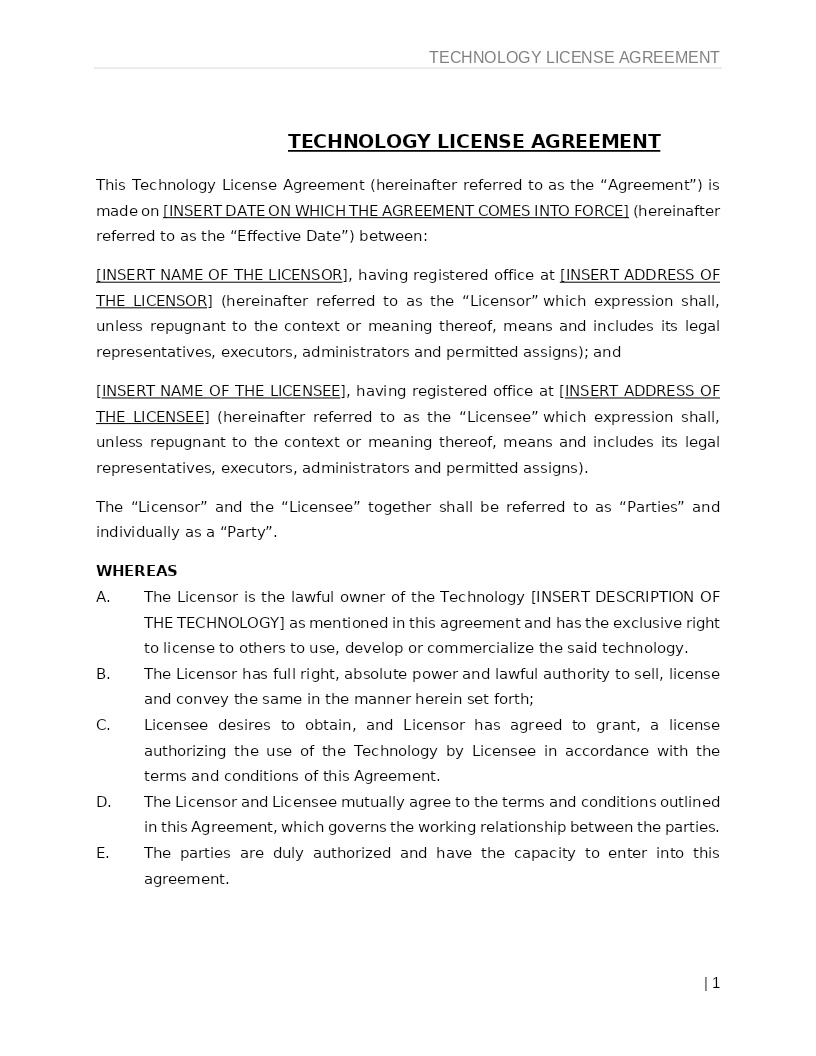
TECHNOLOGY LICENSE AGREEMENT
How does it work?
1. Choose this template
Start by clicking on "Fill out the template"
2. Complete the document
Answer a few questions and your document is created automatically.
3. Save - Print
Your document is ready! You will receive it in Word and PDF formats. You will be able to modify it.
Licensing Proprietary Technology in Commercial Transactions
When parties intend to grant rights to use, develop, distribute, or commercialize proprietary technology, it is essential to establish a clear contractual framework defining such rights. A Technology License Agreement fulfills this purpose. It delineates the terms under which the licensor grants to the licensee certain authorized rights in intellectual property, including software, hardware designs, trade secrets, patented inventions, and related documentation—subject to U.S. intellectual property laws, federal regulations, and applicable state contract statutes.
By executing a Technology License Agreement, the parties establish a legally enforceable understanding that governs the scope of permitted use, ownership of improvements, confidentiality of proprietary materials, compensation arrangements, and limitations on sublicensing or redistribution. The agreement ensures that the technology can be used by the licensee without infringing upon the licensor’s rights while protecting the licensor from unauthorized exploitation or disclosure.
Where Technology License Agreements Are Commonly Used
Technology licensing arrangements are widely used across commercial, research, and industrial sectors, including:
- Software-as-a-Service (SaaS) and platform licensing
- Licensing of proprietary algorithms, code bases, and digital tools
- Transfer or use of patented or patent-pending inventions
- University research commercialization and technology transfer
- Hardware design, engineering specifications, or prototype usage
- Medical, pharmaceutical, or biotechnology innovation licensing
- Joint development projects and collaborative R&D initiatives
- Distribution, OEM, and white-label technology arrangements
Whenever proprietary technology is shared or commercialized, a Technology License Agreement defines the legal parameters of use.
Different Types of Technology License Agreements You May Encounter
- Exclusive License Agreements: Grant the licensee sole rights to use, commercialize, and exploit the technology within a defined field or territory.
- Non-Exclusive License Agreements: Permit multiple users to access the technology concurrently under separate licenses.
- Sole License Agreements: Allow the licensee exclusive rights but permit the licensor to continue using the technology independently.
- Perpetual or Term-Limited Licenses: Define whether rights are granted indefinitely or for a specific duration.
- Sub-licensing Arrangements: Permit the Licensee to grant rights to third parties, subject to the Licensor’s conditions.
When Legal Guidance Becomes Helpful
Legal counsel may be advisable when:
The technology involves patented, confidential, or high-value IP
- Multiple parties contribute to development or ownership of improvements
- The technology is licensed across state or international borders
- The agreement requires complex royalty, milestone, or usage-based compensation
- Government-funded research or export-control laws apply
- The license involves regulated industries like pharmaceuticals, aerospace, finance, or health data
- Disputes may arise concerning ownership of enhancements or derivative works
Professional review helps ensure compliance with U.S. IP laws, reduces ambiguity, and protects both parties from unintended risks.
How to Work With This Template
- Identify the Licensor and Licensee
- Describe the licensed technology, including IP components, documentation, and related materials. Specify the scope of the license (exclusive, non-exclusive, field-specific, territory-specific)
- Outline restrictions on use, distribution, modification, or reverse engineering
- Establish payment terms, royalties, and reporting obligations
- Specify confidentiality, compliance, and data-security requirements
- Select the governing state law and jurisdiction
- Execute the agreement electronically or in writing
This template conforms to widely accepted U.S. intellectual property and commercial contract practices and is compatible with major e-signature platforms.
Frequently Asked Questions
1. What is a Technology License Agreement, and why is it important?
A technology license agreement is a legally binding contract granting a licensee the right to use specific proprietary technology while the licensor retains ownership. It is important because it defines permissible uses, fees or royalties, restrictions, confidentiality obligations, and legal protections under U.S. intellectual property laws.
2. Does a Technology License Agreement transfer ownership of the IP?
No. Licensing provides usage rights, not ownership. The licensor retains full ownership of the underlying technology, unless the agreement expressly states otherwise.
3. What types of technology can be licensed?
Software, SaaS platforms, inventions, patents, algorithms, trade secrets, hardware designs, R&D materials, technical documentation, prototypes, databases, and digital tools can all be licensed through a Technology License Agreement.
4. Is a written license agreement required under U.S. law?
Yes. For intellectual property rights—especially patents, copyrights, and trade secrets—a written agreement is essential to establish valid, enforceable licensing terms and prevent unauthorized use.
5. Can a licensee modify the technology?
Only if the agreement explicitly permits modifications, derivative works, or integration with other systems. Otherwise, such activities may violate intellectual property rights or confidentiality obligations.
6. Are royalties required in a technology license?
Not always. Compensation may take the form of royalties, fixed fees, usage-based charges, milestone payments, or subscription models. The agreement should clearly detail the payment structure.
7. Can the licensee sublicense the technology?
Sublicensing is allowed only if expressly granted. Many agreements restrict sublicensing to protect the licensor’s control over their intellectual property.
8. What happens if the licensee breaches the agreement?
A breach may result in termination of the license, injunctive relief, damages, or immediate revocation of access. Technology License Agreements often include strict enforcement rights to protect proprietary material.
9. Are electronic signatures valid for technology licenses?
Yes. Under the U.S. ESIGN Act, electronic signatures are legally enforceable, and most technology agreements are routinely signed electronically.
10. Does this agreement apply to international licensing?
Yes, but international licensing may require additional compliance steps related to export controls, data privacy laws, and foreign IP protections. The parties should consider these factors when licensing technology abroad.
11. Who owns improvements or derivative works?
Ownership depends on contractual terms. Some agreements grant the licensor ownership of all improvements, while others allocate ownership based on who created the enhancements. Clear drafting avoids disputes.
12. Can this agreement be used for joint development projects?
Yes. Technology License Agreements are commonly used alongside Joint Development Agreements to define rights in shared or jointly created technology.