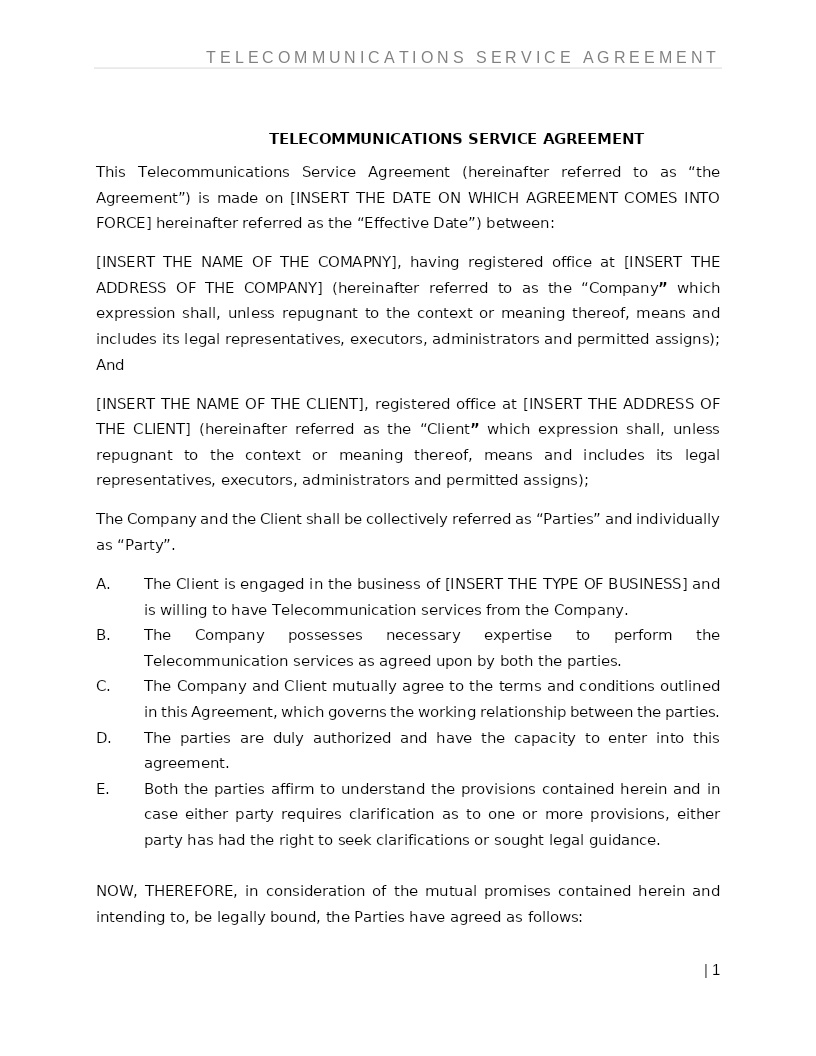
TELECOMMUNICATION SERVICES AGREEMENT
How does it work?
1. Choose this template
Start by clicking on "Fill out the template"
2. Complete the document
Answer a few questions and your document is created automatically.
3. Save - Print
Your document is ready! You will receive it in Word and PDF formats. You will be able to modify it.
Understanding Telecommunication Services Agreements
When a business relies on phone systems, internet connectivity, networking infrastructure, or managed communication services, it’s important to have a clear framework that defines how those services will be delivered. A Telecommunication Services Agreement provides that structure. It outlines the scope of communication services, performance standards, uptime commitments, equipment responsibilities, data usage rules, and what each party is expected to do to keep services running smoothly.
Putting a Telecommunication Services Agreement in place creates clarity and reliability, allowing both the service provider and the customer to understand the terms, service levels, response times, and limitations without any confusion.
Where Telecommunication Services Agreements Are Commonly Used
Telecommunication contracts are standard across industries that depend on continuous, secure, and high-quality communication services, including:
• Businesses using VoIP, PBX systems, or cloud calling platforms
• Organizations relying on dedicated internet access or fiber connectivity
• Managed services for data networks, routers, switches, and security systems
• Satellite, broadband, and wireless internet service providers
• Corporations using unified communication solutions
• Customer support centers and remote-work communication systems
• Government, healthcare, and financial institutions requiring secure networks
Any time a business receives telecom services or relies on a provider’s equipment and infrastructure, this agreement sets clear boundaries and expectations.
Different Types of Telecommunication Agreements You May Encounter
- Internet or Broadband Service Agreements: For fiber, cable, DSL, wireless, or satellite connectivity.
- Voice & VoIP Service Agreements: Covering digital phone systems, SIP trunks, and call routing technology.
- Managed Network Service Agreements: Including routers, switches, firewalls, data circuits, and performance monitoring.
- Mobile or Wireless Communication Agreements: For corporate cellular plans, device bundles, or IoT/M2M connections.
- Data Center & Cloud Communication Contracts: Covering hosted communication platforms, PBX systems, and cloud integrations.
When Legal Guidance Becomes Helpful
Many telecom arrangements are straightforward, but legal guidance becomes valuable when:
• The service includes mission-critical communication infrastructure
• Performance and uptime guarantees (SLAs) involve penalties or credits
• The provider installs equipment on the customer’s property
• The agreement spans multiple locations or jurisdictions
• Data privacy, cybersecurity, or compliance standards (HIPAA, SOC 2, FCC rules) apply
• The customer requires tailored service levels, redundancy, or failover protection
• Long-term commitments involve automatic renewals or early-termination fees
A review helps ensure the agreement protects business continuity, clarifies responsibilities, and aligns with applicable U.S. regulations.
How to Work with This Template
• Identify the service provider and customer
• Clearly state the type of telecom services being supplied
• Describe service levels, uptime standards, and support response times
• Specify equipment responsibilities i.e. owned, leased, or provided
• Select the governing state law
• Outline pricing, billing frequency, and term length
• Review the terms together and adjust for technical requirements
• Sign electronically or in hard copy
The template aligns with widely accepted U.S. telecom service practices and is compatible with all major e-signature platforms.
Frequently Asked Questions
Q1. Is a Telecommunication Services Agreement necessary for basic internet service?
Yes. Even basic internet or phone service involves responsibilities for installation, maintenance, uptime, and usage. A written agreement ensures both parties understand the service expectations.
Q2. Can the same agreement be reused for multiple locations?
Yes, but you should update service details for each location, such as bandwidth levels, equipment, and installation timelines, to maintain clarity and enforceability.
Q3. What happens if the telecom provider does not meet the promised uptime?
Most agreements include Service Level Agreements (SLAs) that may offer service credits or escalation procedures. Reviewing these provisions helps assess how outages are handled.
Q4. Are electronic signatures enforceable for telecom contracts?
Yes. U.S. federal and state laws recognize e-signatures as valid once both parties consent to signing electronically.
Q5. Does this agreement cover data privacy and cybersecurity?
It can. You may include terms addressing data protection, encryption standards, network security, and compliance with industry regulations such as HIPAA, SOC 2, or FCC requirements.
Q6. Can businesses negotiate telecom agreements?
Absolutely. Terms like bandwidth speeds, response times, installation fees, auto-renewals, and early-termination provisions are often negotiable, especially for long-term or multi-site contracts.
Q7. What if equipment is damaged or fails?
The agreement typically explains who owns the equipment, who is responsible for repairs, and whether maintenance is included as part of the service plan.
Q8. Does this cover VoIP and cloud communication platforms?
Yes. VoIP systems, hosted PBX solutions, and cloud-based communication tools can all be included under a Telecommunication Services Agreement.
Q9. Can telecom providers restrict usage?
Yes. Many agreements include acceptable use policies to prevent network abuse, illegal activity, or excessive bandwidth consumption. These rules protect the provider’s infrastructure.
Q10. Is this suitable for small businesses as well?
Definitely. Even small offices depend on stable internet and communication systems. A clear agreement ensures predictable service and cost transparency.