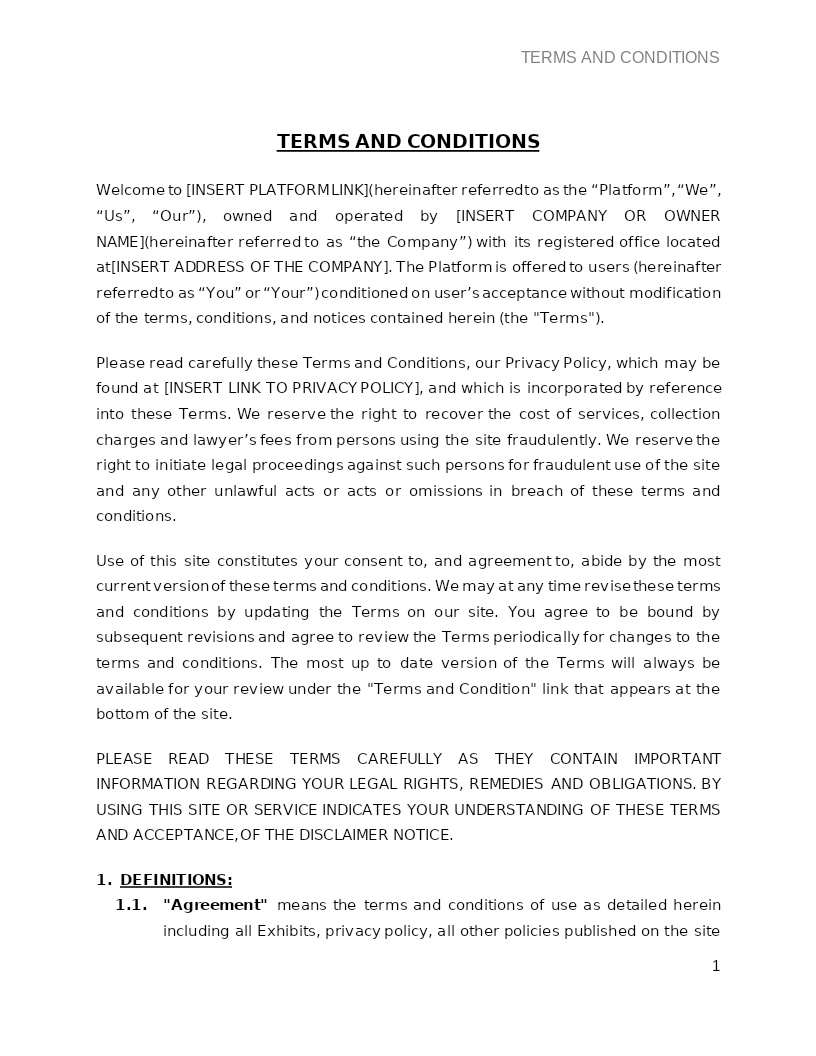
TERMS AND CONDITIONS
How does it work?
1. Choose this template
Start by clicking on "Fill out the template"
2. Complete the document
Answer a few questions and your document is created automatically.
3. Save - Print
Your document is ready! You will receive it in Word and PDF formats. You will be able to modify it.
Understanding General Terms And Conditions in U.S.
General Terms and Conditions are a foundational set of rules that govern the relationship between a business and its customers, clients, or users. These terms define the rights, responsibilities, and legal obligations of each party and establish the framework under which products, services, or digital platforms are used. In the United States, well-drafted Terms and Conditions help ensure compliance with federal and state laws, limit liability, protect intellectual property, and provide clear procedures for payments, dispute resolution, privacy, and service usage. They serve as a legally binding agreement that promotes transparency, safeguards business interests, and ensures smooth business operations.
Where General Terms and Conditions Are Commonly Used
• Service-based companies
• E-commerce websites
• Software and mobile applications
• Professional consulting services
• Subscription platforms
• Contracts for goods or equipment
• Marketing agencies and digital service providers
Any business interacting with customers or clients benefits from standardized Terms and Conditions.
Different Types of General Terms and Conditions
- Sales Terms and Conditions: Cover product sales, pricing, warranties, and delivery.
- Service Terms and Conditions: Define service obligations, limitations of liability, response times, and fees.
- Website or App Terms and Conditions: Include acceptable use policies, intellectual property protection, and user guidelines.
- Subscription or Membership Terms and Conditions: Specify renewal cycles, cancellation policies, and recurring billing details.
- B2B Commercial Terms and Conditions: Cover procurement, commercial warranties, indemnities, and dispute resolution mechanisms.
When Legal Guidance Becomes Necessary
You should consult legal professionals when:
• Your Terms and Conditions affect compliance with U.S. consumer protection, privacy, or e-commerce laws
• You handle personal data and must align with regulations like CCPA, COPPA, or sector-specific laws
• You provide specialized or regulated services (healthcare, finance, education, etc.)
• Contract terms involve limiting liability, indemnification, warranty disclaimers, or arbitration
• Operating across multiple states with differing legal requirements
• You need tailored IP protections, licensing terms, or industry-specific conditions
Legal review ensures your Terms and Conditions are enforceable, comprehensive, and suited to your business.
How to Work With These General Terms and Conditions
• Clearly define your services, pricing, and payment terms
• Establish procedures for termination, refunds, or cancellations
• Add dispute resolution options like mediation or arbitration
• Include IP rights, trademark usage, and confidentiality clauses
• Comply with U.S. data privacy, accessibility, and consumer protection laws
• Ensure users agree explicitly, such as through checkboxes or signature fields
• Regularly update your Terms and Conditions as laws change
This ensures a legally sound and transparent operational framework.
Frequently Asked Questions
Q1. Why are General Terms and Conditions important for U.S. businesses?
General Terms and Conditions create a legally enforceable framework that defines the rights and responsibilities of both parties. They help businesses comply with U.S. commercial, consumer protection, and data privacy laws. By setting clear expectations, they minimize misunderstandings and protect the company from unnecessary legal exposure.
Q2. Do General Terms and Conditions protect against legal disputes?
Yes. By outlining payment rules, liability limitations, service expectations, and dispute resolution procedures, Terms and Conditions significantly reduce the likelihood of conflicts. If a dispute arises, they act as evidence of agreed-upon standards and processes, strengthening the business’s legal position.
Q3. Are Terms and Conditions legally binding in the United States?
They are legally enforceable if presented clearly and accepted by the customer, through a signed agreement, checkbox consent, or continued use of a service. Courts in the U.S. typically uphold well-drafted Terms and Conditions, especially those that are reasonable, transparent, and compliant with state and federal laws.
Q4. Do I need a lawyer to draft or customize Terms and Conditions?
While templates provide a helpful starting point, legal customization is highly recommended. Lawyers ensure your Terms and Conditions comply with U.S. laws, include enforceable clauses, and align with your specific industry and operational needs. This reduces the risk of invalid or non-compliant provisions.
Q5. What should be included in strong Terms and Conditions?
Comprehensive Terms and Conditions include payment terms, warranties, disclaimers, IP protections, privacy practices, termination rights, and dispute resolution procedures. They also define user responsibilities and outline how the business provides services. Each section helps safeguard operations and manage risks.
Q6. Can Terms and Conditions limit my business’s liability?
Yes. They commonly include limitation-of-liability and warranty disclaimer clauses to protect businesses from excessive claims. However, these clauses must comply with U.S. consumer protection laws and cannot waive obligations that are legally required. Proper legal drafting ensures enforceability.
Q7. How often should Terms and Conditions be updated?
Businesses should review them at least annually or whenever there are legal, operational, or technological changes. Updates may be necessary due to new privacy laws, expanded services, revised pricing structures, or customer feedback. Keeping them current ensures ongoing compliance and clarity.
Q8. Are General Terms and Conditions required for online businesses?
Yes, online businesses benefit significantly from clear Terms and Conditions. They help regulate website use, protect intellectual property, manage payment and refund terms, and set rules for user behavior. They also support compliance with U.S. e-commerce regulations, digital privacy laws, and accessibility standards.