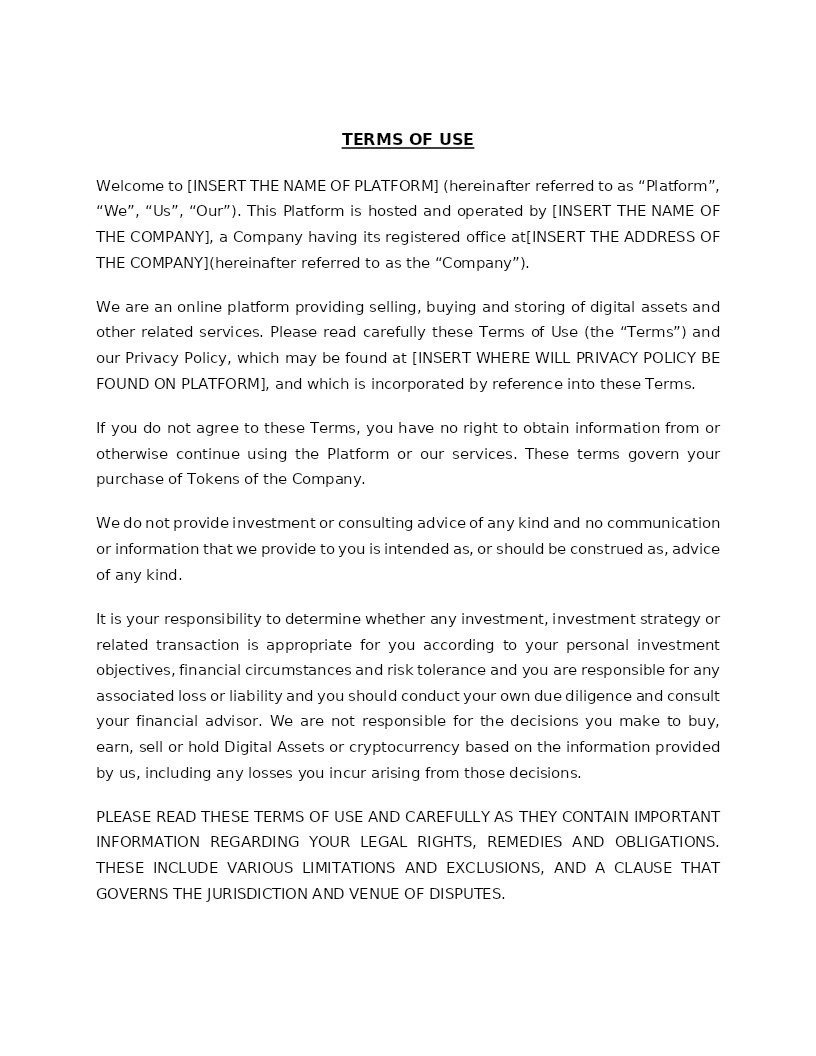
TERMS OF USE- CRYPTOCURRENCY EXCHANGE
How does it work?
1. Choose this template
Start by clicking on "Fill out the template"
2. Complete the document
Answer a few questions and your document is created automatically.
3. Save - Print
Your document is ready! You will receive it in Word and PDF formats. You will be able to modify it.
Understanding Terms of Use for Cryptocurrency Exchanges
When users buy, sell, store, or trade digital assets, it’s essential that both the platform and its users understand their rights and responsibilities. A Cryptocurrency Exchange Terms of Use Agreement provides that framework. It outlines how the exchange operates, what users can and cannot do, the risks involved in digital asset transactions, and the legal obligations of the platform.
Clear Terms of Use create trust and protect users by defining account requirements, trading rules, fees, security expectations, dispute procedures, and regulatory compliance. They also help the platform comply with U.S. laws governing digital assets, anti-fraud measures, and consumer protections.
Where Cryptocurrency Exchange Terms of Use Are Commonly Used
Terms of Use are standard across all digital-asset platforms, including:
• Centralized exchanges (CEX) offering trading, staking, or wallets
• Decentralized exchanges (DEX) enabling peer-to-peer swaps
• NFT marketplaces and digital collectible platforms
• Crypto-based fintech applications or broker services
• Wallet providers that support custody or transactions
• Web3 platforms offering digital tokens, rewards, or incentives
Different Types of Crypto Terms You May Encounter
- Standard Exchange Terms: Cover account creation, trading policies, fees, and security measures.
- Wallet / Custody Terms: Explain how digital assets are stored, insured, or recovered.
- Staking or Yield Terms: Outline reward mechanisms, lock-in periods, and associated risks.
- NFT or Digital Asset Terms: Cover ownership rights, licensing, and marketplace rules.
- DeFi / Smart-Contract Terms: Define risks associated with algorithmic trading, protocols, and liquidity pools.
When Legal Guidance Becomes Helpful
Legal review is useful when:
• The platform handles custodial services, fiat conversions, or U.S. users
• The exchange must comply with AML/KYC, SEC, CFTC, and FinCEN regulations
• The business is offering staking, lending, or interest-earning products
• Smart contracts or token offerings carry investment-related risks
• The platform operates across multiple states or jurisdictions
• You want to include risk disclosures, liability limits, or arbitration terms
• The business integrates NFTs, multi-chain assets, or third-party services
How to Work with This Template
• Identify the platform offering digital-asset services
• Define user eligibility, verification, and onboarding requirements
• Specify trading rules, supported assets, and prohibited activities
• Add fee schedules, deposit/withdrawal policies, and transaction rules
• Include security expectations for passwords, wallets, and 2FA
• Outline compliance requirements (AML, KYC, fraud prevention)
• Add risk disclosures and limits of liability
• Set the governing U.S. state law
• Sign or accept electronically through checkboxes or account creation
Frequently Asked Questions
Q1. Why are Terms of Use important for a cryptocurrency exchange?
They establish the legal rules for using the platform, help protect users, outline trading risks, and ensure the exchange complies with U.S. regulations governing digital assets and online financial services.
Q2. Are cryptocurrency exchange Terms of Use legally enforceable in the U.S.?
Yes. Once a user agrees (typically by clicking “Accept”), the Terms become a binding contract under U.S. contract law, provided the platform discloses terms clearly and fairly.
Q3. What risks should be disclosed in a crypto Terms of Use?
Key risks include market volatility, hacking, software errors, blockchain delays, irreversible transactions, and regulatory uncertainty. Transparent disclosures help protect both the platform and users.
Q4. Do Terms of Use cover account verification and KYC requirements?
Yes. Most platforms must verify user identity under AML/KYC laws. The Terms describe what documents users must provide and how their data will be used.
Q5. Are exchanges required to explain fees in their Terms?
Absolutely. U.S. regulations require clear disclosure of trading fees, withdrawal costs, spreads, and any additional charges.
Q6. What happens if a user violates the Terms of Use?
The exchange may suspend or close the account, reverse transactions if allowed, restrict access, or pursue legal action depending on the severity of the violation.
Q7. Can the platform limit its liability for losses?
Most Terms include liability limits, especially for market losses, system outages, or third-party issues. These clauses must comply with U.S. consumer-protection laws.
Q8. Are dispute-resolution methods included in crypto Terms?
Yes. Many exchanges use arbitration clauses, governing law provisions, and procedures for handling complaints or chargebacks.
Q9. Can the exchange modify its Terms of Use later?
Yes, but it must notify users. Users typically continue using the platform only after accepting updated terms.
Q10. Do the Terms explain wallet security responsibilities?
They should. Terms usually clarify that users must safeguard passwords, enable two-factor authentication, and understand that lost private keys may not be recoverable.