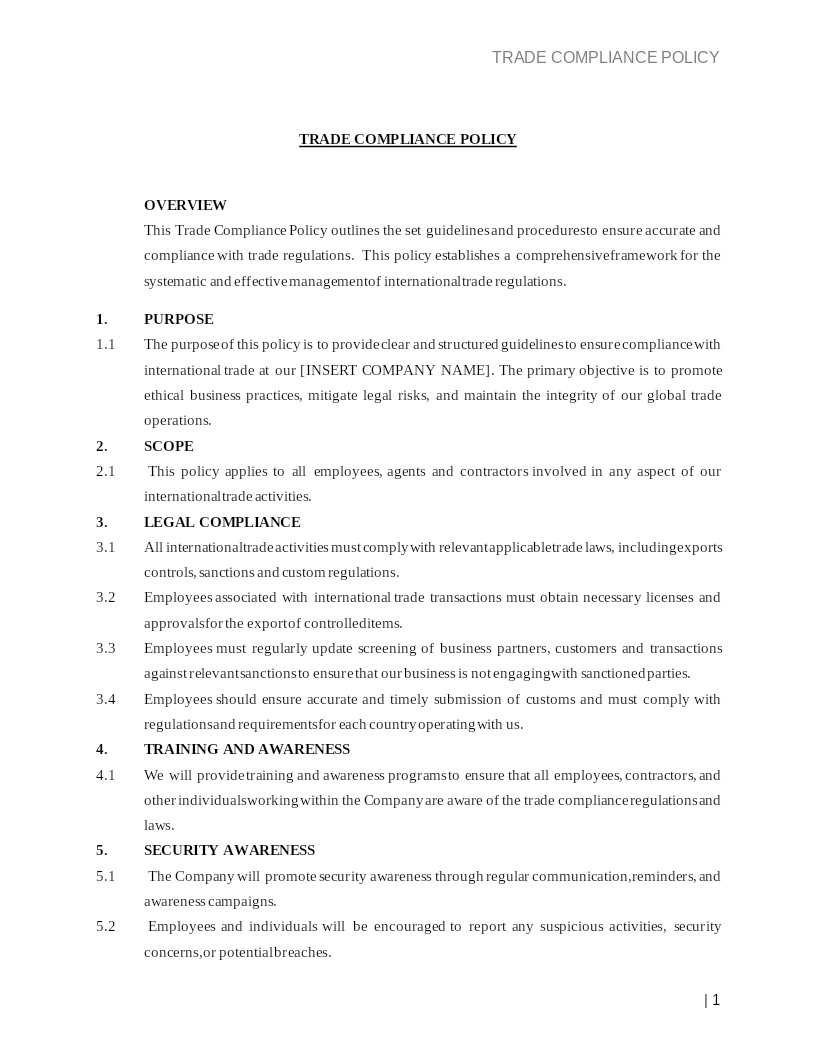
TRADE COMPLIANCE POLICY
How does it work?
1. Choose this template
Start by clicking on "Fill out the template"
2. Complete the document
Answer a few questions and your document is created automatically.
3. Save - Print
Your document is ready! You will receive it in Word and PDF formats. You will be able to modify it.
Understanding Trade Compliance Policy in U.S.
A Trade Compliance Policy is an organizational framework that outlines the rules, standards, and procedures a business must follow to comply with U.S. and international trade laws. It sets guidelines for import and export controls, customs compliance, sanctions screening, recordkeeping, and ethical trading practices. This policy ensures that global operations adhere to regulatory requirements established by agencies such as the U.S. Customs and Border Protection (CBP), the Bureau of Industry and Security (BIS), and the Office of Foreign Assets Control (OFAC). By maintaining an effective Trade Compliance Policy, companies reduce legal and financial risks, ensure smooth cross-border operations, and promote responsible global trade conduct.
Where a Trade Compliance Policy is Commonly Used
- International trading companies
- Import/export businesses
- E-commerce companies with cross-border shipments
- Logistics and freight forwarding organizations
- Manufacturing firms sourcing global materials
- Technology companies with controlled goods/export licenses
- Supply chain and procurement departments
- Defense and aerospace companies subject to ITAR/EAR regulations
Different Types of Trade Compliance policies
- Import Compliance Policy: Covers customs declarations, tariff classifications, duties, and CBP regulations.
- Export Control Policy: Addresses licensing requirements, restricted technologies, and export screening.
- Sanctions & Embargo Compliance Policy: Ensures compliance with OFAC sanctions, denied parties lists, and restricted regions.
- Anti-Bribery & Ethical Trade Policy: Prevents unethical practices such as bribery, forced labor, or illegal sourcing.
- Supply Chain Compliance Policy: Ensures vendors and partners follow global trade regulations and ethical standards.
- Recordkeeping & Documentation Compliance Policy: Outlines document retention requirements under U.S. trade laws.
When Legal Guidance Becomes Helpful
Trade laws are complex, highly regulated, and frequently updated. Consulting real-time lawyers and in-house counsel ensures:
- Compliance with U.S. trade laws (EAR, ITAR, OFAC, CBP regulations, FCPA)
- Proper classification of goods, export licensing, and controlled technology management
- Correct interpretation of sanctions, restricted parties, and embargo restrictions
- Reduction of liability, penalties, or shipment seizures
- Tailored procedures that suit your industry, risks, and supply chain structure
- Effective dispute resolution strategies and enforceable policy language
- Custom solutions for cross-border agreements, taxes, and global compliance
Legal experts ensure your policy remains accurate, compliant, and aligned with your operational needs.
How to Use This Policy
- Include it in your compliance manual or employee handbook
- Train staff involved in import/export activities
- Apply consistently across departments and vendors
- Review at least annually or whenever trade laws change
Frequently Asked Questions
Q1. What does a Trade Compliance Policy typically include?
A Trade Compliance Policy generally includes import and export rules, customs procedures, sanctions requirements, product classifications, and recordkeeping guidelines. It outlines responsibilities for employees and departments involved in international trade. This ensures the company consistently follows U.S. and global regulations.
Q2. Why is trade compliance important for U.S. businesses?
Compliance protects companies from severe penalties, shipment delays, product seizures, and legal consequences. It establishes a strong operational foundation for global trade and helps businesses avoid risks associated with working with restricted entities. Following compliance laws also enhances company credibility with partners and regulators.
Q3. Which U.S. agencies regulate trade compliance?
Key regulatory agencies include U.S. Customs and Border Protection (CBP), Bureau of Industry and Security (BIS), U.S. Department of Commerce, the Office of Foreign Assets Control (OFAC), and the International Traffic in Arms Regulations (ITAR). Each agency governs specific aspects of global trade and regulatory requirements.
Q4. How does a company screen for restricted or sanctioned parties?
Businesses use sanctions screening tools to check customers, suppliers, and partners against OFAC, BIS, and other international watchlists. Screening helps prevent transactions with restricted individuals or organizations. This is critical for avoiding legal penalties and ensuring ethical business practices.
Q5. What are the risks of failing to comply with trade laws?
Non-compliance may result in steep fines, criminal charges, shipment confiscation, loss of export privileges, or reputational damage. Companies may also face blocked transactions, supply chain disruptions, or government investigations. A well-structured policy minimizes these risks and safeguards business operations.
Q6. How often should a Trade Compliance Policy be updated?
Trade laws change frequently, so companies should review their policy annually or whenever major regulatory updates occur. Changes in business operations, new markets, or new product categories may also require policy updates. Regular reviews ensure ongoing compliance and operational safety.
Q7. Who is responsible for implementing trade compliance within a company?
Typically, the compliance department, logistics team, or trade compliance officer oversees policy implementation. However, employees involved in procurement, shipping, sales, and international transactions must also follow the guidelines. A shared responsibility model ensures consistent compliance across the organization.
Q8. How can employees be trained on trade compliance procedures?
Companies can conduct workshops, online training sessions, and annual refresher programs to educate employees on trade regulations and sanctions. Training ensures staff understand documentation requirements, screening procedures, and product classifications. Proper training minimizes errors and reduces legal risks.