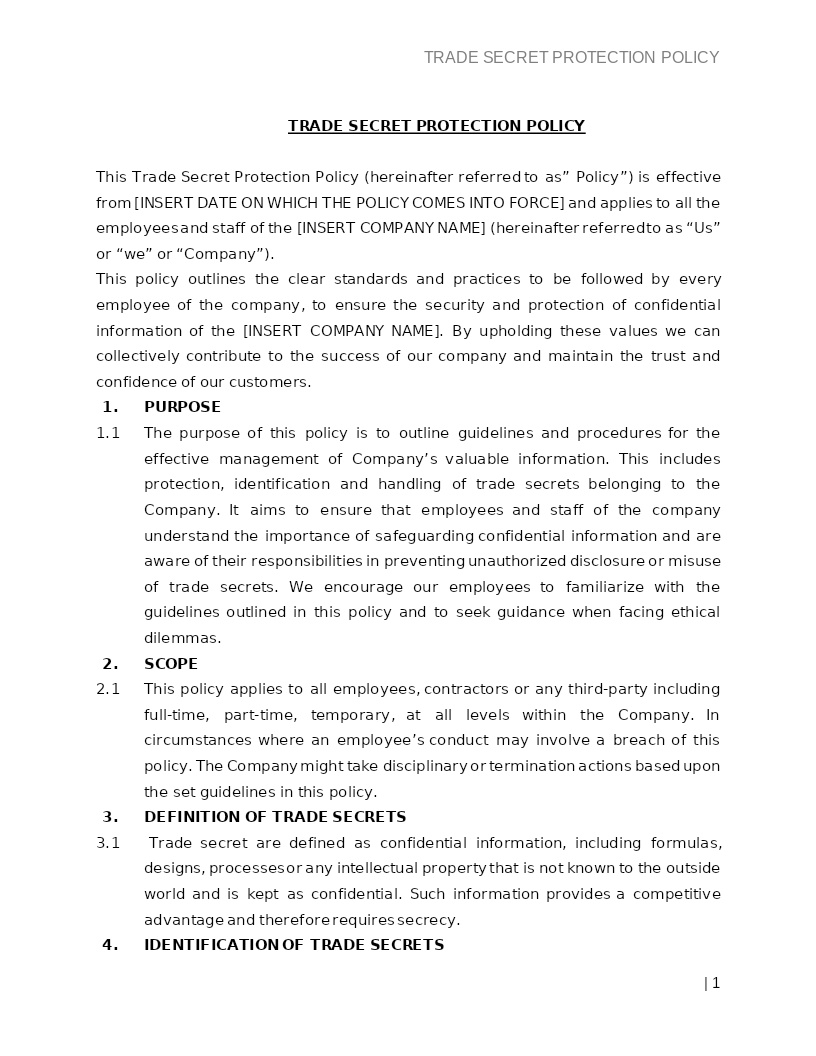
TRADE SECRET PROTECTION POLICY
How does it work?
1. Choose this template
Start by clicking on "Fill out the template"
2. Complete the document
Answer a few questions and your document is created automatically.
3. Save - Print
Your document is ready! You will receive it in Word and PDF formats. You will be able to modify it.
Safeguarding Proprietary and Confidential Information Through a Trade Secret Protection Policy
A Trade Secret Protection Policy is a formal organizational directive that establishes the standards, procedures, and responsibilities necessary to protect confidential and proprietary business information that qualifies as a trade secret under U.S. federal and state laws, including the Defend Trade Secrets Act of 2016 (DTSA) and the Uniform Trade Secrets Act (UTSA). Trade secrets encompass formulas, processes, data, customer lists, research, algorithms, business strategies, and other commercially valuable information that derives its value from not being publicly known. This policy ensures that such information is identified, protected, and handled in a manner that preserves its legal status as a trade secret.
A comprehensive Trade Secret Protection Policy defines the scope of protected information, sets forth access-control measures, outlines confidentiality expectations, and establishes mandatory procedures for storage, use, dissemination, and destruction of sensitive data. It also details requirements for nondisclosure agreements, employee training, labeling of confidential materials, and monitoring of potential misuse. By adopting this policy, organizations strengthen their ability to enforce legal rights against misappropriation, reduce the risk of internal or external theft, and demonstrate reasonable efforts to maintain secrecy an essential element of trade-secret protection under U.S. law.
Where Trade Secret Protection Policies Are Commonly Used
Trade Secret Protection Policies are widely implemented across sectors where valuable proprietary knowledge or information assets exist, including:
- Technology companies developing software, algorithms, platforms, and digital systems
- Manufacturing firms with specialized processes, engineering specifications, or production methods
- Healthcare and pharmaceutical organizations conducting research or clinical development
- Financial institutions managing proprietary models, analytics, or investment strategies
- Retail and e-commerce businesses using customer databases, pricing structures, and marketing systems
- Startups cultivating innovative products, brand strategies, or competitive insights
- Professional firms handling client-sensitive documents, data, or methodologies
- Corporations engaged in research, product development, or confidential business planning
Wherever confidential knowledge provides a competitive advantage, a Trade Secret Protection Policy helps secure it.
Different Types of Trade Secret Protection Policies
1. General Corporate Trade Secret Policies: Cover organizational standards for identifying and protecting trade secrets across all departments.
2. Research and Development (R&D) Trade Secret Policies: Focus on laboratory processes, innovation pipelines, proprietary technologies, and unpublished findings.
3. Data-Security-Integrated Trade Secret Policies: Combine cybersecurity standards with trade-secret protection requirements, addressing digital misappropriation risks.
4. Vendor, Contractor, and Partner Trade Secret Protocols: Govern how external parties may access or use confidential information.
5. Employee-Access Restriction Policies: Define who may view, handle, or manage sensitive information and under what conditions.
When Legal Guidance Becomes Helpful
Legal counsel may be necessary when:
- The organization holds high-value proprietary information or technological innovations
- Employees, contractors, or vendors require access to sensitive data
- Cross-border data transfers or international partners are involved
- Digital storage systems or cloud platforms must be secured under privacy and cybersecurity laws
- The business must respond to suspected misappropriation or internal data theft
- The organization must revise NDAs, confidentiality clauses, or employment agreements
- A lawsuit or investigation requires demonstrating "reasonable efforts" under the DTSA or UTSA
- Policies intersect with labor laws, privacy regulations, or whistleblower protections
Legal review ensures that trade-secret procedures comply with U.S. law, maximize enforceability, and minimize risk exposure.
How to Work with This Template
- Identify what constitutes a trade secret within the organization and define protected categories
- Implement access-control systems, authentication processes, and information-classification procedures
- Require nondisclosure agreements for employees, contractors, and third-party partners
- Outline security requirements, including encryption, password protections, and restricted storage locations
- Establish rules for sharing confidential information internally and externally
- Create incident-response procedures for unauthorized access, leaks, or theft
- Provide guidelines for secure disposal, archival retention, and offboarding of personnel
- Conduct regular training to ensure personnel understand confidentiality responsibilities
- Review the policy periodically to address legal changes, new risks, or technological developments
- Require written or electronic acknowledgment under the ESIGN Act to secure compliance
This template reflects best practices in U.S. trade-secret governance and is suitable for small businesses, corporations, startups, law firms, government contractors, and technology organizations.
Frequently Asked Questions
Q1. What is a Trade Secret Protection Policy, and why is it important?
A Trade Secret Protection Policy is a formal document outlining how an organization protects its confidential and proprietary information. It is important because trade secrets only retain protection if the owner takes reasonable measures to keep them secret, as required under the DTSA and UTSA.
Q2. What qualifies as a trade secret under U.S. law?
A trade secret is information that (1) is not publicly known, (2) derives economic value from its secrecy, and (3) is subject to reasonable protective measures by its owner.
Q3. Do employees need to sign an NDA under this policy?
Yes. Nondisclosure agreements are a key component of trade-secret protection and help ensure enforceability.
Q4. Can digital data be considered a trade secret?
Absolutely. Software code, datasets, algorithms, and electronic files qualify as trade secrets if they meet the legal requirements and are properly secured.
Q5. What happens if an employee steals or misuses a trade secret?
The employer may pursue remedies under the Defend Trade Secrets Act, including injunctions, damages, attorney fees, and, in some cases, criminal penalties.
Q6. Are contractors and vendors covered by this policy?
Yes. Any party with access to sensitive information must abide by trade-secret-protection standards.
Q7. Should trade secrets be labeled or marked?
While not required, labeling confidential documents improves legal defensibility and helps identify restricted materials.
Q8. How does cybersecurity relate to trade-secret protection?
Cybersecurity safeguards such as encryption, access restrictions, and intrusion detection are essential for preventing digital misappropriation.
Q9. How often should a Trade Secret Protection Policy be updated?
Regular updates, typically every 12–24 months, are recommended to address changes in law, business operations, technologies, or organizational risks.
Q10. Should legal counsel review the policy?
Yes. Given the legal and operational importance of trade-secret protection, attorney review ensures compliance and strengthens enforceability under federal and state laws.