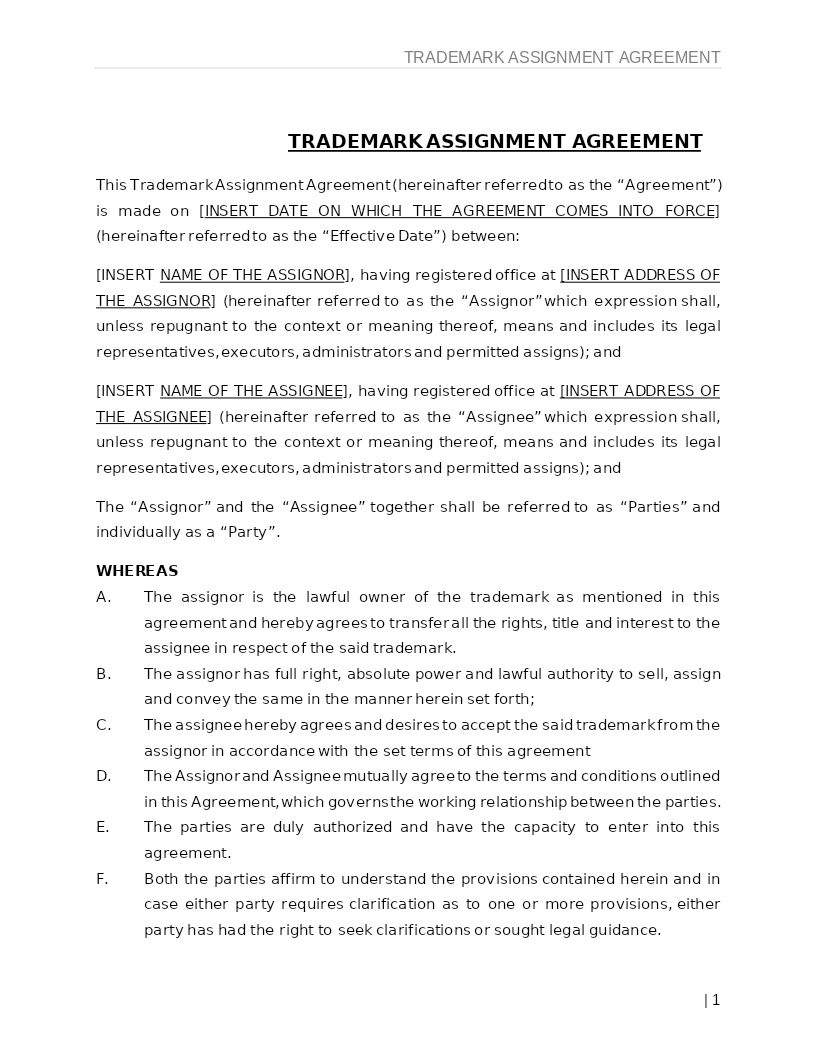
TRADEMARK ASSIGNMENT AGREEMENT
How does it work?
1. Choose this template
Start by clicking on "Fill out the template"
2. Complete the document
Answer a few questions and your document is created automatically.
3. Save - Print
Your document is ready! You will receive it in Word and PDF formats. You will be able to modify it.
Providing Structure and Legal Protection for the Transfer of Trademark Rights in the United States
Trademarks whether business names, brand logos, slogans, product names, or distinctive identifiers, are valuable intellectual property assets that often require lawful transfer from one party to another. A Trademark Assignment Agreement provides the legally binding framework needed to transfer ownership of a registered trademark or pending application from the current owner (“Assignor”) to another party (“Assignee”).
This Agreement establishes the rights being transferred, the consideration exchanged, the goodwill associated with the mark, and the responsibilities of both parties in accordance with United States trademark law, including the Lanham Act, USPTO requirements, and relevant state trademark rules.
It ensures that all aspects of the trademark, including its associated goodwill, registrations, applications, and enforcement rights, are properly assigned. Without a compliant Trademark Assignment Agreement, the transfer may be legally defective, placing the trademark’s validity or enforceability at risk.
Where Trademark Assignment Agreements Are Commonly Used
Trademark assignments are used across many industries and business transactions in the United States, including:
- Sale or acquisition of a business, brand, or product line
- Transfer of trademarks during mergers, reorganizations, or asset purchases
- Purchase or licensing of intellectual property portfolios
- Rebranding and restructuring initiatives
- Transfer of trademark rights between affiliated companies
- Assignment of trademarks created by contractors or independent designers
- Settlement of trademark disputes
- Estate transfers or succession planning for brand assets
Any time ownership of a trademark changes hands, a written Trademark Assignment Agreement is required to effectuate a legal and recordable transfer.
Different Types of Trademark Assignment Agreements You May Encounter
- Outright Trademark Assignment: Full transfer of all rights, title, and interest in the mark.
- Partial Assignment: Transfer of trademark rights only for specific goods, services, or territories.
- Assignment with Goodwill: Essential for U.S. compliance; transfers both the mark and its associated business goodwill.
- Assignment as Part of an Asset Purchase: Occurs during acquisition of a business or specific assets.
- Assignment of Pending USPTO Application: Permitted under specific conditions set by the USPTO.
When Legal Guidance Becomes Helpful
Legal representation is recommended when:
- Assigning trademarks tied to valuable goodwill or brand equity
- The mark is federally registered or part of a complex IP portfolio
- The trademark is involved in litigation or enforcement actions
- The assignment must comply with USPTO recordation requirements
- The transfer occurs between parent/subsidiary entities
- The trademark is partially assigned for different product lines
- The business sells or purchases associated assets with the mark
- The assignment involves international trademark rights
Proper legal drafting ensures compliance with the Lanham Act, avoids “assignment in gross,” and protects the enforceability of the trademark.
How to Work With This Template
- Identify the Assignor and Assignee and specify the mark(s) being transferred
- Reference USPTO registration or serial numbers
- Transfer the trademark along with its associated goodwill (required under U.S. law)
- State consideration, representations, and warranties
- Address timing, recordation, and obligations post-assignment
- Include governing law and dispute resolution
- Sign electronically or in writing (ESIGN Act compliant)
- File the Assignment with the USPTO Assignment Recordation Branch
This structure complies with U.S. trademark assignment practices and Lanham Act requirements.
Frequently Asked Questions
Q1. What is a Trademark Assignment Agreement in the United States?
A Trademark Assignment Agreement is a written contract that legally transfers ownership of a trademark, including all rights, title, interest, and associated goodwill, from one party to another.
In the U.S., trademark assignments must comply with the Lanham Act and are typically recorded with the USPTO to make the transfer publicly valid and enforceable.
Q2. Why is a written trademark assignment necessary?
A written agreement:
• provides proof of legal transfer of ownership,
• ensures compliance with USPTO recordation requirements,
• establishes the scope of rights transferred,
• prevents disputes over ownership,
• protects the trademark from being invalidated.
Trademark ownership cannot be transferred verbally U.S. law requires a written assignment.
Q3. What does “assignment with goodwill” mean?
Under U.S. trademark law, a trademark must be assigned together with the goodwill of the business associated with the mark. Goodwill includes the brand reputation, customer recognition, and commercial value tied to the mark. Assigning a trademark without goodwill may be considered an “assignment in gross,” which is invalid.
Q4. Do I need to record the assignment with the USPTO?
Yes. While the assignment is valid once signed, recording it with the USPTO Assignment Recordation Branch updates public ownership records, protects the assignee’s rights, prevents future ownership disputes, and is required for enforcement and renewal.
Recording should be done promptly after execution.
Q5. Can pending trademark applications be assigned?
Yes, but with restrictions. Under USPTO rules, an application filed based on intent to use (ITU) cannot be assigned before a Statement of Use unless the assignment is to a successor of the entire business associated with the mark.
Violation of this rule can void the application.
Q6. What rights are typically transferred through a trademark assignment?
Assignments usually transfer the registered or pending trademark, associated goodwill, enforcement rights (past and future), rights to sue for infringement, rights to license or commercialize the mark, and all related registrations and applications. The Agreement should clearly define every transferred component.
Q7. What happens if the trademark is involved in litigation?
The Agreement should address whether litigation rights are transferred, who controls ongoing cases, rights to past damages, and obligations for cooperation. Failing to clarify litigation rights can weaken enforcement.
Q8. Can trademarks be partially assigned?
Yes. A trademark may be transferred for a specific set of goods or services, a particular geographic area, or a specific business line. Partial assignments must be carefully drafted to avoid marketplace confusion.
Q9. Are electronic signatures valid for trademark assignments?
Yes. Under the ESIGN Act and UETA, electronic signatures are legally valid across the United States. USPTO recordation also accepts electronically signed documents.
Q10. Can trademark assignments be undone or reversed?
Only through a new written agreement transferring ownership back.
Once recorded with the USPTO, a reversal requires a new, properly executed assignment.