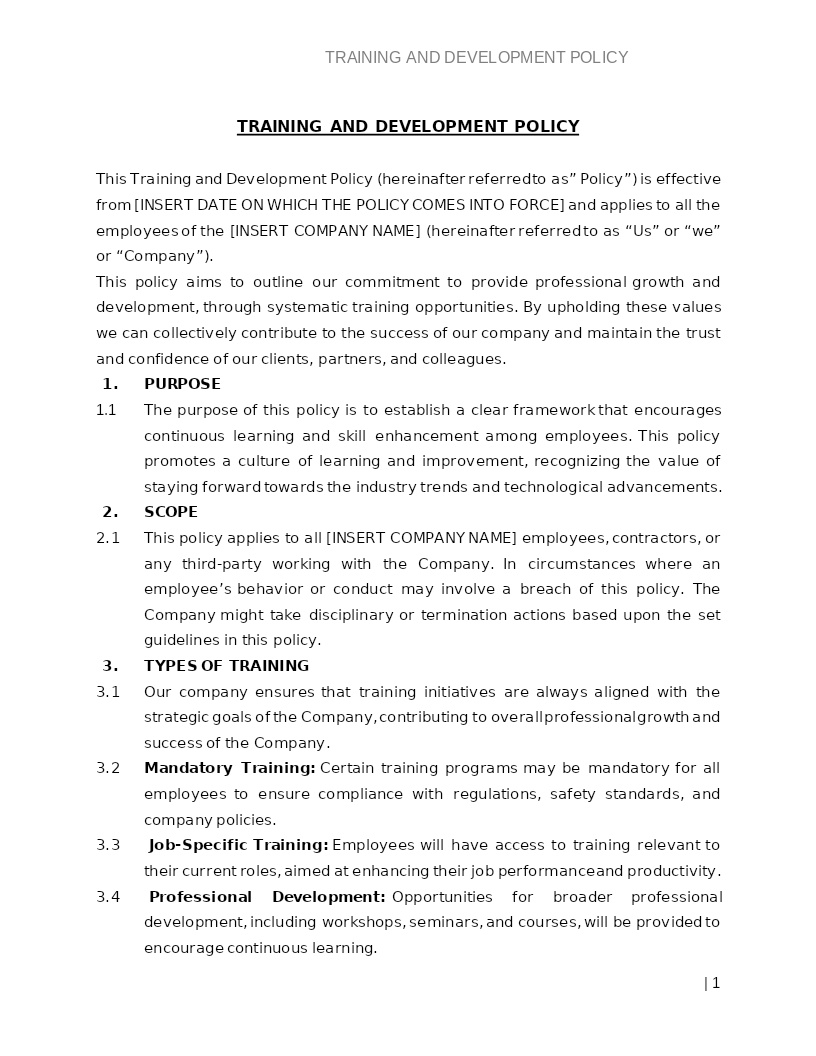
TRAINING AND DEVELOPMENT POLICY
How does it work?
1. Choose this template
Start by clicking on "Fill out the template"
2. Complete the document
Answer a few questions and your document is created automatically.
3. Save - Print
Your document is ready! You will receive it in Word and PDF formats. You will be able to modify it.
Understanding the Purpose and Use of a Training and Development Policy
When a company is committed to strengthening employee capability, enhancing job performance, and fostering long-term professional growth, it becomes essential to establish a clear framework that governs how learning, upskilling, and development initiatives will be carried out. A Training and Development Policy provide that structure. It defines the types of training offered, eligibility criteria, learning objectives, and expected outcomes for employees at every level of the organization.
Having this policy in place creates a culture of continuous learning. It enables employees to expand their skill sets, stay current with industry trends, and contribute more meaningfully to organizational goals. It also helps employers maintain consistency in learning practices, meet compliance requirements, and invest strategically in workforce development.
Where Training and Development Policies Are Commonly Used
Learning and skill-building initiatives are standard in various U.S. workplaces, including:
- Corporations implementing onboarding and role-specific training
- Industries requiring periodic compliance or safety training
- Tech companies focusing on upskilling employees in emerging tools
- Healthcare, finance, and regulated sectors requiring continuous education
- Retail and sales organizations emphasizing product knowledge
- Government, educational institutions, and non-profits with career-path frameworks
Any time an organization conducts training programs, workshops, certifications, or ongoing learning sessions, a written policy ensures consistency and clarity.
Different Types of Training and Development Programs You May Encounter
- Onboarding and Orientation Programs: Introduces new employees to company culture, expectations, processes, and job duties.
- Skill-Based Training: Provides job-specific skills, technical knowledge, and functional expertise necessary for daily tasks.
- Compliance and Regulatory Training: Required for legal, safety, or industry-specific obligations such as OSHA, HIPAA, or financial compliance.
- Leadership and Professional Development: Designed for employees aspiring to leadership roles, focusing on communication, management, and strategic thinking.
- Technology and Digital Skills Training: Helps employees stay updated with modern digital tools, automation platforms, and industry software.
When Legal Guidance Becomes Helpful
Most general training programs can be implemented without deep legal involvement, but legal and in-house counsel guidance becomes valuable when:
- Training involves compliance with U.S. federal or state regulations (OSHA, HIPAA, FINRA, FERPA).
- The policy ties into wage issues such as paid/unpaid training hours, travel time, or employee classification.
- The company collects employee performance data requiring privacy compliance under state laws.
- Training materials include proprietary methods, intellectual property, or licensed content.
- Multi-state workforces require consistency across jurisdictions with differing labor laws.
- Certifications, licensing requirements, or legally mandated continuing education is involved.
Legal review ensures the policy is fair, enforceable, and compliant with relevant employment and regulatory standards.
How to Work with This Template
- Identify who qualifies for training programs and outline approval processes.
- Clearly state the types of training offered and the objectives associated with each program.
- Outline attendance requirements, evaluation procedures, and certification expectations.
- Select the governing state law and ensure compliance with labor and wage regulations.
- Review the policy internally or with legal counsel (optional).
- Communicate the policy to employees and obtain acknowledgment.
This policy follows learning and development standards widely used across the United States and aligns with corporate HR frameworks.
Frequently Asked Questions
Q1. Why is a Training and Development Policy important for U.S. companies?
A structured policy ensures that training efforts are consistent, measurable, and aligned with organizational goals. It supports employee growth, reduces skill gaps, and improves operational efficiency. It also helps employers meet legal and regulatory training requirements across industries.
Q2. Does this policy benefit employees at all levels of the organization?
Yes. From entry-level team members to senior leaders, everyone benefits from defined learning programs. The policy ensures access to skill-building opportunities, career development resources, and role-specific training. It promotes inclusivity and fairness in professional advancement.
Q3. Can a company customize training programs for different departments?
Absolutely. Many organizations tailor training based on departmental needs, job roles, and performance expectations. Customization ensures that employees receive relevant and impactful training while maintaining consistency across the organization through a unified policy.
Q4. Does the policy cover mandatory compliance training?
Yes. Compliance training, such as safety rules, anti-harassment requirements, or industry regulations, is usually included in the policy. This ensures businesses meet federal and state legal obligations while minimizing workplace risks.
Q5. How does this policy support employee retention?
Training demonstrates a company’s investment in its workforce, which improves morale and job satisfaction. Employees are more likely to stay long-term when they feel supported in their personal and professional development. A structured policy creates clear growth pathways and reduces turnover.
Q6. Are training hours considered paid time?
Under U.S. labor laws, many types of required training must be compensated. The policy can clarify which training hours are paid, unpaid, or eligible for reimbursement. Clear rules help employers comply with wage laws and protect employees from compensation disputes.
Q7. How is performance improvement linked to training?
Training equips employees with the knowledge and skills needed to meet performance expectations. Managers can use the policy to align training with performance reviews, ensuring employees receive targeted support. This improves productivity and helps employees advance in their roles.
Q8. Can external courses, certifications, or workshops be included in this policy?
Yes. Many companies allow or sponsor external education, especially when it contributes to job performance or career growth. The policy may outline reimbursement rules, approval criteria, and expectations for certification completion. This supports continuous learning and professional development.