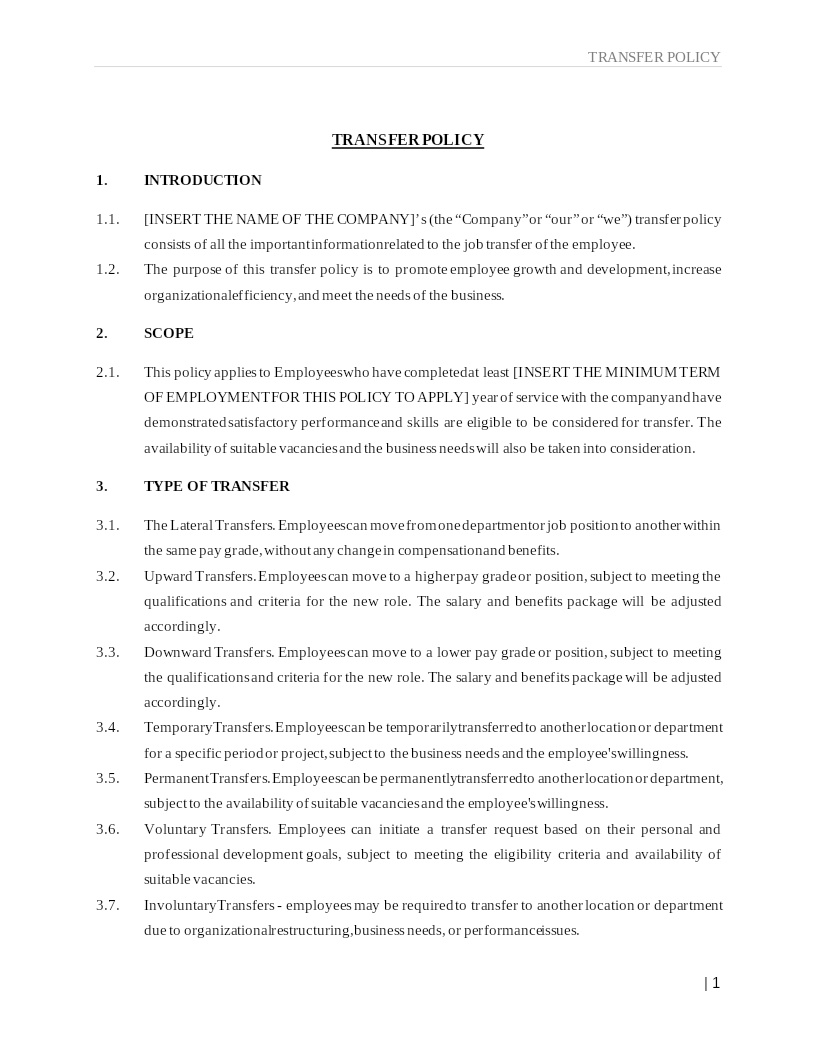
TRANSFER POLICY
How does it work?
1. Choose this template
Start by clicking on "Fill out the template"
2. Complete the document
Answer a few questions and your document is created automatically.
3. Save - Print
Your document is ready! You will receive it in Word and PDF formats. You will be able to modify it.
Supporting Workforce Mobility and Organizational Efficiency Through a Transfer Policy
A Transfer Policy is an organizational governance document that defines the rules, rights, and procedures for transferring employees between departments, positions, work locations, or divisions within the company. Developed in accordance with U.S. employment laws and regulatory standards, including nondiscrimination requirements under Title VII, ADA accommodations, FMLA protections, ADEA, GINA, and applicable state labor laws, this policy ensures that employee transfers are managed fairly, consistently, and without bias. It establishes the conditions under which an employee may request a transfer, the organizational authority to initiate transfers based on operational needs, and the procedural steps for evaluating, approving, or denying such requests. The policy further safeguards employees’ rights by prohibiting discriminatory or retaliatory transfer practices and requiring transparency in decision-making. By adopting this policy, organizations promote workforce flexibility, improve staffing efficiency, optimize business operations, and protect against legal risks associated with employment actions.
A comprehensive Transfer Policy outlines the distinctions among lateral transfers, promotional transfers, temporary assignments, and location-based reassignments. It explains the criteria the organization uses to evaluate transfer requests, including business necessity, job qualifications, staffing levels, performance history, and availability of positions. The policy also details the procedural steps employees must follow to submit transfer applications, the documentation required to support such requests, and the time frames in which management must review them. Additionally, the policy includes guidelines for transfers related to ADA accommodations, medical needs, family care responsibilities, or safety concerns. It describes employer-initiated transfers resulting from organizational restructuring, operational changes, facility expansions, or workload distribution, ensuring such actions are handled objectively and lawfully. By clearly defining these procedures, the organization enhances fairness, supports employee development, and ensures compliance with employment and antidiscrimination laws.
Where Transfer Policies Are Commonly Used
Transfer Policies are used across a wide range of industries, including:
- Corporate and professional services firms with multiple departments or locations
- Retail, hospitality, and service industries managing large and shifting workforces
- Healthcare systems with cross-facility staffing needs
- Manufacturing, logistics, and distribution centers requiring role reassignments
- Educational institutions with varied administrative and academic departments
- Government agencies balancing operational demands and personnel placement
- Nonprofits overseeing field offices or regional divisions
- Technology companies with remote, hybrid, or geographically distributed teams
Any organization with more than one functional area or work location benefits from a formal Transfer Policy.
Different Types of Transfer Policies
1. Lateral Transfer Policies: Reassign employees to roles with similar responsibilities or titles.
2. Promotional Transfer Policies: Combine transfer requests with advancement opportunities.
3. Location-Based Transfer Policies: Address moves to different branches, offices, or geographic regions.
4. Temporary or Special-Assignment Transfer Policies: Allow employees to take short-term or project-specific reassignment.
5. Medical or Accommodation-Based Transfers: Support ADA or FMLA accommodations for health or family needs.
When Legal Guidance Becomes Helpful
Legal counsel may be required when:
- Transfers involve employees in protected classifications under federal or state law
- ADA accommodations or religious accommodations impact placement decisions
- Transfers arise from restructuring, layoffs, or organizational reorganizations
- Employee disputes involve claims of retaliation, discrimination, or unfair treatment
- Multi-state operations require compliance with differing labor codes
- Transfers intersect with collective bargaining agreements or union requirements
- Safety, retaliation, or whistleblower concerns influence transfer decisions
Legal review ensures compliance and reduces liability exposure.
How to Work with This Template
- Identify eligible transfer types and define the criteria for each
- Establish clear procedures for requesting employee-initiated transfers
- Outline employer-initiated transfers, including operational justifications
- Specify required documentation, review processes, and communication timelines
- Address evaluation standards to ensure nondiscriminatory decision-making
- Include provisions for ADA-accommodation transfers and medical-related moves
- Clarify pay, seniority, and benefits implications associated with transfers
- Provide dispute-resolution procedures and appeal options
- Maintain documentation for compliance with EEOC and labor regulations
- Review and update the policy periodically to reflect evolving organizational needs and legal standards
This template reflects best practices for employee mobility, equal opportunity, and organizational governance.
Frequently Asked Questions
Q1. What is a Transfer Policy, and why is it important?
A Transfer Policy outlines the procedures for moving employees between roles or locations. It is important because it promotes fairness, operational efficiency, and compliance with U.S. employment laws.
Q2. Can employees request transfers?
Yes. Employees may request transfers by following the documented procedures and providing necessary supporting information.
Q3. Are transfers guaranteed?
No. Transfers depend on job availability, qualifications, business needs, and compliance considerations.
Q4. Does the policy prohibit discrimination in transfer decisions?
Absolutely. All transfer decisions must comply with Title VII, ADA, ADEA, and other nondiscrimination laws.
Q5. Can a transfer serve as an accommodation under the ADA?
Yes. Transfers may be granted as reasonable accommodations on a case-by-case basis.
Q6. What happens if a transfer is denied?
Management must provide a lawful and nondiscriminatory reason for denial, and employees may request further review.
Q7. Are employer-initiated transfers allowed?
Yes. Employers may initiate transfers based on operational needs, provided decisions are fair and compliant with employment laws.
Q8. Do salaries or benefits change after a transfer?
It depends on the position. Transfers may involve adjustments to pay, responsibilities, or benefits depending on job classification.
Q9. Does the policy apply to remote or hybrid employees?
Yes. Transfer procedures apply regardless of physical location or work arrangement.
Q10. Should legal counsel review a Transfer Policy?
Yes. Legal examination ensures compliance with federal and state employment laws and reduces liability risks.