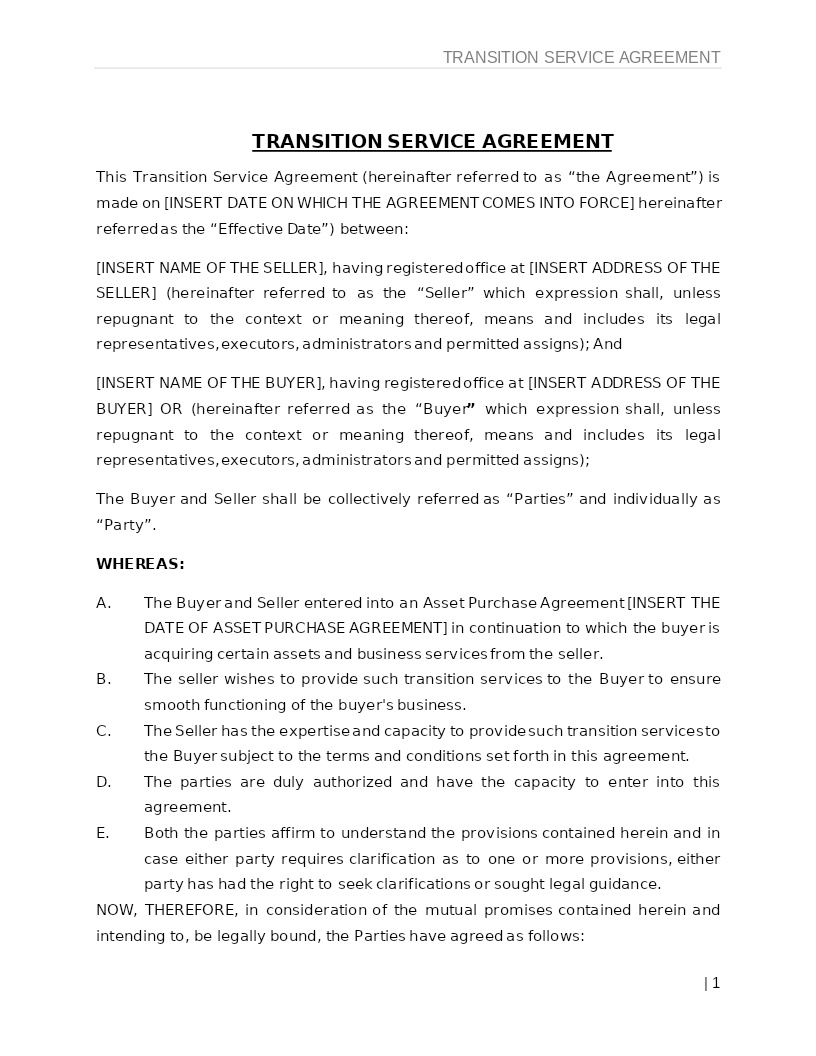
TRANSITION SERVICE AGREEMENT
How does it work?
1. Choose this template
Start by clicking on "Fill out the template"
2. Complete the document
Answer a few questions and your document is created automatically.
3. Save - Print
Your document is ready! You will receive it in Word and PDF formats. You will be able to modify it.
Establishes confidentiality and data protection obligations
In mergers, acquisitions, divestitures, corporate restructuring, or business unit carve-outs, it is often necessary for the seller or the transferring entity to continue providing certain operational, administrative, or technical services to the buyer for a temporary period. A Transition Services Agreement (TSA) establishes the legal framework governing these temporary support services. It outlines the nature, scope, duration, pricing, performance standards, and termination rights associated with post-transaction transitional assistance.
A TSA ensures business continuity by allowing the buyer to maintain essential operations such as IT support, HR administration, payroll processing, accounting services, supply chain management, customer service, or compliance functions until the buyer is capable of independently performing those activities. It protects both parties by setting clear expectations, defining service levels, allocating liability, and establishing confidentiality and data protection obligations similar to those in an NDA.
Transition Services Agreements are commonly used during acquisitions, asset transfers, spin-offs, or reorganizations where immediate operational independence is not feasible. Whenever a seller must assist a buyer in managing ongoing operations after closing, a TSA provides a structured and enforceable mechanism to facilitate a smooth transition with minimal disruption.
Where Transition Services Agreements Are Commonly Used
TSAs are widely deployed in:
- Mergers and acquisitions involving business unit transfers
- Corporate divestitures or spin-offs of subsidiaries
- Carve-outs where key infrastructure remains with the seller
- Strategic reorganizations involving partial business transfers
- Private equity acquisitions requiring interim operational support
- Cross-border transactions requiring staggered regulatory approvals
- IT system migrations, ERP transitions, and data transfer arrangement
- Industries with complex operations (healthcare, finance, manufacturing, logistics)
- Any transaction in which the buyer cannot immediately assume full operational responsibility typically requires a TSA.
Types of Transition Services Agreements
- Full-Scope TSA: Covers multiple categories of support services like IT, HR, finance, compliance, and logistics.
- Function-Specific TSA: Applies to a single function (e.g., IT helpdesk support, accounting).
- Reverse TSA: The buyer provides services to the seller post-closing.
- Global TSA: Used when services are provided across multiple jurisdictions, involving cross-border data transfers and regulatory considerations.
- Long-Term TSA: For complex businesses requiring extended transition timelines.
When Legal Guidance Becomes Helpful
Legal consultation is critical when:
- Services involve confidential, regulated, or sensitive data
- Pricing requires cost-plus models or benchmarking
- Liability or indemnification risks are significant
- The transaction spans multiple countries or regulatory regimes
- Intellectual property or proprietary technology is temporarily licensed
- Employees of one party perform work for the other
- Service termination could cause operational failure
- The buyer or seller requires explicit compliance with industry-specific laws (HIPAA, GDPR, SOX, PCI-DSS, etc.)
A carefully negotiated TSA minimizes business disruption, reduces risk, and avoids post-closing disputes.
How to Work With This Template
- Identify the service provider and receiving party
- Define each transition service in detail, including scope and deliverables
- Establish pricing, cost allocation, invoicing, and payment terms
- Specify service levels (SLAs), performance standards, and remedies
- Include data privacy, cybersecurity, and confidentiality protections
- Note key deadlines, milestones, and transition timelines
- Outline governance, escalation procedures, and dispute resolution mechanisms
- Execute electronically or in physical form
This structure aligns with commonly accepted standards in M&A and corporate transitional support agreements.
Frequently Asked Questions (FAQs)
Q1. What is the primary purpose of a Transition Services Agreement?
The purpose of a TSA is to ensure business continuity after a corporate transaction. When the buyer does not yet possess the infrastructure, personnel, systems, or licenses needed to operate the acquired business independently, the seller provides temporary services under defined terms. This avoids disruptions in payroll, accounting, supply chain operations, IT systems, customer service, and other essential functions.
Q2. Does a TSA transfer ownership of any assets or systems?
No. A TSA only provides temporary access to services, systems, or resources. Ownership of assets, including IT infrastructure, software licenses, equipment, or intellectual property, remains with the service provider unless expressly transferred in the underlying transaction agreement.
Q3. How long do transitional services typically last?
Most TSAs last 3 to 24 months, depending on the complexity of operations. Certain IT or ERP system migrations may require additional time. The TSA may include fixed service periods, optional extensions, milestone-based termination for specific services, and partial wind-down of services as functions become independent. The duration must be realistic and mutually agreed upon.
Q4. Who bears the cost of the transition services?
Typically, the buyer pays the seller for services provided. Pricing models may include cost-plus pricing (seller’s cost + agreed margin), fixed fees for defined services, metered usage fees (e.g., per employee, per transaction), and benchmark-linked pricing for competitive fairness. The TSA should specify billing cycles, invoicing requirements, payment deadlines, and audit rights.
Q5. What happens if the seller stops providing services or the buyer is unsatisfied with service levels?
The TSA generally includes service levels (SLAs) with remedies such as fee reductions for underperformance, escalation procedures to senior management, rights to source services from third parties, and termination of specific services for material breach. In extreme cases, unresolved failures may allow termination of the Agreement or legal claims for damages.
Q6. Are confidentiality and data protection obligations included in a TSA?
Yes. Similar to an NDA, a TSA contains robust confidentiality provisions requiring both parties to protect customer data, employee information, operational records, financial data, proprietary technology, intellectual property, and trade secrets. If personal or regulated data is involved, the TSA must comply with GDPR, HIPAA, CCPA, or other sectoral laws.
Q7. Can employees of the seller perform work for the buyer during the transition?
Yes, but the TSA must clarify:
- that seller employees remain employees of the seller
- that the buyer does not assume employment obligations
- that health and safety, insurance, and supervision responsibilities remain clear
- that labor laws governing employee leasing or secondment are respected
In some countries, improper structuring may trigger automatic employee transfer rights, so careful drafting is essential.
Q8. Can the TSA cover the temporary licensing of intellectual property?
Yes. Many TSAs include temporary IP licensing, such as software tools, branding elements, proprietary databases, internal operating manuals, technology systems, and custom applications. The license is time-limited, non-exclusive, and revocable upon termination.
Q9. Who is responsible for liabilities during the transitional period?
Responsibility generally depends on the nature of the liability. The service provider is responsible for errors, omissions, or negligence in service delivery. The service recipient is responsible for consequences arising from its own operations. Shared operations may require negotiated indemnities. The TSA should clearly allocate liability and include caps, exclusions, and insurance requirements.
Q10. What happens if the service provider uses subcontractors?
Subcontracting is permitted only if expressly authorized. The TSA must ensure that:
- subcontractors are bound by equivalent confidentiality and security obligations
- subcontractors meet performance standards
- the service provider remains liable for subcontractor actions
Unauthorized subcontracting is typically a material breach.
Q11. How is access to IT systems managed during the transition?
The TSA should specify permitted user accounts, access rights and authentication methods, cybersecurity protocols, system segmentation for data protection, monitoring and logging requirements, and conditions for revoking access. IT access must be temporary, secure, and compliant with both parties’ policies.
Q12. Can the buyer terminate individual services before the TSA ends?
Yes. TSAs often allow early termination of specific services, categories of services, or phased reductions in service volume. Early termination may require notice and may trigger termination fees.
Q13. What if the transition takes longer than expected?
The Agreement may include optional extension periods, renegotiated pricing for extended services, project governance mechanisms to track progress, and escalation procedures for delays. Extensions must be mutually agreed upon unless automatic extensions are included.
Q14. How are disputes resolved?
Typical mechanisms include senior executive escalation, negotiation, mediation, arbitration, and litigation (rare due to cost and time). For cross-border TSAs, international arbitration is often preferred.
Q15. What happens upon expiration or termination of the TSA?
Upon termination all access rights, licenses, and support services cease, data and documents must be returned or securely destroyed, final invoices must be paid, system access must be revoked and any remaining services may transition to third parties. A termination protocol may be included to ensure an orderly conclusion.