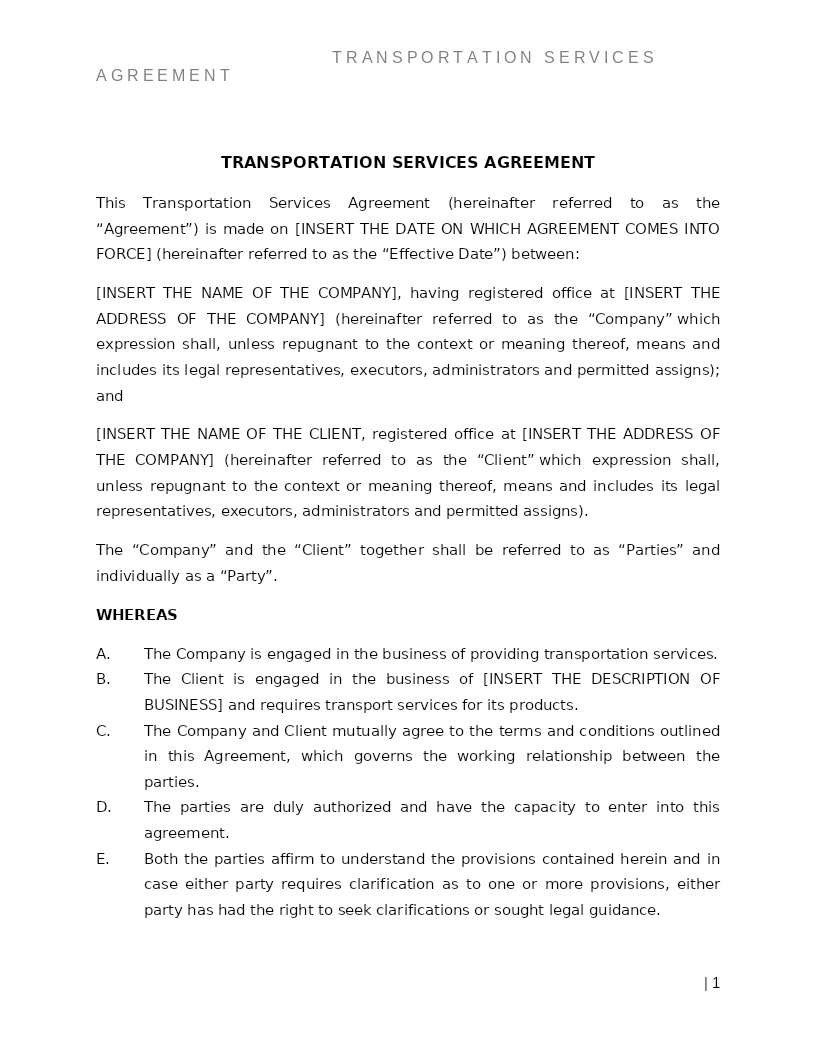
TRANSPORTATION SERVICES AGREEMENT
How does it work?
1. Choose this template
Start by clicking on "Fill out the template"
2. Complete the document
Answer a few questions and your document is created automatically.
3. Save - Print
Your document is ready! You will receive it in Word and PDF formats. You will be able to modify it.
Defining Service Obligations in Commercial Transportation Arrangements
Companies that rely on the movement of goods, equipment, or passengers must clearly set out the terms that govern such transportation activities. To ensure consistent performance, legal compliance, and operational reliability, the parties must adopt a written document establishing their respective rights and responsibilities. A Transportation Services Agreement serves this purpose. It defines the terms under which a Carrier, Driver, or Service Provider furnishes transportation-related services to a client, in accordance with U.S. transportation law, Department of Transportation (DOT) regulations, Federal Motor Carrier Safety Administration (FMCSA) rules, commercial contract standards, and applicable state laws.
When entering a Transportation Services Agreement, the parties create a legally binding framework that clarifies service expectations, safety standards, liability allocations, payment terms, scheduling procedures, compliance duties, and dispute-resolution mechanisms. This ensures that transportation services are performed safely, efficiently, and in compliance with national and state-level regulatory requirements.
Where Transportation Services Agreements Are Commonly Used
Transportation Services Agreements are utilized in a broad range of commercial and operational contexts, including:
- Freight shipping, logistics, and supply-chain operations
- Passenger transport, shuttle services, and corporate transportation
- Delivery services, courier programs, and last-mile distribution
- Equipment transport, oversize load movement, and specialized hauling
- E-commerce and retail fulfillment networks
- Medical transport, paratransit, and non-emergency transportation
- Construction, manufacturing, and energy-sector operations
- Airport, hotel, and event transportation services
Any business relying on third-party transportation providers benefits from a formal agreement governing the service relationship.
Different Types of Transportation Services Agreements You May Encounter
1. Freight and Cargo Transport Agreements: Cover shipping, freight handling, logistics coordination, and delivery terms.
2. Passenger Transportation Agreements: Apply to shuttle operations, rideshare partnerships, and employee transport services.
3. Contractor or Independent Driver Agreements: Used when drivers operate as independent contractors rather than employees.
4. Specialized Transportation Agreements: Address hazardous materials, medical transport, or oversize/overweight loads.
5. Delivery and Courier Service Agreements: Focus on last-mile delivery, pickup services, and package handling obligations.
When Legal Guidance Becomes Helpful
Legal counsel may be advisable when:
- The transportation involves hazardous materials or regulated cargo
- The Carrier must meet DOT, FMCSA, or state licensing requirements
- Insurance policies, indemnity clauses, or liability limitations are complex
- The agreement includes cross-state or interstate commercial transport
- The service involves passenger safety or ADA compliance standards
- The parties need assistance defining performance metrics or penalties
- Disputes may arise concerning delays, damaged cargo, or accidents
Legal review ensures the agreement complies with U.S. transportation regulations and helps mitigate risks associated with commercial transport.
How to Work With This Template
- Identify the Carrier, Client, and the nature of transportation services
- Define pickup, delivery, routing, and scheduling requirements
- Establish safety rules, compliance obligations, and equipment standards
- Specify payment terms, fees, and invoice procedures
- Address cargo liability, insurance requirements, and indemnification
- Outline performance metrics, reporting duties, and tracking requirements
- Choose governing law and dispute-resolution procedures
- Review and update the agreement periodically
- Execute the agreement electronically or in written form
This template aligns with U.S. commercial and transportation industry practices and can be integrated into logistics contracts, fleet operations, and service-provider agreements.
Frequently Asked Questions
Q1. What is a Transportation Services Agreement, and why is it important?
A Transportation Services Agreement is a legally binding contract that outlines the terms under which a Carrier provides transportation or delivery services. It is important because it clarifies performance obligations, safety standards, costs, and legal responsibilities, helping prevent disputes and ensuring compliance with U.S. transportation regulations.
Q2. What laws apply to transportation service contracts in the U.S.?
Relevant laws may include the Federal Motor Carrier Safety Regulations (FMCSR), Department of Transportation (DOT) requirements, state commercial motor vehicle laws, and contract laws under the Uniform Commercial Code (UCC).
Q3. Who is responsible for cargo damage or loss?
Liability depends on the agreement’s terms. Typically, the Carrier is responsible for the cargo while in transit, unless damage results from circumstances beyond their control. Insurance and indemnity provisions should be clearly defined.
Q4. Are Carriers required to have insurance?
Yes. Most transportation providers must maintain liability, cargo, and commercial automobile insurance at levels required by federal and state law.
Q5. Can the Client specify pickup and delivery schedules?
Yes. Transportation Services Agreements usually include detailed scheduling requirements, delivery windows, and service-level expectations.
Q6. Can a transportation provider subcontract the work?
Only if the agreement permits it. Some contracts require prior written approval before the Carrier may use subcontractors or independent drivers.
Q7. Are electronic signatures valid for Transportation Services Agreements?
Yes. Under the ESIGN Act, electronic signatures are legally enforceable and commonly used in logistics and transportation contracts.
Q8. What happens if delays occur?
The agreement may specify acceptable delays, penalties, or remedies. Clear communication protocols and defined responsibilities help manage unexpected disruptions.
Q9. Can the agreement include GPS tracking or reporting requirements?
Yes. Many modern transportation contracts incorporate tracking technology, reporting obligations, and performance metrics to ensure transparency.
Q10. What if the Carrier fails to meet safety standards?
Failure to comply with safety, regulatory, or contractual requirements may result in termination, penalties, or legal action, depending on the agreement’s terms