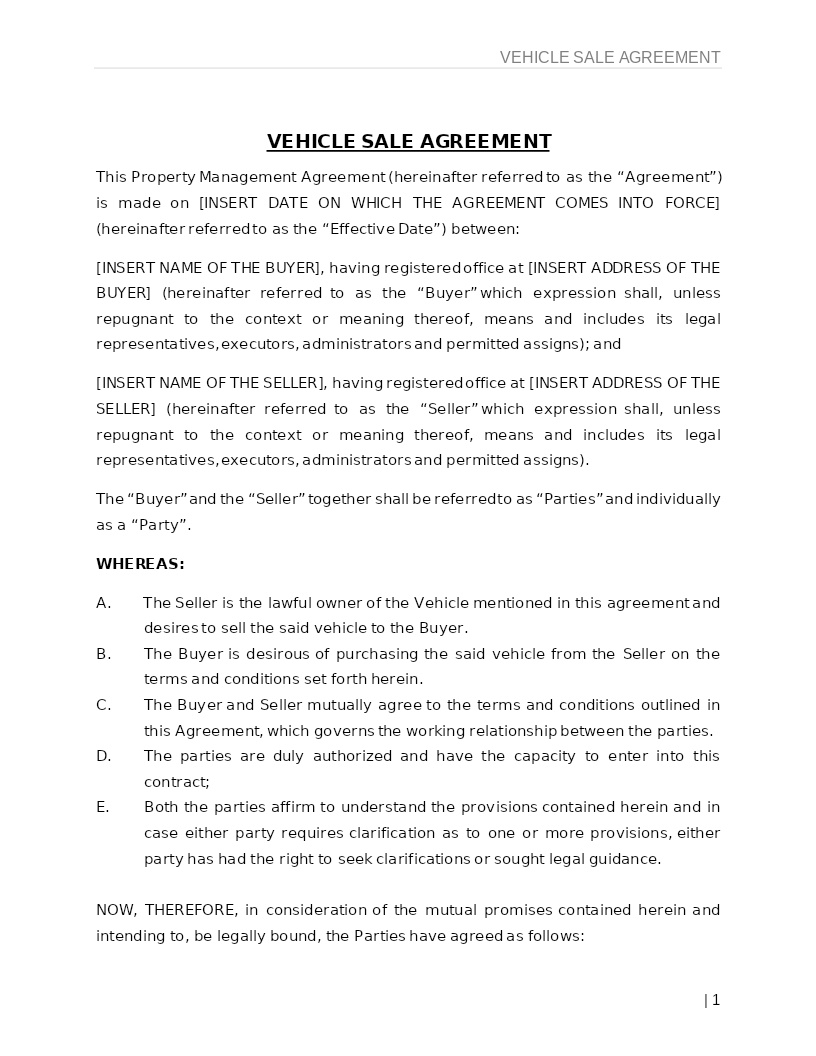
VEHICLE SALE AGREEMENT
How does it work?
1. Choose this template
Start by clicking on "Fill out the template"
2. Complete the document
Answer a few questions and your document is created automatically.
3. Save - Print
Your document is ready! You will receive it in Word and PDF formats. You will be able to modify it.
Understanding Vehicle Sale Transactions in the U.S.
A Vehicle Sale Agreement is a straightforward but essential legal document used when selling or purchasing a motor vehicle. It records the full terms of the transaction, including the vehicle’s details, its condition, the purchase price, and the responsibilities of both parties.
In the United States, this agreement serves as valid proof of the transfer of ownership, ensures compliance with state motor vehicle laws, and protects both the buyer and the seller from future disputes.
By clearly documenting the price, payment terms, odometer reading, VIN, and the condition of the vehicle (including “as-is” disclaimers, if applicable), the agreement provides transparency and legal protection throughout the sale process.
It also supports title transfer, registration, tax filing, and insurance updates.
Where Vehicle Sale Agreements Are Commonly Used
These agreements are routinely used in situations such as:
- Sale of used cars between private parties
- Dealership sales where additional terms must be documented
- Sales of motorcycles, trucks, RVs, or trailers
- Fleet sales or company vehicle transfers
- Interstate vehicle sales requiring multi-state compliance
- Sales involving financed, leased, or liened vehicles
- Transactions requiring odometer disclosure and safety compliance
Any time a motor vehicle changes hands, a written agreement creates clarity and serves as legal evidence of the transaction.
Different Types of Vehicle Sale Agreements You May Encounter
- Standard Private-Party Vehicle Sale Agreement: Used for common transactions between individuals selling or buying used vehicles.
- Dealership Purchase Agreement: Includes detailed terms on warranties, financing, add-ons, and dealership obligations.
- “As-Is” Vehicle Sale Agreement: Disclaims all warranties and clarifies that the buyer accepts the vehicle in its current condition, as allowed under U.S. state and federal law.
- Vehicle Trade-In Agreement: Used when a buyer trades in a vehicle as part of a new purchase.
- Lienholder/Financed Vehicle Agreement: Details the status of outstanding loans, title obligations, and lender requirements.
- Interstate Vehicle Sale Agreement: Addresses state-specific requirements for taxes, smog checks, temporary permits, and registration.
When Legal Guidance Becomes Helpful
Most vehicle sales are simple, but legal guidance can be valuable when:
- The vehicle has existing liens, loans, or title complications
- The sale involves interstate or cross-country transfers
- The vehicle is commercial, specialized, or high-value
- There are disputes regarding accidents, repairs, or warranties
- The vehicle is part of a company fleet transfer
- Financing, insurance, or repossession issues are involved
- Odometer discrepancies or salvage/rebuilt titles exist
- The seller is a dealership and must follow consumer protection rules
- The agreement includes special clauses or liabilities
Professional review ensures that the sale complies with state DMV requirements and that the contract terms are enforceable under U.S. consumer and motor vehicle laws.
How to Work With This Template
- Identify the buyer and seller with full legal names
- Enter complete vehicle details (VIN, make, model, year, mileage)
- Specify the purchase price and payment method
- Clarify the vehicle’s condition (with or without warranties)
- Confirm title status (clear, financed, salvage, rebuilt)
- Outline responsibilities for taxes, registration, and smog inspection
- Add the date of sale and possession transfer
- Choose the governing U.S. state law
- Review the terms together (legal consultation is optional)
- Sign electronically or in print
This template is compatible with U.S. DMV requirements and commonly accepted e-signature platforms.
Frequently Asked Questions
1. Is a Vehicle Sale Agreement legally required in the U.S.?
Not always, but it is strongly recommended. Most states require written proof of purchase for title transfer, tax assessment, registration, and insurance updates. The agreement also protects both parties from disputes.
2. Does this agreement replace the vehicle title?
No. The vehicle’s Certificate of Title is the primary ownership document. The Vehicle Sale Agreement supports the transfer by documenting the terms of the sale and is often required for DMV processing.
3. Can the vehicle be sold “as-is”?
Yes. An “as-is” sale is permitted under U.S. law as long as the agreement clearly states that no warranties are being offered. The buyer must acknowledge and accept the condition of the vehicle.
4. What details must be included to prevent fraud?
The agreement should include the VIN, odometer reading, title status, accident disclosures (if known), and seller’s certification of lawful ownership. These details help prevent issues like odometer fraud or purchasing a stolen vehicle.
5. Is an odometer disclosure required?
Yes. Under federal law (49 CFR § 580), odometer disclosures are mandatory for most vehicles under 16,000 pounds and less than 10 years old. Many states require this disclosure to be included in the sale agreement.
6. Are electronic signatures valid?
Absolutely. Under the ESIGN Act and UETA, electronic signatures are legally valid for vehicle sale contracts in all U.S. states.
7. Can this agreement be used for interstate sales?
Yes, but additional state-specific requirements (such as emissions tests, VIN inspections, or temporary permits) may apply. The agreement helps streamline the process.
8. What if the buyer does not transfer the title after purchase?
The Vehicle Sale Agreement protects the seller by showing the date of possession transfer. It can help avoid liability for future tickets, accidents, or claims involving the vehicle.
9. Does the agreement include warranties?
Only if specifically added. Otherwise, most private-party sales in the U.S. are “as-is,” with no implied warranties unless required by state law.
10. Can this agreement be used for motorcycles, RVs, or trailers?
Yes. The same structure applies to cars, motorcycles, trucks, RVs, boats with trailers, and most motorized vehicles.