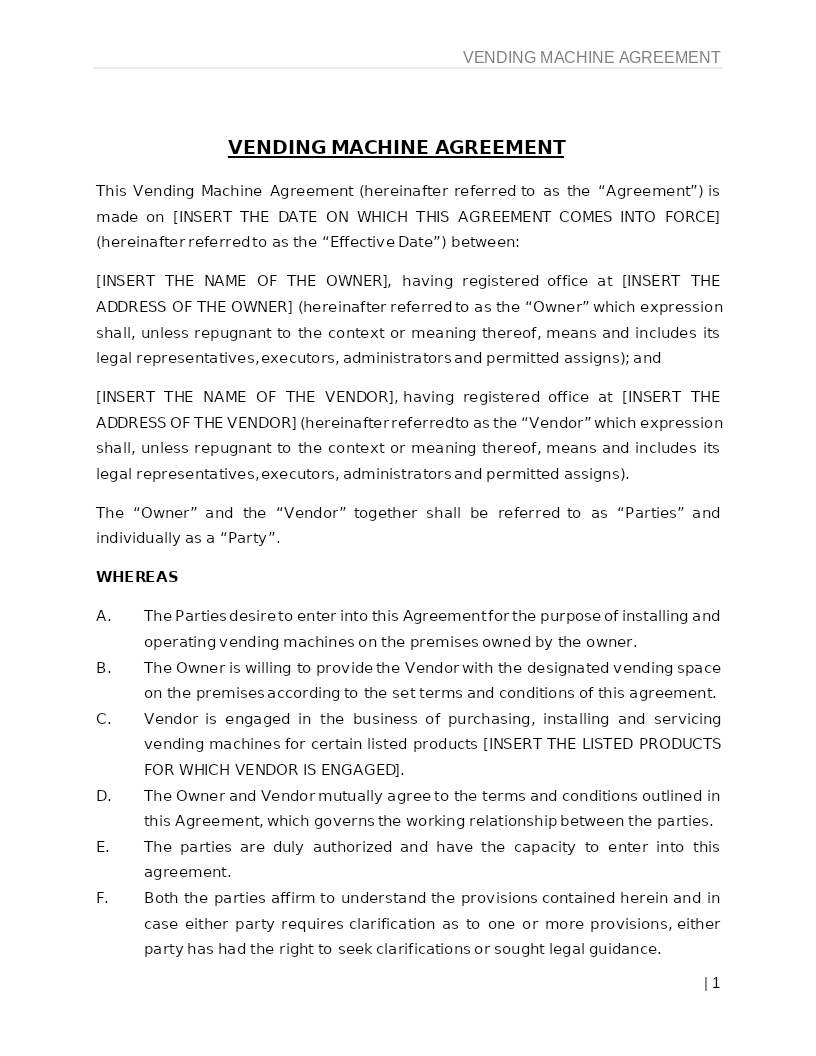
VENDING MACHINE AGREEMENT
How does it work?
1. Choose this template
Start by clicking on "Fill out the template"
2. Complete the document
Answer a few questions and your document is created automatically.
3. Save - Print
Your document is ready! You will receive it in Word and PDF formats. You will be able to modify it.
Providing Structure and Legal Protection for Vending Machine Operations in the United States
Vending machine businesses operate across a broad range of locations including office buildings, retail stores, schools, hospitals, warehouses, malls, gyms, airports, and commercial properties. To clearly define the rights and obligations of both the vending machine operator and the property owner, parties use a Vending Machine Agreement.
A Vending Machine Agreement outlines the terms under which a vending machine is placed, stocked, maintained, and operated on a property. It establishes responsibilities for installation, servicing, electricity usage, commission payments, ownership of machines and inventory, insurance, cash collection procedures, and rules for site access.
This Agreement ensures compliance with U.S. commercial laws, safety regulations, ADA accessibility guidelines, food and beverage rules (including FDA labeling requirements for certain products), and state-specific business operation statutes. It protects both parties by preventing disputes, securing access rights, and ensuring transparent revenue sharing.
Where Vending Machine Agreements Are Commonly Used
Vending Machine Agreements are widely used across the United States in locations such as:
- Corporate offices, co-working spaces, call centres
- Retail stores, malls, and shopping centres
- Schools, colleges, Universities (subject to district rules)
- Hospitals, clinics, and medical centres
- Car dealerships, repair shops, gas stations
- Hotels, motels, and hospitality venues
- Airport terminals, train stations, and transit hubs
- Gyms, fitness centres, and recreational areas
- Government buildings and community centres
- Multi-family residential complexes and dorms
Anytime a vending machine owner places a machine on someone else’s premises, a written agreement ensures clarity and legal security.
Different Types of Vending Machine Agreements You May Encounter
1. Full-Service Vending Agreement: The vendor provides machines, inventory, and maintenance while sharing revenue with the property owner.
2. Location Agreement for Vending Machines: The property owner simply leases space for a machine in exchange for rent or commission.
3. Micro-Market or Self-Checkout Retail Agreement: For managed micro-stores and unmanned convenience kiosks.
4. Snack/Drink Combination Machine Agreement: Designed for multi-product vending units.
5. Bulk Candy or Toy Vending Agreement: Used for small equipment without electricity.
6. Specialty Vending Machine Agreement: Ice machines, frozen meal vending, CBD vending (state-permitted), electronics vending, etc.
When Legal Guidance Becomes Helpful
Legal review is recommended when:
- High-traffic or regulated locations (schools, hospitals, government buildings) are involved
- The machine sells food, beverages, or products subject to FDA or state labelling rules
- ADA accessibility standards apply to machine placement
- Complex revenue-sharing or commission structures are used
- Insurance requirements or liability concerns are significant
- The machine operates with electricity from the property owner
- Long-term placement or exclusivity rights are negotiated
- The vending business handles sensitive payment data (cashless terminals)
Legal counsel ensures the agreement complies with U.S. laws and protects both parties from operational and financial risks.
How to Work With This Template
- Identify the vending operator and property owner
- Describe the vending machines, inventory, and placement location
- Define commission percentages, rent, or other compensation
- Specify installation, servicing, and restocking obligations
- State electricity usage, maintenance, and repair responsibilities
- Address liability, insurance, and damage to property
- Include termination rights and machine removal processes
- Sign electronically (valid under the ESIGN Act) or physically
This structure follows standard U.S. vending industry practices and state contract law.
Frequently asked Questions
Q1. What is a Vending Machine Agreement in the United States?
A Vending Machine Agreement is a legally binding contract between a vending machine operator and a property owner that outlines how a vending machine will be placed, maintained, and operated on the property. It covers location use, electricity, maintenance, commissions, stocking responsibilities, and liability, ensuring compliance with U.S. commercial and consumer protection laws.
Q2. Why is a written vending machine contract necessary?
A written agreement helps:
- prevent disputes over revenue sharing,
- clarify who pays for maintenance and repairs,
- ensure the operator has legal access to the premises,
- determine responsibility for property or equipment damage,
- comply with food safety and ADA placement rules,
- protect both parties in case of accidents or theft.
Without a contract, misunderstandings about profit distribution and operational rights are common.
Q3. Who is responsible for maintaining the vending machine?
Typically, the vending machine operator is responsible for restocking inventory, cleaning and sanitizing, repairing malfunctions, collecting cash, ensuring product freshness, and following health and safety regulations. The property owner usually only provides floor space and electricity (if applicable).
Q4. How do commission payments or revenue splits work?
Common U.S. models include a percentage of gross sales (e.g., 10%–20%), a flat monthly location fee, and hybrid rent + commission structures. The Agreement should specify payment schedules, reporting requirements, and access to sales data from cashless systems.
Q5. Are vending machines regulated by U.S. law?
Yes. Compliance may involve:
• FTC advertising and consumer protection rules,
• FDA labelling requirements for nutrition or ingredient disclosures,
• State food service regulations,
• ADA accessibility guidelines for machine height and operation,
• Local business licensing requirements,
• Sales tax collection rules,
• Credit card processing compliance (PCI-DSS).
A Vending Machine Agreement should require the operator to comply with all applicable regulations.
Q6. Who is liable if a vending machine causes injury or property damage?
Liability depends on the situations. When caused by poor maintenance, the vending operator is typically responsible. When caused by unsafe placement by the property owner, the owner may share liability, and when caused by vandalism or theft, responsibility depends on contract terms and insurance. Most agreements require the vending operator to carry liability insurance.
Q7. Can the property owner move or unplug the machine?
Not without permission. Moving or unplugging the machine can cause mechanical damage or product spoilage. The Agreement should state that the machine cannot be moved without written consent and who is responsible for relocation fees. Unauthorized moving may trigger damages or termination.
Q8. What happens if the machine is not selling well?
The Agreement may allow relocating the machine within the property, replacing it with a more suitable product type, and terminating the agreement for low performance after a notice period. This protects both the operator and the location owner.
Q9. Are electronic signatures valid for vending machine contracts?
Yes. Under the U.S. ESIGN Act and UETA, vending machine agreements signed electronically are legally enforceable nationwide.
Q10. How do termination and removal work?
A typical agreement includes a 30-day–60-day termination notice, rules for safe removal of equipment, settlement of commissions owed, repair of any site damage caused by the machine, and obligations to restore the area to original condition. Clear procedures help ensure cooperation at the end of the arrangement.