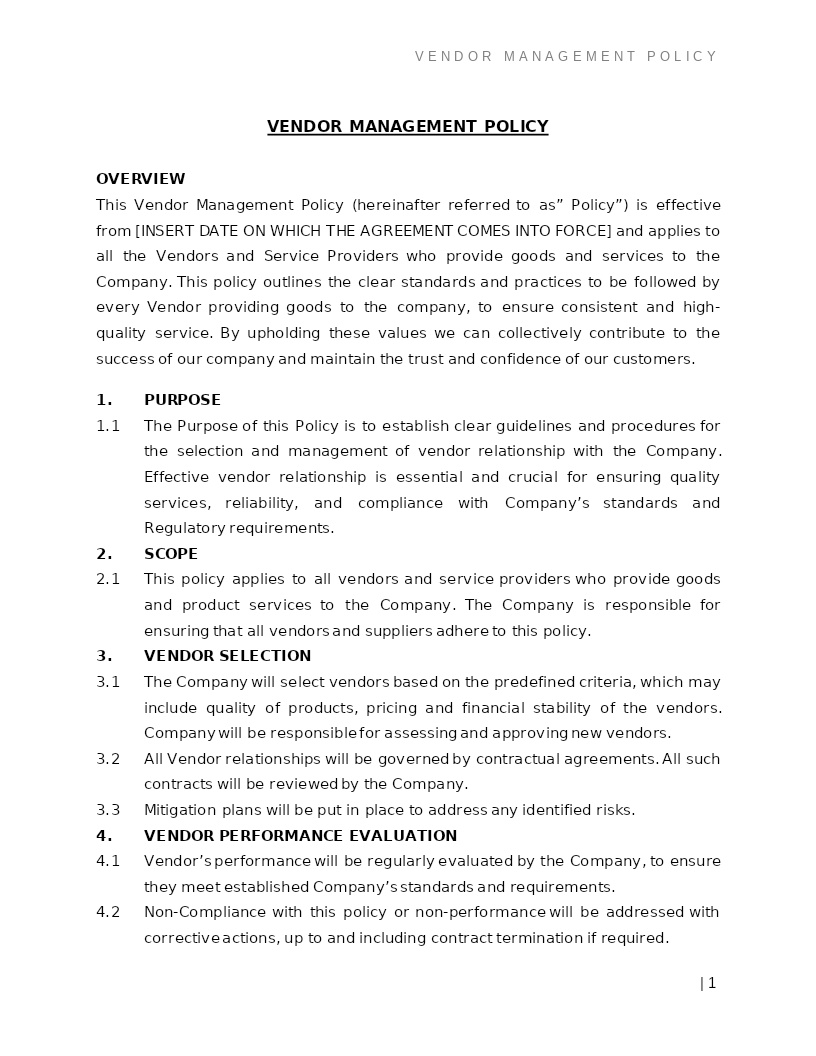
VENDOR MANAGEMENT POLICY
How does it work?
1. Choose this template
Start by clicking on "Fill out the template"
2. Complete the document
Answer a few questions and your document is created automatically.
3. Save - Print
Your document is ready! You will receive it in Word and PDF formats. You will be able to modify it.
Understanding Vendor Management Policy in U.S.
A Vendor Management Policy establishes a standardized framework for selecting, onboarding, managing, and evaluating vendors who supply goods, services, or technology solutions. It sets requirements for due diligence, performance monitoring, contract obligations, data security, and compliance, ensuring vendors align with the organization’s operational standards and legal responsibilities.
A well-designed policy promotes fairness, transparency, and risk management throughout the procurement lifecycle. By implementing clear guidelines, companies can enhance service quality, reduce operational risks, strengthen vendor relationships, and ensure compliance with U.S. federal and state regulations. This structured approach safeguards business continuity and improves overall procurement efficiency.
Where Vendor Management Policies Are Commonly Used
Vendor Management Policies are widely adopted across industries that rely on third-party suppliers or service providers, including:
• Information technology, SaaS, and cloud-services companies
• Manufacturing, logistics, and supply-chain operations
• Financial services, fintech, and insurance sectors
• Healthcare and life sciences organizations requiring HIPAA compliance
• Retail, e-commerce, and hospitality businesses
• Government contractors and large enterprises with regulated procurement
Any organization that works with external vendors benefits from consistent evaluation standards and documented processes that ensure quality, reliability, and compliance.
Different Types of Vendor Management Processes You May Encounter
- Vendor Selection and Approval: Involves assessing vendor qualifications, conducting due diligence, reviewing compliance certifications, and selecting suppliers based on predefined criteria such as quality, cost, and reliability.
- Contracting and Negotiation: Establishes mutually agreed terms covering deliverables, responsibilities, SLAs, confidentiality, pricing, and performance metrics.
- Vendor Performance Monitoring: Includes periodic review of service levels, product quality, delivery timelines, problem-resolution history, and audit results to ensure ongoing compliance.
- Risk Management and Compliance Oversight: Focuses on identifying and mitigating financial, operational, cybersecurity, data-privacy, and reputational risks. Many U.S. industries require contractual protections for data security and regulatory compliance.
- Vendor Termination and Offboarding: Outlines the process for ending vendor relationships, retrieving company-owned data or assets, and transitioning services without operational disruption.
When Legal Guidance Becomes Helpful
Legal counsel plays a crucial role in shaping a strong Vendor Management Policy because:
• U.S. federal regulations (such as the FTC Act, GLBA, HIPAA, and cybersecurity standards) impose vendor-related compliance requirements.
• State laws, including California’s CCPA/CPRA, New York’s SHIELD Act, and other data-protection statutes, regulate vendor handling of personal and sensitive data.
• Legal review ensures contracts include appropriate indemnities, liability protections, and security provisions.
• Multi-state or international vendors require additional compliance considerations, data-transfer safeguards, and jurisdiction-specific clauses.
• Lawyers help interpret risk exposure, address procurement disputes, and strengthen the enforceability of vendor agreements.
In-house and real-time counsel ensure alignment with regulatory, contractual, and operational obligations, reducing the risk of legal complications.
How to Work With This Policy Template
• Identify all vendor categories (critical, high-risk, moderate-risk, and low-risk).
• Establish due-diligence criteria, compliance requirements, and documentation standards.
• Clarify vendor onboarding procedures, contract requirements, and approval workflows.
• Set up performance monitoring systems, reporting schedules, and review intervals.
• Define risk-management protocols, cybersecurity expectations, and audit rights.
• Outline termination procedures, asset-return rules, and data-deletion obligations.
• Ensure alignment with U.S. federal/state regulations and internal governance policies.
• Customize the policy based on industry needs, operational size, risk level, and long-term procurement strategy.
Frequently Asked Questions
Q1. Why is a Vendor Management Policy important for businesses?
A Vendor Management Policy ensures that all third-party suppliers meet quality, security, and compliance standards before and during the engagement. It reduces risks related to poor performance, data breaches, and regulatory violations. By setting clear expectations, businesses maintain operational efficiency and protect themselves from vendor-related liabilities.
Q2. Does this policy help with regulatory compliance?
Yes. Many U.S. regulations, including HIPAA, GLBA, SOX, and state privacy laws, require organizations to manage vendor risks and document oversight. A formal policy helps demonstrate compliance by outlining due diligence, security requirements, audit rights, and contractual obligations. This reduces exposure to fines and legal disputes.
Q3. What types of risks does vendor management address?
Vendor management mitigates operational, financial, cybersecurity, data privacy, reputational, and supply-chain risks. It ensures vendors follow proper controls, maintain service quality, and comply with laws. Identifying risks early prevents disruptions and helps companies maintain consistent performance across all vendor relationships.
Q4. How often should vendor performance be evaluated?
Most organizations conduct quarterly, biannual, or annual evaluations depending on the vendor’s risk category. Critical vendors may require more frequent monitoring. Performance metrics typically include service quality, delivery timelines, compliance status, and issue-resolution history to ensure ongoing alignment with contractual obligations.
Q5. Can this policy help reduce costs?
Absolutely. Standardized vendor selection and negotiation processes enable better pricing, stronger contract terms, and fewer operational inefficiencies. By tracking performance and identifying high-value vendors, organizations improve budgeting, reduce waste, and maximize long-term cost savings.
Q6. How does this policy improve vendor transparency and accountability?
A Vendor Management Policy outlines responsibilities, reporting requirements, SLAs, and measurable performance criteria. Vendors know what is expected of them, and organizations can hold them accountable through structured evaluations and audits. This transparency enhances trust and encourages long-term, mutually beneficial partnerships.
Q7. What happens if a vendor fails to meet performance or compliance standards?
The policy provides a framework for corrective actions, remediation plans, escalations, and possible contract termination. Organizations can document deficiencies, request improvements, or replace the vendor if risks remain unresolved. This structured approach protects operations from prolonged disruptions.
Q8. Is this policy suitable for both small businesses and large enterprises?
Yes. Vendor Management Policies are scalable and can be adapted to the size, risk level, and operational needs of any organization. Small businesses benefit from structured vendor oversight, while large enterprises require detailed frameworks to manage complex supplier networks. Customization ensures effectiveness across industries.