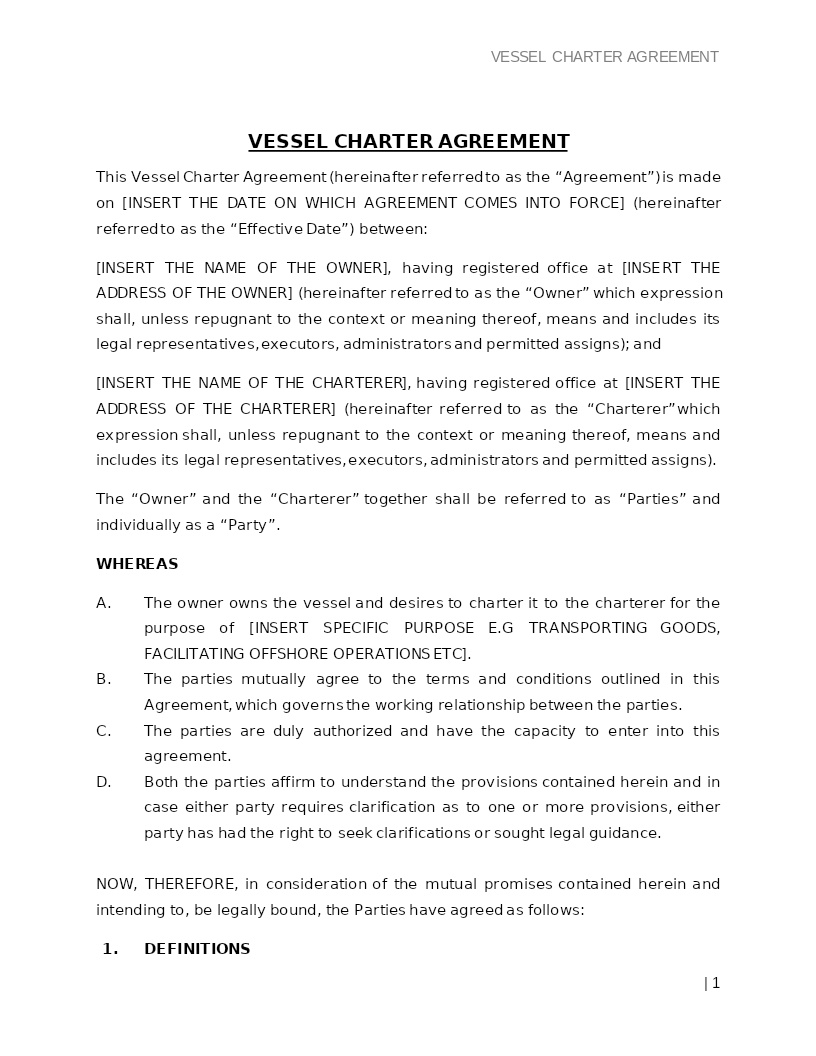
VESSEL CHARTER AGREEMENT
How does it work?
1. Choose this template
Start by clicking on "Fill out the template"
2. Complete the document
Answer a few questions and your document is created automatically.
3. Save - Print
Your document is ready! You will receive it in Word and PDF formats. You will be able to modify it.
Understanding Vessel Chartering in U.S. Maritime and Commercial Operations
A Vessel Charter Agreement is a legally binding maritime contract between a shipowner and a charterer that outlines the terms under which a vessel will be hired for commercial, industrial, or logistical purposes. This agreement specifies the type of charter arrangement such as a bareboat, time, or voyage charter along with payment terms, responsibilities, operational control, liabilities, and regulatory compliance requirements.
In U.S. maritime operations, vessel chartering is used in shipping, offshore energy, fishing, port services, cargo transport, tourism, and construction support. The agreement protects the interests of both parties by defining precise usage rules, operational guidelines, and financial obligations, creating a structured and enforceable framework for vessel utilization.
Where Vessel Charter Agreements Are Commonly Used
- Cargo transport, logistics, and bulk shipping
- Offshore oil, gas, and renewable energy operations
- Commercial fishing and marine harvesting
- Tourism and recreational fleet services
- Dredging, towing, and construction support
- Research, surveying, and governmental maritime operations
- Defense, security, and coastwise transport
Any commercial activity involving vessel leasing benefits from clear operational and financial terms.
Different Types of Vessel Charter Agreements You May Encounter
- Bareboat (Demise) Charter: The charterer takes full possession and control of the vessel, including crewing and operations.
- Time Charter: The shipowner provides the vessel and crew, while the charterer controls commercial operations for a set period.
- Voyage Charter: The vessel is hired for a single voyage, with the shipowner managing operations and crew.
- Trip or Contract Charter: A shorter-term arrangement tailored to specific commercial needs.
- Hybrid Charters: Customized combinations blending operational and commercial responsibilities.
When Legal Guidance Becomes Helpful
Maritime contracts are complex and often governed by both U.S. maritime law and international regulations. Legal counsel becomes essential when:
- The vessel will operate across international waters
- Cargo involves hazardous materials or regulated goods
- The charter includes performance guarantees or financial penalties
- The parties want to customize liability, insurance, or off-hire clauses
- Disputes may fall under maritime arbitration (e.g., SMA, LMAA)
- The charter will be used for offshore energy or specialized operations
- Environmental, safety, or Jones Act compliance is required
Legal review ensures the agreement is enforceable and aligned with maritime law.
How to Work with This Template
- Identify the vessel, owner, and charterer with detailed information
- Specify the type of charter (bareboat, time, voyage)
- Define operational control, responsibilities, and permitted uses
- Include payment terms, fuel costs, crew obligations, and port charges
- Set inspection rights, safety standards, and insurance requirements
- Add clauses on off-hire, delays, breakdowns, and force majeure
- Choose governing law, dispute resolution, and maritime arbitration forum
- Sign electronically or physically
This template follows widely accepted U.S. maritime contracting standards.
Frequently Asked Questions
Q1. What makes a Vessel Charter Agreement essential for maritime operations?
A Vessel Charter Agreement provides a structured legal framework that outlines exactly how the vessel will be used, who controls operations, how payments will be handled, and what liabilities apply. In the U.S. maritime environment where safety, regulatory compliance, and high-value assets are involved, this agreement protects both parties from misunderstandings and ensures smooth commercial operations.
Q2. What is the difference between a bareboat, time, and voyage charter?
A bareboat charter transfers nearly full operational control to the charterer, who becomes responsible for crewing, maintenance, fuel, and navigation. A time charter allows the charterer to use the vessel for a fixed period while the owner retains responsibility for crew and technical management. A voyage charter applies to a single trip, with the shipowner managing operations while the charterer pays for the agreed voyage services. Each model suits different commercial needs and risk preferences.
Q3. How are payment and operational expenses allocated in vessel chartering?
Payment structures vary based on charter type. Bareboat charterers typically assume most operational costs, while time and voyage charterers pay hire fees and may share expenses like fuel (bunkers), port charges, or cargo handling. Clear cost allocation in the agreement helps avoid financial disputes and ensures transparency in operational budgeting.
Q4. What happens if the vessel becomes inoperable or unsafe during the charter period?
Most agreements include off-hire provisions, which suspend payment obligations when the vessel cannot perform its intended services due to equipment failure, safety issues, or mechanical breakdowns. The agreement should also outline responsibilities for repairs, inspection procedures, and timelines for restoring the vessel to operational status.
Q5. How does liability work in a Vessel Charter Agreement?
Liability depends on the type of charter. Bareboat charterers assume greater responsibility for navigation, crew actions, and damages, while shipowners under time or voyage charters remain responsible for crew conduct and vessel seaworthiness. Insurance requirements including P&I (Protection & Indemnity), hull insurance, and pollution coverage, are usually clearly specified to manage risk.
Q6. Are Vessel Charter Agreements governed by U.S. maritime law?
Yes. Most vessel charter contracts involving U.S. waters fall under U.S. maritime law, which has unique rules on liability, seaworthiness, cargo handling, and dispute resolution. International voyages may also involve conventions such as SOLAS, MARPOL, and COLREGS. Choosing the right governing law helps ensure the agreement is enforceable across jurisdictions.
Q7. Can the charterer modify the vessel or install equipment during the charter?
Modifications, equipment installation, or structural changes typically require written consent from the shipowner. Many agreements allow temporary equipment installation such as navigation tools, communication devices, or cargo-handling gear provided it does not damage the vessel and is removed at the end of the charter.
Q8. What happens if either party wants to terminate the charter early?
Early termination usually requires advance notice and may involve penalties, reimbursement for damages, or settlement of outstanding hire payments. The charter may also include termination rights for breaches, safety violations, vessel unseaworthiness, or force majeure events. Clearly defined termination clauses protect both parties from abrupt financial losses.
Q9. Can Vessel Charter Agreements be signed digitally in the U.S.?
Yes. Under the ESIGN Act and UETA, vessel charter contracts can be signed electronically and remain fully enforceable. Digital signing platforms streamline the contracting process, especially when parties are located in different states or countries.