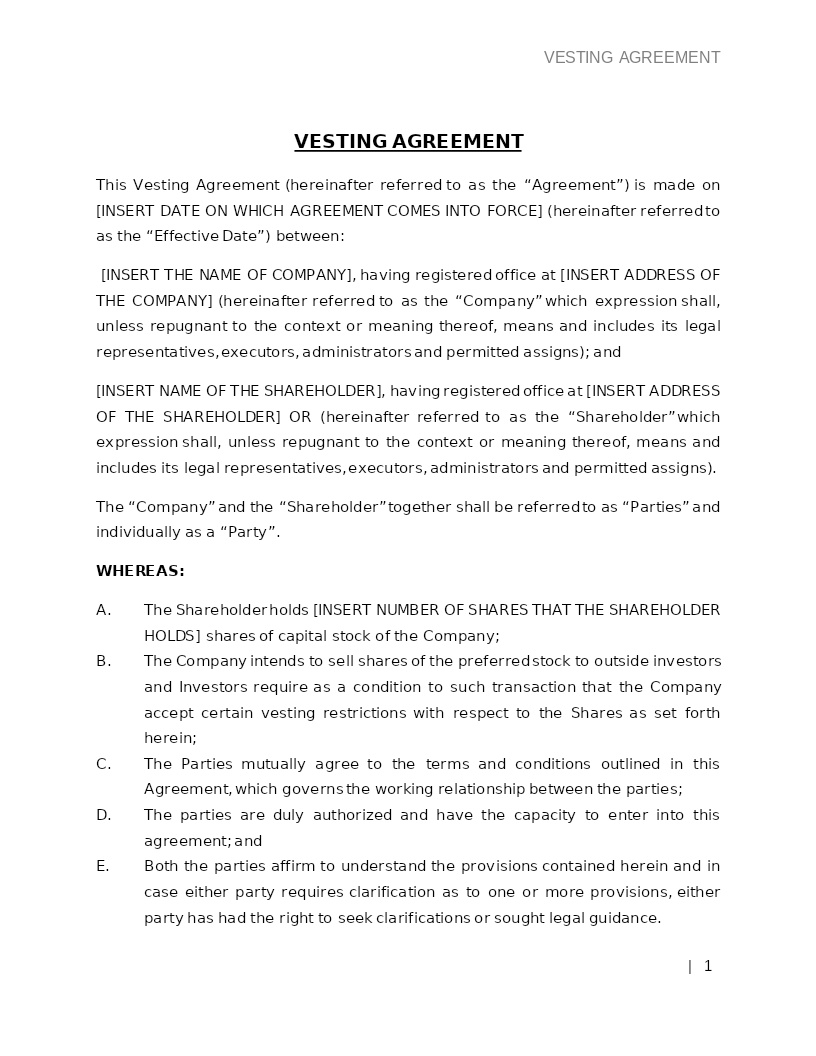
VESTING AGREEMENT
How does it work?
1. Choose this template
Start by clicking on "Fill out the template"
2. Complete the document
Answer a few questions and your document is created automatically.
3. Save - Print
Your document is ready! You will receive it in Word and PDF formats. You will be able to modify it.
Ensuring Long-Term Commitment and Fair Equity Distribution Through Vesting Agreements
A Vesting Agreement is a legal contract that outlines how an individual gradually earns ownership rights to company shares, equity interests, or other assets over a defined period or upon reaching specific milestones. In the United States, vesting is widely used for founders, employees, advisors, and investors to ensure long-term engagement and protect the company from early ownership dilution.
This agreement defines the vesting schedule, conditions for earning equity, restrictions on transfer, and consequences of departure or termination. By detailing these elements upfront, the agreement supports stability, prevents disputes, and aligns stakeholder incentives with the company’s long-term success.
For startups, fast-growing companies, and organizations issuing equity-based compensation, a Vesting Agreement is an essential part of maintaining fair ownership structure and retaining key contributors.
Where Vesting Agreements Are Commonly Used
Vesting Agreements are widely adopted across U.S. businesses and industries, including:
- Technology startups offering equity to founders and employees
- Venture-backed companies compensating key executives with stock options
- Advisors or consultants receiving equity in exchange for services
- LLCs offering membership interests to partners or managers
- Companies issuing restricted stock or RSUs under compensation plans
- Founder teams seeking stability and long-term commitment
- Businesses using performance-based vesting for leadership roles
Any situation involving equity-based compensation or shared ownership benefits from a clear, enforceable vesting framework.
Different Types of Vesting You May Encounter
- Time-Based Vesting: Equity is earned gradually over months or years (e.g., 4-year vesting with a 1-year cliff).
- Milestone or Performance-Based Vesting: Equity vests only when specific goals or achievements are met (revenue targets, product launches, KPIs).
- Hybrid Vesting: Combines time-based and performance vesting for greater alignment with company objectives.;
- Immediate or Accelerated Vesting:Certain events, such as acquisition, termination without cause or disability may accelerate vesting.
- Founder Vesting: Ensures founders earn their equity over time, protecting the company from early departures.
When Legal Guidance Becomes Helpful
Equity structures and vesting schedules can be complex. Legal review is particularly valuable when:
- Multiple founders or partners are involved
- Vesting terms must align with U.S. securities and tax laws
- The company has investors or plans to raise capital
- There are buy-back rights, repurchase options, or transfer restrictions
- Vesting is tied to sensitive performance metrics
- Equity involves LLC membership units or partnership interests
- The agreement interacts with employment, compensation, or termination terms
A customized, lawyer-reviewed Vesting Agreement reduces risk and ensures long-term sustainability.
How to Work with This Template
- Identify the company and the individual receiving equity
- Define the type and amount of equity or ownership interest
- Establish the vesting schedule and any cliffs or milestones
- Explain conditions for acceleration, forfeiture, or termination
- Add restrictions on transfer, sale, or pledge of unvested equity
- Include rights of repurchase or clawback if separation occurs
- Choose the governing state law and dispute resolution method
- Sign electronically or in hard copy, both fully enforceable in the U.S.
This template aligns with standard U.S. equity compensation practices and is suitable for startups, corporations, and LLCs.
Frequently Asked Questions
Q1. Why is a Vesting Agreement important for U.S. startups and companies?
A Vesting Agreement protects the business by ensuring that ownership is earned over time. It prevents founders or employees who leave early from keeping full equity and helps maintain a fair distribution of ownership among active contributors. It also reassures investors that the ownership structure is stable and future-proof.
Q2. What key terms must a U.S. Vesting Agreement include?
Essential terms include the vesting schedule, cliff period, repurchase rights, acceleration clauses, restrictions on transfer, and conditions for termination or forfeiture. Clear terms help avoid misunderstandings and legal disputes.
Q3. Does vesting apply only to employees?
No. Vesting is also used for founders, advisors, contractors, board members, and service providers who receive equity as part of their compensation or role. Any individual earning ownership gradually should have a Vesting Agreement.
Q4. What happens to unvested shares if someone leaves the company?
Unvested equity is typically forfeited or repurchased by the company at a predetermined price. The agreement outlines what happens under different scenarios, including resignation, termination for cause, or termination without cause.
Q5. How does a vesting schedule work?
A vesting schedule defines how and when equity is earned, commonly monthly or annually over several years. Many U.S. companies use a four-year schedule with a one-year “cliff,” meaning no equity is earned until the first year is completed.
Q6. Are vesting agreements legally enforceable in the U.S.?
Yes. When clearly written, properly executed, and compliant with securities and employment laws, vesting agreements are enforceable and recognized by U.S. courts. They protect both the company and the equity recipient.
Q7. Can vesting accelerate under certain circumstances?
Yes. Many agreements include “accelerated vesting” for events like acquisition, company sale, death, disability, or termination without cause. This provides added protection for individuals during major corporate changes.