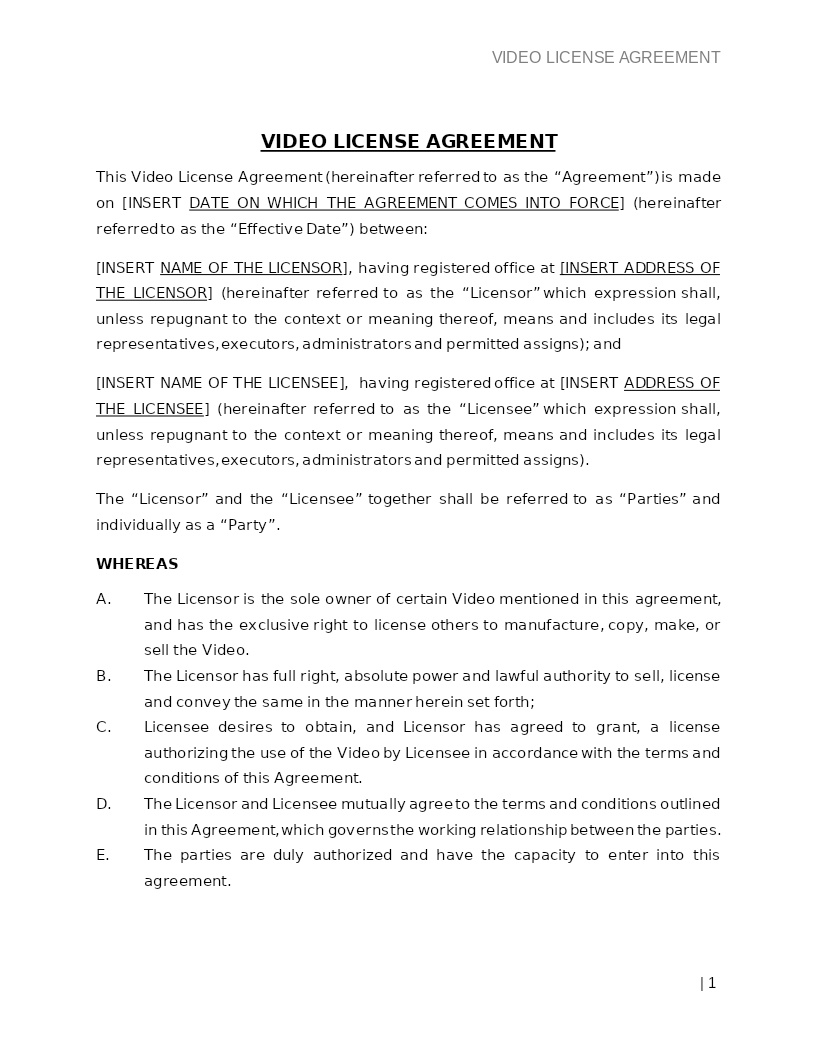
VIDEO LICENSE AGREEMENT
How does it work?
1. Choose this template
Start by clicking on "Fill out the template"
2. Complete the document
Answer a few questions and your document is created automatically.
3. Save - Print
Your document is ready! You will receive it in Word and PDF formats. You will be able to modify it.
Understanding Video License Agreements in the United States
A Video License Agreement is a legal document that grants one party (the licensee) the right to use a video created or owned by another party (the licensor) under specific terms. It outlines where, how, and for what purpose the video can be used whether in marketing, commercial projects, educational programs, or online platforms. A Video License Agreement establishes clear boundaries around intellectual property usage, ensuring creators maintain ownership while licensees understand their permitted rights.
By putting this agreement in place, both parties can collaborate with confidence, reduce the risk of copyright infringement, and prevent unauthorized distribution or modification of the video.
Where Video License Agreements Are Commonly Used
Video licensing is widely used across various U.S. industries, including:
- Digital marketing & advertising campaigns for brands, influencers, and agencies.
- Film, TV, and media production, where clips are incorporated into larger works.
- Online platforms, such as YouTube, e-learning modules, streaming channels, and corporate websites.
- Educational and nonprofit organizations using licensed content for training, outreach, or presentations.
- Businesses and startups that rely on visual content for product demos, ads, and promotional materials.
Anytime a video leaves the creator’s control, a licensing agreement sets the legal framework for how it can be used.
Different Types of Video License Agreements You May Encounter
- Exclusive License: Grants the licensee exclusive rights to use the video, meaning the creator cannot license it to anyone else during the agreement’s term.
- Non-Exclusive License: Allows multiple people or companies to use the same video, often at lower cost and with fewer restrictions.
- Royalty-Free License: Enables the licensee to use the video multiple times without paying ongoing royalties, usually in exchange for a one-time fee.
- Rights-Managed License: Usage is restricted to specific locations, durations, formats, or platforms, often with detailed limitations on distribution.
- Commercial Use License: Allows the video to be used for business or advertising purposes, such as marketing, brand promotions, or monetized content.
- Editorial Use License: Permits the video to be used for news, commentary, educational purposes, or public interest content, usually without commercial exploitation.
When Legal Guidance Becomes Helpful
Legal assistance becomes valuable when:
- The license involves complex distribution channels, such as broadcast, OTT platforms, or global media networks.
- You are dealing with exclusive rights, royalty structures, or long-term licensing.
- The video includes third-party music, footage, or likenesses that require additional permissions.
- You want to protect your brand, avoid copyright claims, or ensure compliance with U.S. intellectual property laws.
- The licensing terms affect your commercial strategy, monetization plans, or cross-platform usage.
Lawyers ensure that the agreement is enforceable, risk-free, and customized to your business model or creative needs.
How to Work with This Template
- Identify the licensor and licensee and describe the video content being licensed.
- Specify the scope of the license, including usage rights, platforms, locations, and restrictions.
- Clarify payment terms, such as royalties, lump-sum fees, or credit requirements.
- Select the governing state law and include copyright provisions to minimize risk.
- Review the terms together, ensuring both parties agree on limitations and obligations.
- Sign electronically or in hard copy, as permitted under U.S. contract law.
This process ensures transparency, protects creative ownership, and allows both parties to proceed confidently.
Frequently Asked Questions
Q1. Is a Video License Agreement legally binding in the U.S.?
Yes. Once signed by both parties, a Video License Agreement is a legally binding contract that defines how the video can be used. It protects the creator’s copyright while giving the licensee specific usage rights. Courts enforce these agreements as long as the terms are clear and lawful. This makes licensing safer and more predictable for both sides.
Q2. What should a Video License Agreement include to avoid disputes?
A strong agreement includes clear usage rights, restrictions, payment terms, duration, and territory of use. It should also address editing permissions, credit requirements, and rules for redistribution. Precise wording helps prevent misunderstandings about ownership and usage limits. This clarity reduces the risk of copyright or contract-related conflicts.
Q3. Can a creator limit where or how the licensed video is used?
Absolutely. Creators can restrict usage by platform, region, audience, or duration through rights-managed licensing. These limitations ensure the video is used only as intended, preventing misuse or unauthorized distribution. Clear restrictions help protect brand identity and align the content with the creator’s vision. Licensees must follow these terms to stay compliant.
Q4. Can a licensee modify the video after receiving permission?
It depends on the agreement. Some licenses allow editing, trimming, or repurposing, while others require the creator’s approval before any changes. Defining modification rights upfront prevents legal issues related to unauthorized edits. Creators often require credit retention or review rights to protect the integrity of their work. Licensees benefit from knowing exactly what they can and cannot alter.
Q5. Is a royalty-free video license the same as free usage?
No. Royalty-free means the licensee pays once and can use the video multiple times without ongoing fees but it doesn’t mean the video is free. Usage is still governed by restrictions stated in the agreement. Royalty-free models are popular because they simplify budgeting and provide flexibility across platforms. Always review the allowed and prohibited uses before relying on the footage.
Q6. What happens if the licensee violates the Video License Agreement?
A breach may lead to termination of the license, financial penalties, or legal action for copyright infringement. The creator can demand removal of the video from platforms or restrict further usage. Clearly written enforcement clauses make it easier to resolve violations. Licensees should strictly follow the terms to avoid costly consequences.
Q7. Can multiple companies use the same video under one agreement?
Only if the license is non-exclusive or explicitly allows sublicensing. Exclusive licenses restrict use to one party, while non-exclusive licenses can be shared among many. Sublicensing rights must be clearly granted to avoid unauthorized distribution. Businesses should choose the licensing structure that fits their content strategy and risk tolerance.
Q8. When should you consult a lawyer for a Video License Agreement?
Legal advice is helpful when the video has commercial value, includes third-party assets, or will be used across multiple platforms or countries. Lawyers ensure compliance with copyright laws, draft enforceable clauses, and protect against liability. This is especially important for high-budget productions or long-term licensing. Proper legal review prevents future disputes and strengthens your rights.